
Topical authority is the ranking signal that search engines and AI platforms now use to decide who gets cited. This guide breaks down the real difference between Topical Authority (TA) and Domain Authority (DA), proves why TA consistently wins for small businesses, and shows you how to build it with verified data and real examples.
Key Highlights
- A Graphite study tracking 332 URLs across 12 domains, reported by Kevin Indig, that pages on high-topical-authority sites gain visibility 57% faster and are 62% more likely to receive traffic in the first week (Source: Graphite / Kevin Indig, Growth Memo, May 2025)
- The 2024 Google Content Warehouse API leak confirmed two internal metrics, siteFocusScore and siteRadius, proving that niche focus is mathematically measured and rewarded by Google’s own systems (Source: Wikipedia – 2024 Google Search documentation leak)
- A finance site with 12 clustered articles outranked a competitor with 50 scattered posts and 60% more backlinks by building topical depth rather than keyword breadth (Source: DataEnriche, March 2026)
- Healthline overtook WebMD in monthly organic visitors in 2020 with deeper, E-E-A-T-rich content in focused health verticals, despite WebMD’s longer domain history (Source: Comscore / Healthline Media, June 2019)
- 88% of SEOs now rate topical authority as very important to their content strategy (Source: Reviewlyhub, 2026)
- Domain Authority is still valuable, but chasing it in isolation is the reason most small businesses stay invisible
- SEO is the foundation. Topical authority is what you build on top of it. AEO is the layer above that (Source: SyncWin, 2026)
The Obsession with DA is Costing Small Businesses
Everyone wants to know their Domain Authority score.
Marketing agencies quote it in proposals. Potential clients ask for it in discovery calls. SEO tools put it front and center on every dashboard.
I understand the appeal. It is a number. Numbers feel like progress.
Here is the problem: Domain Authority is a third-party score created by Moz. Google does not use it. And even if it did, a high DA score without topical focus is delivering weaker results than a lower-DA site that genuinely owns a niche, and that gap is widening every year.
I have watched this play out many times, at SyncWin and with clients. Newer, lower-DA sites with tightly focused content clusters outrank bigger, older domains that spread themselves too thin. The 2024 Google API leak confirmed exactly why this happens in Google’s own internal code.
The biggest mistake I see small business owners make is chasing unnatural backlinks and inflated DA metrics instead of building genuine topical coverage. It causes more harm than it prevents, and it completely misses what search engines are actually measuring now.
What Topical Authority & Domain Authority Actually Mean
These two signals are different in almost every way that matters. They get conflated constantly, which is why the wrong one ends up driving strategy.
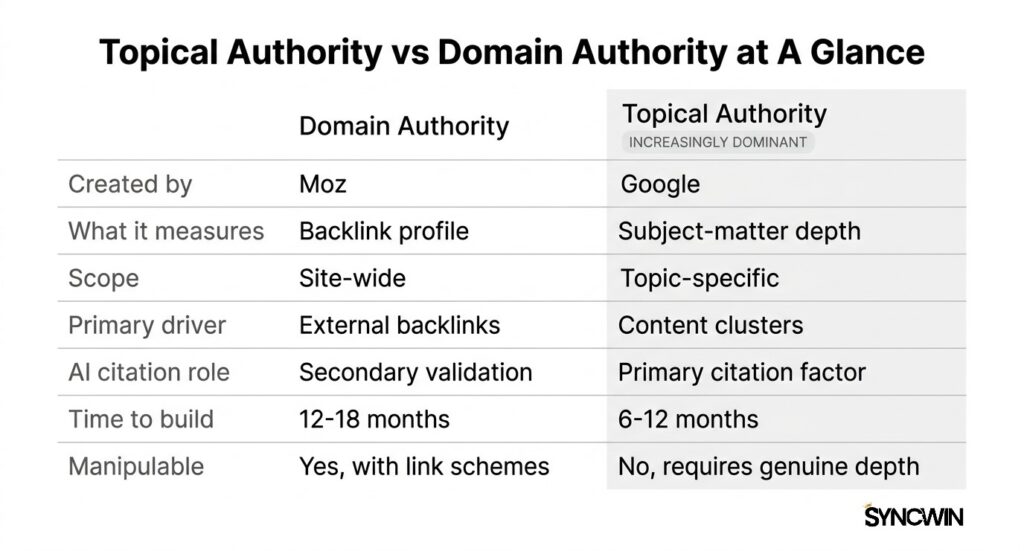
Domain Authority (DA) is a metric created by Moz to estimate the strength of a site’s backlink profile, on a scale from 1 to 100. Ahrefs calls their version Domain Rating. Semrush calls theirs Authority Score. All of them are third-party estimates, not official Google metrics.
DA measures the overall strength of your domain’s link graph. It is site-wide and topic-agnostic.
Topical authority is how comprehensively and consistently you cover a specific subject area. It is Google’s internal assessment of whether your site is a reliable expert on a particular topic, built through content depth, semantic coherence, and internal linking structure.
| Factor | Domain Authority | Topical Authority |
|---|---|---|
| Created by | Moz (third-party) | Google’s algorithm (internal) |
| What it measures | Backlink profile strength | Subject-matter depth and coherence |
| Scope | Site-wide | Topic-specific |
| Primary driver | External backlinks | Content clusters and internal linking |
| Role in AI citations | Secondary validation signal | Primary citation factor |
| Time to build | 12-18 months minimum | 6-12 months with focused strategy |
| Manipulable | Yes, with link schemes | No, requires genuine content depth |
(Source: Moz, Ahrefs, 2024 Google Content Warehouse API leak / Wikipedia, June 2024 / Multiple industry analyses, 2025-2026)
The key distinction is that DA asks, “How strong is this domain overall?” Topical authority asks, “Does this domain actually know this subject?”
A site with DA 70 can rank poorly for its core topic if the content is scattered across unrelated subjects. A site with DA 28 can dominate a niche if the content is deep, clustered, and structured correctly. That is documented, not theoretical.
What Google’s 2024 API Leak Confirmed
For years, topical authority was treated as an intuition-based concept without hard confirmation.
The 2024 Google Content Warehouse API leak changed that. Over 14,000 internal ranking attributes from Google’s Content Warehouse API were inadvertently exposed, and two of them directly confirm how topical focus is measured.
siteFocusScore measures how concentrated a site is on a specific topic. Sites with narrow, deep focus in one area score higher. Sites that spread content across unrelated subjects see this score diluted.
siteRadius measures how far any individual page’s content deviates from the site’s core theme. Pages that stray too far from the established topic cluster signal incoherence to Google’s systems.
According to Growfusely’s analysis of the leak, high topicality scores can directly enhance a site’s rankings for queries related to its primary topics.
The same leak also confirmed that Google maintains its own internal site authority metric, separate from third-party DA scores. So DA proxies for something real. But that real signal works best when paired with strong topical coherence, not as a standalone ranking lever.
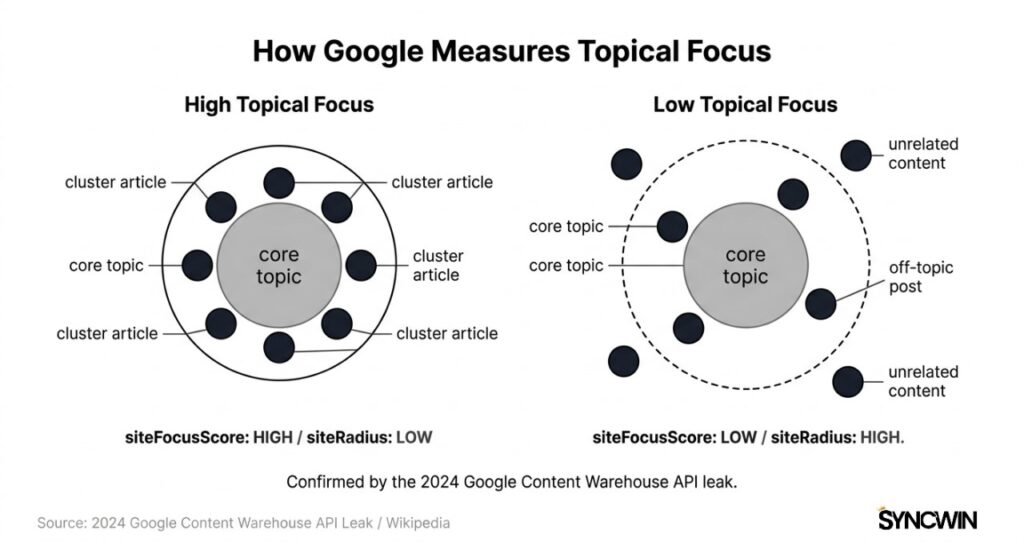
The practical implication: publishing content outside your core topic area does not just fail to help. It actively lowers your siteFocusScore and raises your siteRadius for existing content. Scattered publishing is not neutral. It works against you.
When Topical Authority Beats Domain Authority: Three Real Examples
These are documented cases, not hypotheticals.
Healthline vs WebMD
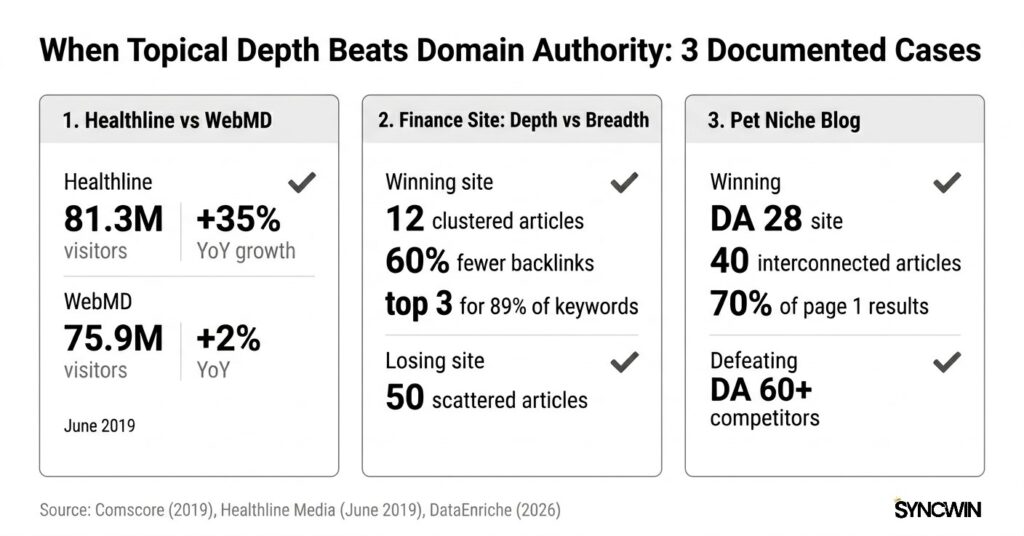
Healthline overtook WebMD in monthly unique visitors in June 2019, reaching 81.3 million visitors versus WebMD’s 75.9 million. Healthline also posted 35% year-over-year traffic growth versus WebMD’s 2%.
WebMD had years of domain history and strong name recognition. Healthline won by publishing expert-authored health content organized into focused verticals, with verified author credentials, medical citations, and topically coherent content clusters.
According to Healthline Media’s official announcement, the growth came from Healthline’s focused /health/ directory rather than broad site-wide expansion. Deeper content in focused health categories beats a wider legacy domain every time.
The finance site with fewer articles
A 2025 content audit documented by dataenriche covered a finance site with 50 credit card articles, each targeting a different long-tail keyword with no topical cohesion. Their competitor had 12 articles forming a complete, internally linked credit card content cluster.
The 12-article site ranked in the top 3 for 89% of shared keywords with 60% fewer backlinks.
The raw dog food niche site
The same dataenriche report documented a pet blog that published 40 interconnected articles covering every angle of raw dog food before expanding to any other pet care topic. At month 8, they owned 70% of page 1 for raw dog food queries with a domain authority of just 28, consistently outranking sites with DA 60 and above.
The pattern across all three is the same. Topical depth with fewer, better-connected articles consistently beats scattered keyword targeting, regardless of how the DA scores compare.
Does Domain Authority Still Matter in 2026?
Yes. I want to be direct about this, because the honest answer is not a clean dismissal.
DA is not worthless. A strong backlink profile still affects how quickly Google crawls and indexes your pages. When two pages are equally relevant for a query, Google may favor the one from the more authoritative domain.
And the 2024 Google API leak confirmed that Google does maintain an internal site authority metric. The underlying signals that third-party DA tools approximate do influence rankings. What Google does not use is the specific Moz number.
My honest take: DA is one signal in a much larger picture, and it is no longer the primary lever for most small businesses.
In highly competitive commercial niches, backlinks still break ties. But for a local clinic in Kolkata, a small accounting firm in Bengaluru, or an independent consultant in the US operating in a defined niche, topical depth will outperform a generic high-DA domain with scattered content almost every time.
The real mistake is treating DA as the primary goal. When you build genuine topical authority, you naturally earn quality backlinks from relevant sources, which improves your link-based authority scores as a byproduct.
Chase DA directly, and you end up with unnatural links that cause more harm than they prevent.
SEO is the Foundation. Topical Authority is What You Build on Top.
I see two failure modes playing out in real time.
The first: someone reads that “domain authority is dead” and immediately abandons any link-building effort, writing entirely from a keyword list with no topical structure. The second: someone hears “AEO is the future” and jumps to optimizing for AI citations without a functioning website or foundational SEO underneath.
Both approaches produce the same result: invisible.
SEO is the foundation. On-page, technical, and off-page SEO must exist before topical authority or AEO tactics deliver meaningful results. The relationship between AEO and SEO is one of layers, not alternatives. Content structure, authority, and AI extractability all build on top of each other.
Think of it this way: topical authority is what you earn by consistently covering a subject with depth and quality. Domain authority follows from earning that quality. AEO is the structure you add so that AI platforms can extract and cite what you have already built.
None of these replace each other. They compound.
For small businesses in India, this matters more than it might appear. Most local competitors have not completed basic foundational SEO, let alone built topical clusters. The room to establish clear niche authority in markets like Kolkata, Pune, or Chennai is wider right now than in most comparable US niches.
E-E-A-T is How Topical Authority Gets Validated
Experience, Expertise, Authoritativeness, and Trustworthiness. Google’s E-E-A-T framework is how topical authority becomes credible in Google’s systems.
The Experience component, added in 2022 and emphasized heavily through 2025, specifically rewards first-hand involvement. A medical clinic publishing symptom guides written by board-certified doctors outcompetes generic health content for the same query, even at lower DA, because the authorship signals are visible and verifiable.
For small businesses, the practical version of this is: show your work.
A wedding venue in Kolkata with content authored by their actual events coordinator, with real ceremony photos and verified booking logistics, has stronger topical signals than a directory listing with generic descriptions.
A US tax consultant who publishes a content cluster on self-employed deductions, written under their name with credentials listed, earns more topical trust than a nameless finance blog publishing the same information.
How AI platforms decide which sources to cite follows these same E-E-A-T signals. Expertise that is visible and verifiable gets cited. Content without authorship attribution gets passed over by AI systems looking for credible sources to ground their answers.
How Topical Authority Feeds AI Search
When someone asks ChatGPT, Perplexity, or Google AI Overviews a specific question, the AI does not check your DA score. It looks for the most structured, comprehensive, authoritative answer on that subject.
A 2025 Digital Bloom analysis of 680 million AI citations found that brand search volume, not backlinks, is the strongest predictor of AI citations, with a 0.334 correlation. Brands active on four or more platforms are 2.8x more likely to appear in ChatGPT responses.
According to iPullRank’s research cited in the same analysis, entity-rich content achieves 267% more AI citations than keyword-optimized content, and knowledge graph alignment carries an 89% correlation with AI visibility.
What this means practically: the content clusters you build to establish topical depth are the same structures that AI platforms use to identify and cite authoritative sources. Topical authority is not just an SEO signal. It is the foundation of Answer Engine Optimization.
For businesses in India and globally, the zero-click search shift is already compressing informational traffic. The businesses earning AI citations are the ones with deep, structured topic coverage. How AI answer engines are reshaping SEO in 2026 follows this pattern directly.
My Actual Workflow for Building Topical Authority
When I started building SyncWin’s content systematically, I used WriterZen for topic cluster generation. It did the job.
Now I use Claude and Gemini directly. The quality of semantic topic mapping from current AI models is significantly better, and the workflow is faster.
Here is the prompt I use to generate a full topic cluster for any niche. I shared the complete version in this guide on semantic search vs keyword search, along with instructions for saving it so you can reuse it every time you plan a new cluster.
After generating the cluster, I follow the process:
- Search each topic in Google to check intent and what currently ranks
- Identify where Reddit or Quora outranks established sites; that is your open content gap
- Build the pillar article first, then the cluster articles around it
- Interlink every cluster article back to the pillar with descriptive anchor text
- Add a 40-60-word direct answer at the top of each article for AI extraction
SyncWin has started appearing in AI citations for AEO-related queries. It is recent, not massive yet, but the trajectory is consistent. WPnomy has seen similar early citation appearances for WordPress-related topics.
I am tracking this actively. When the numbers are worth reporting, they go up as case studies with actual data.
How to Start Building Topical Authority: A Practical Roadmap
This does not need a large budget or a technical team to start.
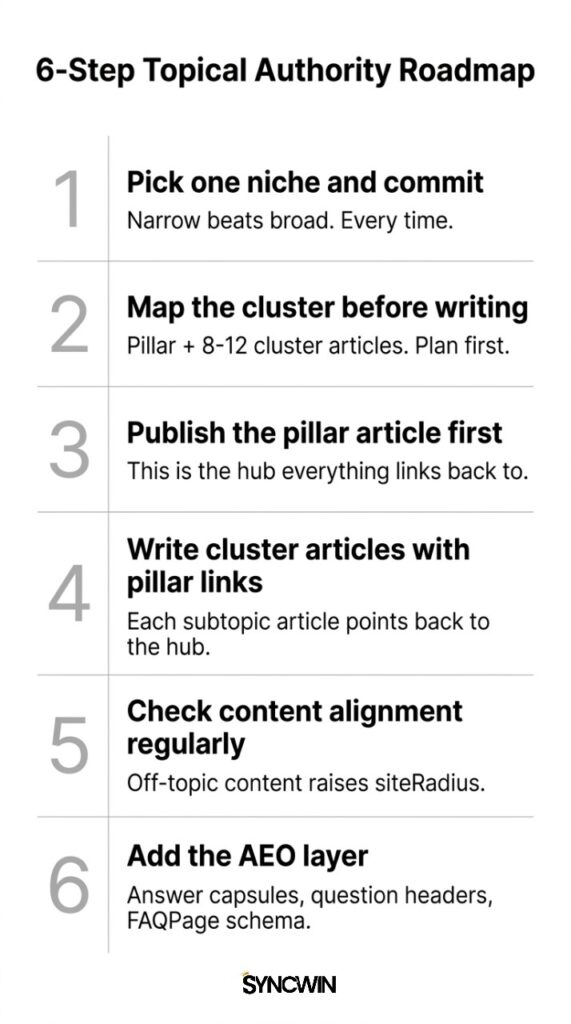
Step 1: Pick one niche and commit. Not “digital marketing.” Try “Google Business Profile optimization for restaurants in Mumbai.” The narrower the starting point, the faster the authority builds. Trying to own everything means owning nothing.
Step 2: Build the cluster before writing anything. Use the topic cluster prompt from this semantic search guide to map out your pillar and 8-12 supporting articles first.
Step 3: Publish the pillar article first. It becomes the hub that everything else links back to. It should answer the broadest question in your cluster with depth and a clear structure.
Step 4: Write cluster articles with internal links back to the pillar. Each one answers a specific subtopic question. Each one ends with at least one link to the pillar and one to a related cluster article.
Step 5: Check your content alignment regularly. Every new article should be semantically close to your established topic area. Off-topic publishing raises your siteRadius and dilutes your siteFocusScore.
Step 6: Add the AEO layer. Put a 40-60-word answer capsule at the top of each section. Format H2 headings as direct questions. Add FAQPage schema to service and informational pages. The AEO implementation checklist covers the complete technical structure in sequence.
The differences between AEO, GEO, and LLMO matter when deciding which AI platforms to optimize for. But topical authority is the shared foundation for all three. Build it first.
Tools That Actually Help
There is no single tool that gives you a topical authority score with the same simplicity as a DA number. That gap is a real limitation in the current tooling landscape.
Here is what I use and recommend:
- Claude / Gemini / ChatGPT: Topic cluster generation, semantic gap analysis, and content brief creation. Start here before any other tool.
- Google Search Console: Track which queries your site receives impressions for in each topic area. Clusters of impressions around a theme are early signs that your topical authority is building.
- Semrush or Ahrefs: Analyze competitor topical coverage. Find what topics they own, what they miss, and where their internal linking is weak.
- Google Search and People Also Ask: Still the most direct way to understand query intent. Check what ranks, what gets cited in AI Overviews, and what appears in related questions.
Paid tools like NeuronWriter and Surfer SEO offer topical coverage scoring if you want a more structured content workflow at scale. They are worth it once the foundational cluster strategy is in place.
FAQs About Topical Authority vs. Domain Authority
What is topical authority in SEO?
Topical authority is how comprehensively and consistently a website covers a specific subject area. Google measures it through internal signals, including content depth, semantic coherence, and internal linking structure.
Sites with high topical authority rank faster for niche queries, hold rankings more stably through algorithm updates, and earn more citations in AI-generated answers.
It is the result of building interconnected content that covers every relevant angle of a subject rather than targeting isolated keywords.
Is Domain Authority a Google ranking factor?
No. Domain Authority is a Moz metric. Google does not use it directly.
The 2024 Google API leak confirmed that Google maintains its own internal site authority score, which the backlink quality and site trust signals behind third-party DA tools partially approximate.
DA as a number is not the factor. The backlink credibility and trust signals it represents are.
Can a new site with low DA outrank an older high-DA site?
Yes, and documented examples confirm it regularly.
The finance site with 12 clustered articles outranking 50 scattered ones, and the pet blog with DA 28 outranking sites with DA 60+, are both verified cases.
In niche and local search, topical depth consistently outperforms broad domain authority when the lower-DA site covers the subject with genuine depth and structured internal linking.
How does topical authority connect to AI search and AEO?
AI platforms, including ChatGPT, Perplexity, and Google AI Overviews, use topical authority signals to identify credible sources worth citing. Entity-rich, topic-clustered content earns 267% more AI citations than keyword-optimized content.
Building topical authority is the foundational step in Answer Engine Optimization.
Understanding how AI Overviews affect website traffic explains why citation visibility has become as important as ranking position.
How many articles do I need to build topical authority?
Depth beats volume every time. A cluster of 10-15 well-researched, well-interlinked articles covering a specific topic from every angle builds stronger authority than 50 shallow keyword-targeted posts.
Start with one pillar article and 8-12 supporting cluster articles. Publish consistently, interlink everything, and go deeper on subtopics before expanding to new subject areas.
Does topical authority help local businesses in India and Kolkata?
Yes, and the advantage is larger in India precisely because most local competitors have not started.
A local service provider who publishes structured, expert content around their specific service area and location has a genuine head start over competitors relying on directory listings alone.
Google’s semantic capabilities through MUM now process regional language queries across Bengali, Hindi, and other languages, so businesses publishing content in regional languages build a topical footprint that English-only competitors cannot replicate easily.
What is the difference between topical authority and E-E-A-T?
Topical authority is the measurable outcome of covering a subject comprehensively.
E-E-A-T is the framework Google uses to validate whether that coverage is trustworthy.
A medical clinic with board-certified authors and verifiable credentials has topical authority with strong E-E-A-T validation. A business blog with no author attribution has weaker validation, even if the content is thorough.
Both work together: topical authority establishes the breadth and depth of coverage, and E-E-A-T signals confirm it is credible.
Where does the Knowledge Graph fit in?
The Knowledge Graph is Google’s structured map of entities: organizations, people, services, locations, and the relationships between them.
Understanding how the Knowledge Graph has evolved helps explain why entity clarity matters for both topical authority and AI citations.
When your business exists as a consistent, verifiable entity across your website, Google Business Profile, LinkedIn, and Wikidata, AI systems can reference you with greater confidence.
Vector embeddings in SEO are the technical mechanism behind how this works.
Conclusion
Domain Authority is not the enemy. It is just the wrong goal to chase directly.
The businesses building durable search visibility in 2026 are the ones going deep on specific topics, structuring that depth for both human readers and AI extraction, and letting the backlinks and authority scores follow naturally from that work.
Topical authority is not a replacement for SEO. It is what good SEO has always looked like: genuine expertise, structured for discovery.
For small businesses, this is really good news. You do not need ten years of link-building history to outrank a generalist competitor. You need to know your subject better, cover it more completely, and structure it more clearly than anyone else in your specific niche or market.
That is achievable. Build the foundational SEO first. Layer topical authority on top through clustered, coherent content. Add the AEO structure above that. Build them in order, and the rankings and citations will follow.
Building topical authority from scratch takes the right structure from day one. SyncWin works with small businesses globally on content cluster strategy, AEO implementation, and technical SEO foundations. Get in touch with SyncWin, and let’s map out where you actually stand.
Based in Kolkata or anywhere in India? Most local businesses here have not started on topical SEO yet, which means the competitive gap is real and available right now. Reach out to SyncWin before your window to build this advantage closes.