
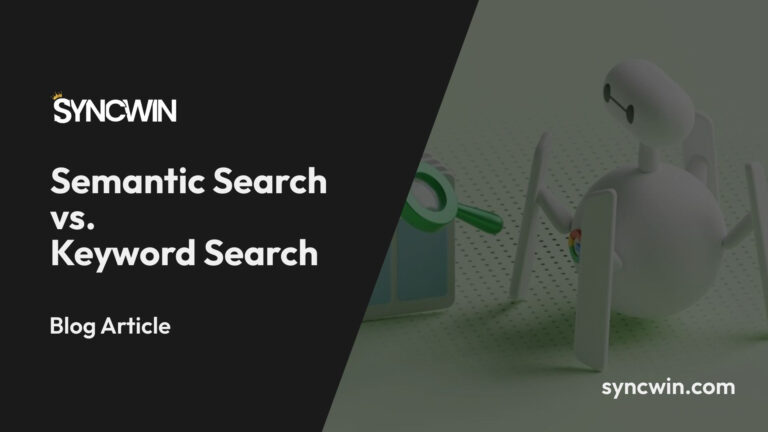
Keyword search matches the exact words you type. Semantic search matches the meaning and intent behind them. Google and every major AI platform now runs on semantic search. For small businesses, this changes how content should be written, structured, and positioned to earn both search rankings and AI citations in 2026.
Key Highlights
- Keyword search retrieves pages by matching exact characters. Semantic search retrieves pages by matching intent and meaning.
- Google shifted from keyword to semantic search through five updates: Panda (2011), Hummingbird (2013), RankBrain (2015), BERT (2019), and MUM (2021).
- BERT improved result relevance for roughly one in ten English searches immediately at launch.
- MUM is 1,000 times more capable than BERT and processes text, images, and video across 75 languages simultaneously.
- A KPMG-Google India report found that 90% of new Indian internet users prefer regional-language content over English.
- Approximately 59% of Google searches now end without a click. Citation visibility matters as much as page rankings.
- Writing for humans but structuring for search engines and AI platforms is the only approach that works in 2026.
What Is Keyword Search?
Keyword search retrieves pages by matching the exact characters you type against a stored index of words. Type “best accountant New York” and the system finds pages containing those exact words in sequence.
Keyword search is fast, deterministic, and precise: the same query always returns the same results. It powered digital discovery from the early internet through roughly 2013.
Keyword search works like the index at the back of a textbook: each term maps directly to specific pages.
Keyword search systems match character sequences, not the meaning or intent behind the words being searched.
A search for “affordable restaurant nearby” would miss a page titled “Budget-Friendly Eateries Near You” entirely.
The gap between the words a user types and the words a document uses is called the vocabulary mismatch problem.
For product SKUs, legal codes, and precise identifiers, exact character matching remains the most reliable retrieval method.
What Is Semantic Search?
Semantic search understands the meaning and intent behind a query rather than matching the exact characters typed. It uses AI models to map words and ideas into a shared mathematical space where related concepts sit close together.
The full mechanism behind this is covered in the article on what vector embeddings actually are in AI SEO. “Car repairs” and “automotive maintenance” become neighbors in that space, so a search for one naturally surfaces results for the other.
Semantic search reads language the way a thoughtful person does: by understanding context, not just characters.
A user searching “quiet cafe with Wi-Fi in Salt Lake for a long meeting” gets results drawn from review sentiment analysis.
Voice queries are naturally semantic because nobody speaks in keyword strings when talking to a phone.
According to Google India data, over 28% of searches in India are now voice-based, and most are in regional languages.
Also, according to the WeAreSocial Digital 2025 Report, India has a weekly voice assistant usage rate of 33.6%, ranking among the top five countries globally.
A customer in Kolkata asking “South Kolkata-e bhalo AC repair kothay hoy?” uses Bengali word order and mixed-language intent. Semantic search reads that correctly.
How Do Semantic Search and Keyword Search Compare?
Semantic search and keyword search operate on fundamentally different logic. One matches characters, the other matches meaning. The table below covers every dimension that matters for a small business owner deciding how to build content that earns both search rankings and AI citations in 2026.
| Factor | Keyword Search | Semantic Search |
|---|---|---|
| Core mechanism | Matches exact character strings | Matches meaning via vector proximity |
| Technology | Inverted index, TF-IDF | NLP, neural networks, vector embeddings |
| Handles synonyms | Manual mapping only | Automatic via embedding similarity |
| Conversational queries | Struggles significantly | Handles naturally |
| Voice search support | Weak | Strong |
| Regional language queries | Very limited | Improving via MUM across 75 languages |
| Speed | Fast, low computational cost | Computationally intensive |
| Best use case | SKUs, legal codes, exact identifiers | Consumer discovery, voice queries, AEO |
| AI citation potential | Low without semantic structure | Direct path to extraction and citation |
| What it rewards | Keyword density and exact placement | Topical depth and direct answers |
How Does the Same Query Get Treated Differently?
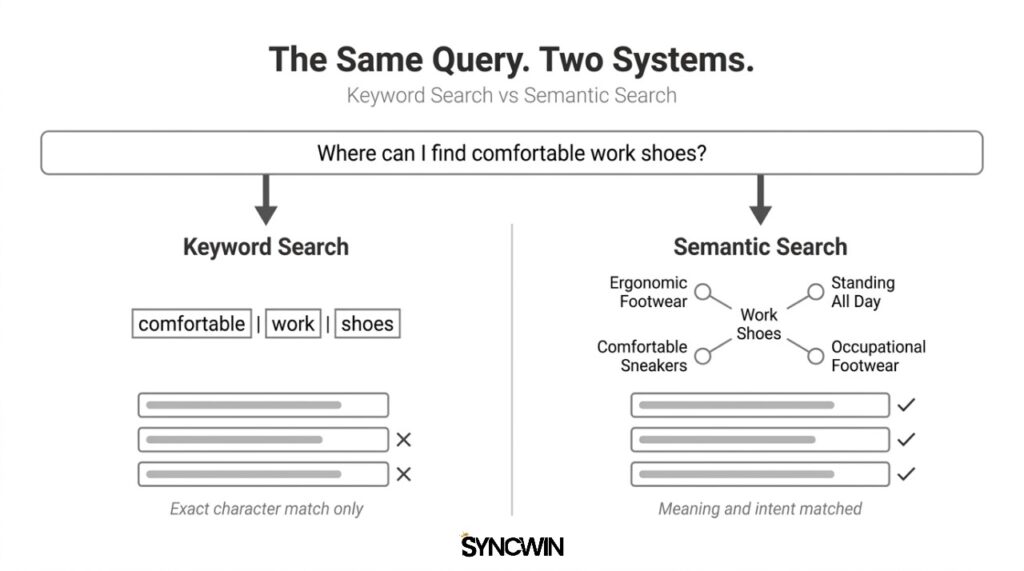
The clearest way to see the difference is to watch how each system handles a real-world query. Keyword search returns pages containing the typed words. Semantic search returns pages that answer the intent, even when no words overlap. These two examples show why meaning-first content now consistently outperforms keyword-targeting content.
Example 1: A Kolkata local query
A customer asks: “South Kolkata-e sosta painter kothay pabo?” (Bengali for “Where is an affordable painter in South Kolkata?”)
Keyword search finds nothing: no indexed English page contains those Bengali characters or phrases.
Semantic search reads the intent, the location, and the service type. It surfaces relevant results based on meaning.
Example 2: A US buyer query
A buyer types: “Comfortable work shoes for someone on their feet all day.”
Keyword search misses pages titled “Ergonomic Footwear for Standing Professions” because zero words overlap.
Semantic search maps both phrases close together in the meaning space and returns the relevant results correctly.
When Did the Rules Actually Change?
Google shifted from keyword to semantic search through a series of algorithm updates between 2011 and 2021. Each update moved the system further from character matching and closer to intent understanding.
For small business owners, knowing this timeline explains why content strategies that drove traffic in 2019 started losing ground quietly after 2023.
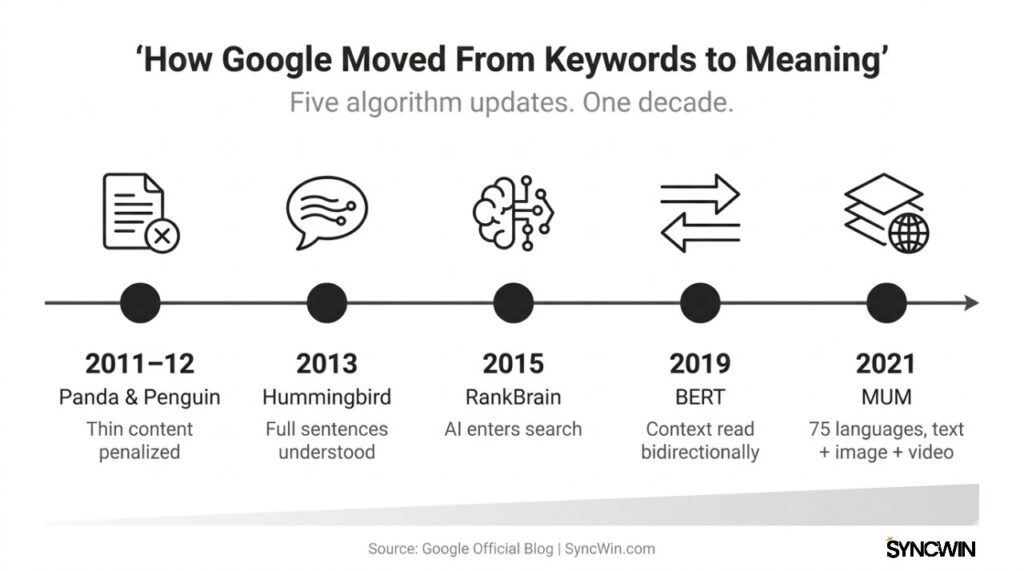
Panda and Penguin (2011-2012): Google began penalizing thin, duplicate content and unnatural backlinks. Keyword-stuffed pages started losing ground here.
Hummingbird (2013): Google rewrote its core algorithm to understand full sentences rather than individual words.
Stop-words like “for,” “near,” and “from” became meaningful intent signals for the first time.
RankBrain (2015): Google’s first AI integration interpreted ambiguous queries by mapping them to known concepts via machine learning.
BERT (2019): BERT reads language bidirectionally, understanding how every word in a sentence relates to the others around it.
Google confirmed BERT improved relevance for roughly one in ten English searches immediately upon its October 2019 launch.
MUM (2021): MUM is 1,000 times more capable than BERT and processes text, images, and video across 75 languages at once.
A business in Kolkata publishing Bengali content can now surface for relevant English queries through MUM’s cross-language synthesis.
How Did I Learn This the Hard Way?
When I started writing blog posts in 2018 and 2019, I had no real understanding of how SEO worked. I read somewhere that repeating a keyword multiple times was the key to ranking, so that is exactly what I did. Some of those articles worked and started bringing traffic. I thought I had figured it out.
Then, in 2022-23, those same articles started falling off quietly. No warning. Just a slow, steady decline.
Google’s Helpful Content Update hit first. Then AI Overviews pushed things further. At the worst point, Toolonomy had lost close to 90% of its traffic.
What I found more interesting than the drop: some articles started ranking for keywords I had never targeted at all.
My article about how to humanize AI-generated content started bringing traffic for dozens of different search variations I had never written for.
Watching that happen pushed me to learn about semantic search and NLP seriously for the first time.
Those pages ranked because the meaning matched the query intent, not because the right characters appeared in the right density.
That lesson changed how I approach every article I write now.
Are Keyword Research Tools Still Worth Using in 2026?
Keyword research tools are not useless. They are being used the wrong way by most people.
Opening a tool, finding a keyword with decent search volume, and writing a page around it is a workflow built for a search engine that no longer exists in the same form. That approach worked in 2019 and produces inconsistent results in 2026 at best.
The better approach is to pick a sub-topic in your niche and build a full topic cluster around it.
Cover the essential articles, and prioritize content gaps your competitors are not working on.
Check what Google, Bing, and the major AI platforms show for each topic. Study what ranks and gets cited, and understand the intent behind it.
If a topic shows Reddit or Quora ranking on page one, cover it immediately. Forums outranking established brands means the content gap is real and wide open.
To build your topic cluster, use this prompt in ChatGPT, Gemini, or Claude:
# Topic Cluster Generator

You are a content strategist specializing in SEO and AEO for small businesses.

Generate a comprehensive topic cluster for the niche: {{your_niche}}

- My business: {{brief_description_of_your_business}}
- Target audience: {{your_target_audience}}
- Location focus: {{your_primary_location_or_market}}

## Produce:
1. One pillar article topic (the main content hub)
2. 8-12 cluster article topics supporting the pillar
3. 3-5 content gap topics your competitors are not covering
4. For each topic: 3 suggested H2 headings and the primary search intent
   (informational / commercial / local)

Format as a structured markdown table.
Flag any topic where Reddit or Quora currently outranks established brands.
Save this prompt in the Prompt Builder Chrome extension so it is ready every time you plan a new cluster. You will not have to rebuild it from scratch each time.
After generating the cluster, search each topic on Google and Bing. Check the top-ranked and AI-cited results. Ask: what is the intent here, what did they cover, and how do I make my version more complete and more useful?
What Does “Write for Humans” Actually Mean?
“Just write for humans, and Google will figure it out” is the most useless advice I have seen repeated across the SEO industry. I understand why people say it: the alternative sounds complicated. But the advice is incomplete, and incomplete advice produces invisible content.
Writing for humans matters. Structuring for search engines and AI platforms matters just as much.
If you write plain-text content with no headings, no bullets, and no links, search engines and AI tools cannot find, process, or extract from it.
And your human readers will not engage with it either. In 2026, people skim. We scan subheadings and bullets before we commit to reading.
A wall of text loses both the human reader and the AI extraction system at the same time.
The real advice: write for humans, structure for bots. Both need the same content. One reads it, one processes it.
Use question-format H2 headings. Write 40-60-word answer capsules directly below each one. Add context below for depth. Cover related semantic terms naturally. Link internally and externally with descriptive anchor text.
AEO is what happens when you do this consistently. The difference between AEO and SEO is partly that SEO targets rankings and AEO targets extraction. Both start from the same foundation: clear, structured content useful to a real person asking a real question.
When Does Keyword Search Still Have a Role?
Keyword search is not the right tool for every search context, and honest advice acknowledges that. Exact character matching remains the more reliable approach for specific, structured retrieval needs where interpretation errors create real problems.
Understanding where keyword search still works prevents over-rotating into semantic optimization for the wrong use cases.
Keyword search still wins for:
- Product SKUs and inventory lookup: exact match retrieval finds the right item without interpretation
- Legal and compliance queries: deterministic results are essential where the same query must always return the same records
- Internal site search: customers who know exactly what they need are better served by exact matching
- Medical and clinical databases: where a misinterpreted synonym could return a dangerous result
For consumer-facing discovery, voice queries, informational research, and AI citation building, semantic structure wins in every case.
FAQs About Semantic Search vs Keyword Search
What is the main difference between semantic search & keyword search?
Keyword search matches the exact characters you type. Semantic search matches the meaning and intent behind your words. A keyword search for “how to fix a leaky tap” only finds pages using those exact words. Semantic search also finds pages about “plumbing repairs” and “stopping water waste” because the meaning overlaps. For small businesses, semantic search rewards content written around topics and intent, not individual keyword phrases.
Does keyword research still matter in 2026?
Keyword research tools are useful for understanding what people search, but using them to target individual high-volume keywords is an outdated content strategy. A better approach is to build topic clusters around a niche subject, identify content gaps competitors are missing, and check what AI platforms currently cite for each topic. Use keyword data as input, not as a content blueprint or a substitute for intent research.
How do I write content for semantic search?
Write content that directly answers a specific question. Use question-format H2 headings. Place a 40-60-word direct answer immediately below each heading. Add supporting context and evidence below that for depth. Use related terms naturally throughout, not just the primary keyword. Apply FAQPage schema. The AEO implementation checklist covers the full structure in the correct sequence, from technical foundation through content formatting.
How does semantic search affect businesses in India and Kolkata?
A KPMG-Google India report found that 90% of new Indian internet users prefer content in regional languages over English. Google’s MUM model now processes Bengali, Hindi, and other regional languages with cross-language synthesis capability. A business in Kolkata that publishes structured Bengali content is building a semantic footprint that English-only competitors cannot replicate without significant effort. Zero-click search patterns in India are growing fast, especially for voice queries.
What is the vocabulary mismatch problem?
The vocabulary mismatch problem is the gap between the words a user types and the words a document uses, even when both are describing the same thing. A user searching “fix broken laptop screen” may miss a page titled “laptop display repair services.” Semantic search was built specifically to bridge this gap by matching meaning rather than characters. Writing content with semantic depth, covering related terms and related questions naturally, reduces this gap for your pages.
How do zero-click searches connect to semantic search?
Zero-click searches happen when a query gets answered directly on the results page by an AI Overview, without the user clicking through. Approximately 59% of Google searches now end without a click, per SparkToro’s 2024 data. Semantic search powers those AI answers. The businesses cited in AI summaries are the ones whose content is structured for semantic extraction. Understanding how AI Overviews affect website traffic explains why citation visibility has become as important as ranking position.
How does this connect to AEO & what should I do next?
AEO (Answer Engine Optimization) is the practice of structuring content so AI systems can extract and cite it directly. It is built on top of semantic search. The comparison between AEO, GEO, and LLMO shows how semantic principles apply across every major AI platform differently. Start with understanding what AEO is, then work through the AEO implementation checklist in sequence.
Conclusion
Keyword search gets the content found. Semantic search gets content understood. The practical difference for a small business owner is straightforward: the approach that drove traffic in 2019 is not the approach that earns citations and AI visibility in 2026.
Getting there does not require a large budget or a technical team. It requires clear answers, logical structure, consistent entity data across platforms, and content that covers a topic with genuine depth rather than keyword repetition.
Write for the person asking the question. Structure it so both the human reader and the AI system can find, read, and extract the answer without friction. That is the complete version of the advice most people summarize as “just write for humans.” Start with what AEO is and build forward from there.
How AI answer engines are changing SEO in 2026 is a good next read before moving into implementation.
Building the semantic and entity layer that earns AI citations takes the right foundation. SyncWin helps small businesses in the USA and globally build that foundation and the AEO layer on top of it. Start the conversation here.
For businesses in Kolkata and across India, the regional language semantic opportunity is real, and most local competitors have not acted on it yet. Reach out to SyncWin and let’s look at where your business currently stands.