
AEO-referred traffic outperforms organic SEO traffic in conversion rate across every major study published in 2025 and 2026. The differential ranges from 2x to 23x depending on industry, platform, and methodology. AI visitors arrive pre-qualified because the AI interface handles the research phase before any click happens. But the data is still early, the sample sizes are limited, and the right strategic answer is not to pick one over the other.
Key Highlights
- AI visitors accounted for 0.5% of traffic but generated 12.1% of all signups, a 23x conversion rate differential over organic search (Source: Ahrefs, June 2025).
- AI-driven visitors are worth 4.4x more per visit than standard organic visitors across industries (Source: Semrush, June 2025).
- Cross-site analysis found AI referral conversion rate at 11.4% versus organic at 5.3%, a 2.15x premium at scale (Source: Similarweb, 2026).
- AI-referred visitors spend 68% more time on websites than standard organic visitors (Source: SE Ranking, 2025).
- The conversion premium exists because AI platforms complete the research and qualification phase before a user ever clicks.
- The data is based on limited, mostly SaaS and US-centric samples. Results will vary by industry, market, and content type.
- The right question is not “which converts better” but “how do I get found everywhere my potential customers are looking?”
- Zero-click search now affects ~59% of searches globally. Citation visibility matters independently of raw traffic volume.
What Does the Conversion Data Actually Show?
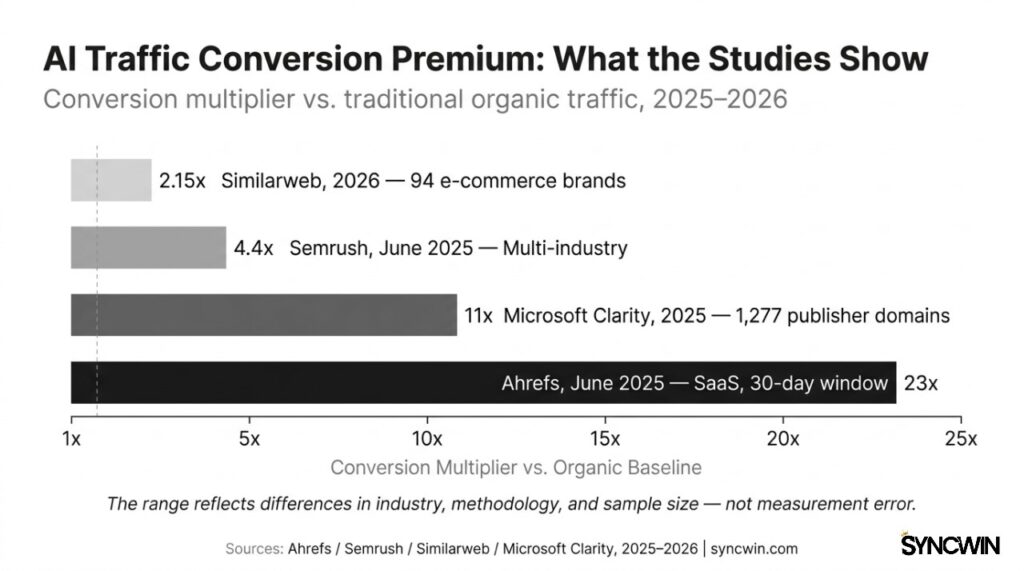
Multiple independent studies from 2025 and 2026 consistently show that traffic arriving from AI citations converts at a materially higher rate than traffic from traditional organic search. The range of the differential varies significantly across studies, industries, and platforms, which is exactly why single-headline claims about “23x conversion” require more context than most summaries provide.
Here is what the verified data actually says across different sources.
| Source | AI Traffic CR | Organic CR | Differential | Context |
|---|---|---|---|---|
| Ahrefs, June 2025 | 12.1% (signup share) | 0.5% (traffic share) | 23x | Ahrefs own site, SaaS, 30-day window |
| Semrush, 2025-2026 | 4.4x visitor value | 1x baseline | 4.4x | Multi-industry, aggregated |
| Similarweb, 2026 | 11.4% | 5.3% | 2.15x | Cross-site, broader sample |
| Visibility Labs, 2025 | 1.81% | 1.39% | +31% | 94 ecommerce brands, ChatGPT referrals |
| SE Ranking, 2025 | 68% longer session | Baseline | Higher engagement | Time on site, multi-industry |
(Sources: Ahrefs, June 2025 / Semrush, June 2025 / Similarweb, 2026 / Visibility Labs via Search Engine Land, 2026 / SE Ranking, 2025)
The variance across studies tells you something important. The 23x figure comes from a SaaS company’s own data over 30 days. The 2.15x figure comes from a broader cross-site analysis. Both are real. Neither is universally applicable.
Why Do AI Visitors Convert at Higher Rates?
The conversion premium exists because of where AI visitors are in their decision process when they arrive. When someone types a question into ChatGPT or Perplexity, the AI completes an entire research and comparison phase on their behalf. The user only clicks through after the AI has already filtered options, summarized differences, and validated choices. By the time they land on your site, the heavy lifting is done.
Here is the clearest way I have explained it: when AI recommends a business, people trust it the way they once trusted Google’s top results.
Earlier, people believed that if Google showed something first, it had to be legitimate. They did not understand the SEO behind it. The same psychology applies to AI citations now. When ChatGPT or Gemini names your business as a solution, the visitor arrives already believing you are trustworthy. They do not need to keep researching. They need to confirm they are in the right place, then act.
That pre-validation is the conversion premium. It was always the search engine doing qualification work. The AI just does it faster and more thoroughly.
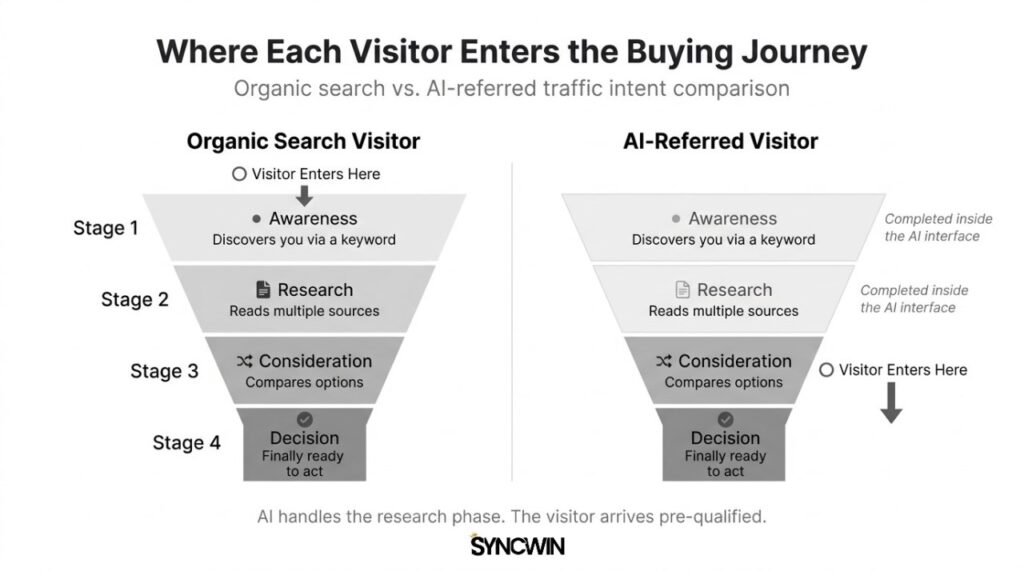
AI platforms process the research phase in a way that traditional organic search never did. A Google result shows you a link. A ChatGPT response tells you what the link is for, why it matters, and how it compares to alternatives.
The visitor who clicks after that summary is not just curious. They have decided.
Should You Trust These Numbers Completely?
No, and this is worth saying plainly. The conversion data is real, but it comes from a limited and early dataset. Most studies are based on a small number of websites, primarily SaaS companies in the US and UK. The 23x figure is Ahrefs’ own site, over 30 days. That is not the whole web.
Ahrefs’ own follow-up study found that AI visitors also show higher bounce rates and lower pages per session than organic visitors in some contexts, a pattern that points to “information validation” behavior rather than deep engagement.
“Separately, a 54-website cross-site analysis found no statistically significant conversion difference between AI and organic visitors, contrasting sharply with the Ahrefs finding. The directional signal is strong. The specific multiplier is not universal.”
The actual multiplier for your business could be 2x or 20x, depending on your industry, content type, and which AI platform sends the traffic.
The AI revolution also happened faster than anyone expected. The data we have now reflects early adoption patterns, not mature behavior across the entire market. Future studies with broader samples and longer timeframes may look meaningfully different.
The honest position: optimize for AI citations because the directional evidence is strong. Do not bet your entire strategy on a specific conversion multiplier holding true for your business.
What Happens When You Depend on a Single Channel?
I lost close to 90% of Toolonomy’s traffic in 2023. The Helpful Content Update hit first. Then AI Overviews pushed it further. Toolonomy was a review and directory-based informational site, exactly the kind of content AI Overviews answer directly without sending anyone through to the source.
No AI traffic came to replace the organic traffic that disappeared. The type of content the site published did not earn AI citations.
Revenue tanked alongside the traffic. That experience is the clearest illustration I can give of what single-channel digital dependence looks like when the channel changes under you.
This is not an argument against SEO. Toolonomy was doing SEO, and SEO built the traffic that existed to lose. The argument is against building everything on one source with no redundancy.
A business visible on Google, cited by AI platforms, discoverable on YouTube, mentioned in industry communities, and findable on regional platforms in India has five entry points. Losing one does not collapse everything.
What Should Small Businesses Actually Focus On?
Asking “Which converts better: AEO or SEO traffic?” is asking the wrong question. The more useful question is: how do I get found everywhere my potential customers are looking?
Customers come from Instagram, YouTube, AI platforms, Reddit, Google, Quora, WhatsApp groups, and regional directories. Staying dependent on any single channel is the actual risk, not whether AI traffic or organic traffic converts at a higher rate.
This is what I mean by Search Everywhere Optimization. SEO is still the foundation. Without it, your content is not findable and therefore not citable by AI systems. But SEO alone is now one layer of a multi-layer presence, not the complete strategy.
AEO is the layer that makes your content extractable and citable by AI platforms. GEO and LLMO extend this across different generative systems. Video presence makes you citable on YouTube. Active community participation makes you findable on Reddit and Quora.
For a digital consultancy in New York or a service business in Kolkata, the goal is the same: build a presence that survives if any single channel changes its algorithm or behavior.
The businesses most exposed to the current AI disruption are the ones that built everything on informational SEO traffic and nothing else.
How Do You Actually Get Into AI Citations?
The conversion premium from AI traffic is only useful if AI platforms are citing you in the first place. That requires the same foundation as good SEO, plus a structural layer built specifically for machine extraction.
Every key page on your site should open with a direct 40-60-word answer to the question that page addresses. Question-format H2 headings, FAQPage schema markup, and clean JSON-LD entity data give AI systems the signals they need to select your content over a competitor’s.
How AI platforms decide citations explains the selection logic in detail.
For local businesses, consistent NAP data across Google Business Profile, Justdial, IndiaMART, and Sulekha strengthens the entity trust signals that make AI systems confident enough to recommend you for local queries in Kolkata and across India.
The AEO implementation checklist covers the full technical and content sequence in the correct order.
How AI answer engines are changing SEO in 2026 explains the broader strategic shift that makes this work necessary.
How Do You Track AI Traffic Conversions?
Most AI referral traffic does not arrive with a clean referral header. ChatGPT, Perplexity, and other AI platforms often send visitors who appear as direct traffic in Google Analytics by default.
Setting up a custom channel group in GA4 that classifies visits from known AI engine domains fixes this and creates a separate AI traffic channel in your reports.
Analytics Mania has a step-by-step guide for setting this up in GA4, including the exact referral sources and channel definitions to configure.
Once your AI channel is properly isolated in GA4, you can track conversion rate, session duration, pages per session, and goal completions separately from organic traffic and measure the differential on your own site, not just from industry studies.
Running that comparison on your own data over 8 to 12 weeks gives you a far more accurate multiplier than any study can.
AI visibility metrics and how to measure your share of AI citations cover the broader measurement framework alongside GA4 tracking.
FAQs About AEO Traffic vs. Organic SEO Traffic
Does AEO traffic really convert 23x better than organic SEO traffic?
The 23x figure comes from Ahrefs’ own site analysis published in June 2025, where 0.5% of AI visitors drove 12.1% of all signups. This is a real finding, but it applies to a single SaaS company over 30 days.
Broader cross-site studies like Similarweb’s 2026 analysis found a 2.15x premium across a larger sample. The conversion advantage is real and consistent across studies. The specific multiplier will vary significantly by industry, content type, and AI platform.
Why does AI-referred traffic convert at higher rates than organic search traffic?
AI platforms handle the research and qualification phase before a click happens.
When a user asks ChatGPT which digital consultancy to hire in Kolkata or which accounting software suits a US startup, the AI filters options, summarizes differences, and validates quality before the user sees a link.
The visitor who clicks has already made most of their decision. Organic search delivers someone who is still in early-stage research. That difference in intent is the conversion premium.
Should small businesses prioritize AEO over SEO?
No, and prioritizing one over the other is the wrong framing. SEO is the foundation that makes content findable and crawlable, which is a prerequisite for AI citation.
AEO is the layer built on top that makes content extractable. A small business without solid SEO cannot earn AI citations consistently. Build the SEO foundation first, then add the AEO content structure on top.
Abandoning SEO to focus on AEO removes the infrastructure that AEO depends on.
Does this mean organic SEO traffic has no value?
Organic traffic still drives the majority of website visits for most businesses and remains the primary channel for brand discovery, informational research, and top-of-funnel reach.
The conversion premium of AI traffic does not make organic traffic worthless. It signals that the two channels serve different stages of the buyer journey.
AI traffic arrives at the bottom of the funnel, ready to convert. Organic traffic fills the top. Both are needed for a complete strategy.
How do I know if AI platforms are sending me traffic?
Set up a custom channel group in GA4 that classifies visits from AI engine referral domains (chatgpt.com, perplexity.ai, claude.ai, gemini.google.com) as a distinct channel.
Without this configuration, AI referrals appear as direct traffic and are invisible in standard reports. Analytics Mania’s GA4 guide covers the exact setup.
Beyond GA4, run your FAQ schema questions across ChatGPT, Perplexity, Gemini, and Google AI Mode manually each week to check for citations. AI visibility metrics explain the full measurement framework.
Is the conversion advantage of AI traffic the same across industries?
No. The data shows the largest conversion differentials in SaaS, B2B software, and professional services, where the research-heavy buying process benefits most from AI pre-qualification.
Ecommerce brands in the Visibility Labs study of 94 brands saw a more modest 31% higher conversion from ChatGPT referrals versus non-branded organic.
For service businesses in local markets like Kolkata, the AI citation advantage may also operate differently as AI local search behavior and regional language indexing continue to develop.
What is the real risk of ignoring AEO even if my SEO is strong?
A business with strong organic SEO rankings but no AI citation presence is invisible to an increasing share of high-intent research that happens inside AI platforms before any search engine visit occurs.
How AI Overviews affect website traffic shows the structural decline in organic CTR even for top-ranked pages. Strong rankings alone are no longer sufficient for capturing the portion of buyer research that now happens inside ChatGPT, Perplexity, and Gemini before a traditional search even begins.
Conclusion
AEO traffic converts better than organic SEO traffic in every major study that has measured it. The mechanism is clear: AI platforms do the qualifying work before the click, which means visitors arrive closer to a decision. The conversion advantage is real. So is the caveat that the data is early, the samples are limited, and the multiplier will vary significantly by business type.
The more important insight is not which channel converts better. It is that depending entirely on any single channel creates the kind of fragility that a single algorithm update can expose.
Search Everywhere Optimization is the right frame. Build your SEO foundation. Add the AEO layer. Show up on YouTube, in communities, and on regional directories for Indian markets. The businesses that survive channel disruptions are the ones that were never dependent on just one source of visibility.
Start with what AEO actually is and how it differs from SEO. Then work through the AEO implementation checklist in order. Set up AI traffic tracking in GA4 so you can measure the conversion differential on your own site. That data, built from your own audience, is worth more than any industry average.
If you want to build the content and entity foundation that earns AI citations in the USA and globally, SyncWin works with small businesses on exactly this. Start the conversation here.
For businesses in Kolkata and across India, the window to earn AI citations ahead of local competitors is open right now. Most are not optimizing for it yet. Reach out to SyncWin and let’s start with an honest look at where your content currently stands.