
Search still works. It just works differently now. AI answer engines like Google Gemini, ChatGPT, Microsoft Copilot, and Perplexity no longer just point people toward websites. They answer the question directly, often without a single click, leaving the page. For small businesses, this changes the objective: getting found online now means getting cited, not just ranked.
The Traffic Drop Nobody Warned Small Businesses About
I’ll be honest with you about something personal here.
My software review website, Toolonomy, was hit hard. The decline started in September 2023 when Google’s Helpful Content Update targeted informational content across the board. Then AI Overviews arrived and pushed things further. At the worst point, traffic had dropped close to 90%.
That number is not meant to be dramatic. It is meant to be clarifying.
Two forces landed at nearly the same time: an algorithm update that penalised thin, search-first content, and an AI layer that started answering questions directly without sending users anywhere. Together, they exposed every weak foundation in the content industry.
If your traffic was built primarily on informational queries with no brand presence behind it, you felt this shift. Many small businesses are still feeling it.
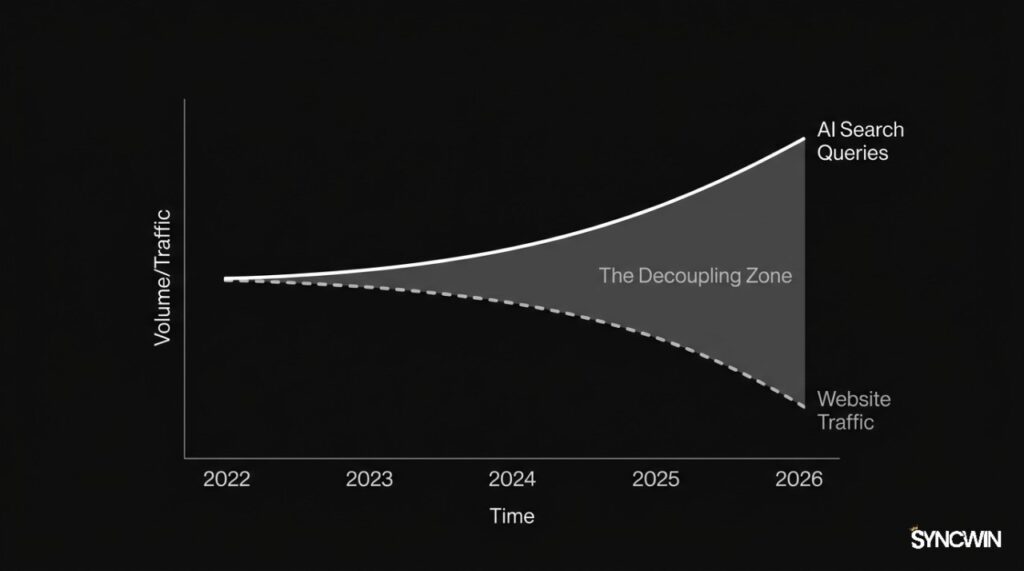
This is not an isolated story. According to Gartner projections, traditional search engine volume is forecast to decline by 25% by the end of 2026.
Research from Sparktoro and Datos consistently shows that around 59% of Google searches now end without a single click to an external website.
That is zero-click search, and it sits at the centre of why the conversation around SEO has changed so fast.
“SEO Is Dead.” Sure. We Have Heard That Before.
Every few years, a new technology shows up, and someone announces that SEO is finished.
Social media was supposed to kill it. Voice search was supposed to kill it. Now AI is supposed to kill it. And every single time, the people making that announcement are either selling something new or genuinely do not understand what SEO is.
SEO is a set of standard practices that help you get found online. That is it. The platforms where people search have expanded, so SEO has expanded with them.
It used to mean rank in Google’s blue links. Now it means get found everywhere your customers are actually looking: Google, YouTube, Reddit, Quora, ChatGPT, Perplexity, Gemini, and Instagram. Search Everywhere Optimization. That is what SEO has become in 2026.
AEO is one layer of that expanded picture. An important, fast-growing layer that most small businesses have not touched yet. But it sits on top of a foundation, not in place of one.
If someone is telling you to abandon SEO and chase AEO instead, they either do not understand how AEO works or they are not thinking about your actual business situation.
What AEO Is & Where It Actually Fits
Answer Engine Optimization is the practice of structuring your content so that AI systems can extract, trust, and cite it when generating answers to user questions.
The goal shifts from “rank on page one” to “become the source this AI cites.” That is a meaningful difference, and it changes how you write.
Traditional SEO gets your page in front of a crawler. AEO gets your specific answer pulled from that page and placed directly in front of a user, often with no click involved at all.
AI engines like Gemini, ChatGPT’s search mode, and Perplexity do not read websites the way humans do. They scan for semantic units: self-contained passages that answer a specific question without needing surrounding context to make sense.
Research suggests the optimal length for these extractable passages is between 75 and 150 words. Content that buries the answer under a long introduction gets skipped, regardless of how well the page ranks.
AEO, GEO, and LLMO each target a slightly different system, but in practice, they share the same foundation. Clarity, structure, entity authority, and semantic completeness serve all three.
How AI Engines Actually Decide What to Cite
This part is worth slowing down on, because most articles covering this topic skip the mechanism entirely.
When a user submits a complex question, an AI engine does not run a single search. It breaks the question into multiple sub-queries and aggregates answers from different sources for each one. This is called query fan-out.
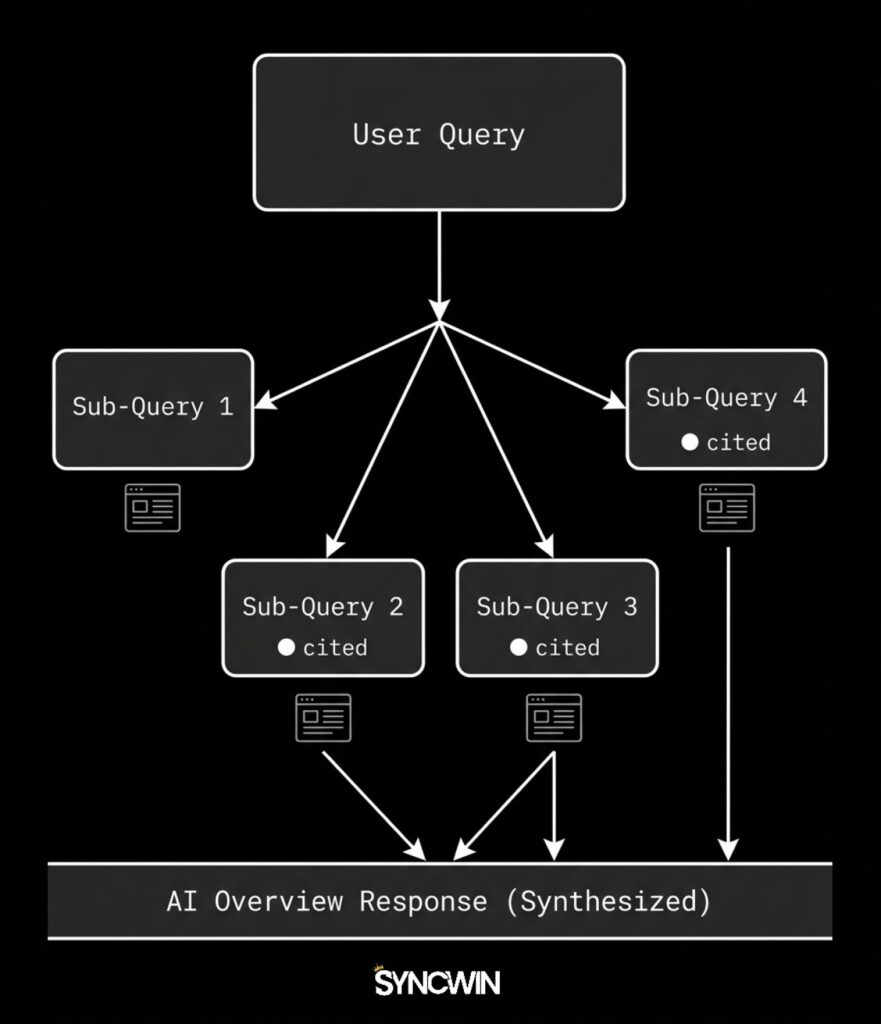
Understanding how AI platforms decide citations matters here because it explains why a business that does not rank in the top 5 can still be cited by AI tools.
You may not rank for the broad keyword, but if your page gives the clearest, most self-contained answer to one specific sub-query in the chain, you get cited. That is the opportunity most small businesses are missing right now.
Current 2026 data from Ahrefs and BrightEdge shows that the overlap between pages ranking in the organic top 10 and those cited in AI Overviews has fallen from 76% to somewhere between 17% and 38%.
A page can rank well and still be absent from AI responses. The two systems evaluate content through different lenses.
Here is how content format affects AI selection likelihood:
| Content Format | AI Selection Likelihood | Reason |
|---|---|---|
| Direct answer paragraphs | Very high | Addresses query intent immediately |
| Comparison tables | High | Structured data for comparative questions |
| Numbered step-by-step lists | High | Easy to extract for “how-to” responses |
| FAQ sections | High | Mirrors conversational search patterns |
| Narrative-only blocks | Low | Hard to parse into distinct, verifiable facts |
One figure worth noting: pages that combine clear text with relevant images and video see a 156% higher selection rate by AI engines compared to text-only pages.
An Ahrefs study suggests YouTube now accounts for over 18% of AI Overview citations from sources outside the organic top 100. Video is no longer a social media tactic. It is an SEO asset with direct AI visibility implications.
The Mistake That Makes Both Approaches Fail
The biggest error small business owners make right now comes in one of two forms.
The first group ignores AEO entirely because SEO has always worked for them, and they see no reason to change what is not broken.
The second group reads a few articles about AEO, gets excited, and shifts their focus immediately, optimizing for AI citations before any proper SEO foundation is in place under them.
Both groups end up invisible.
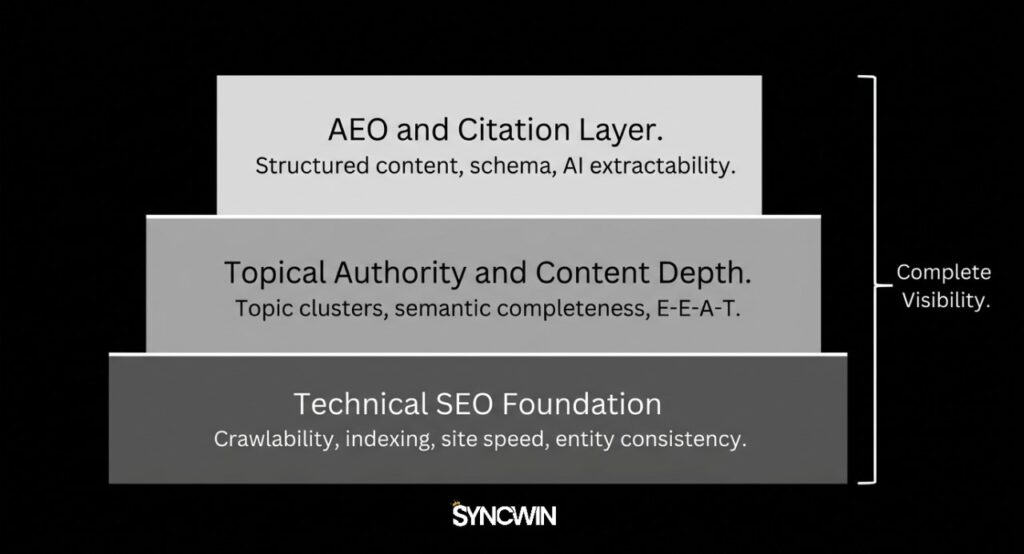
Research by SEOClarity confirms that 97% of the URLs appearing in AI conversational modes are also present in the top 20 organic search results.
Your content needs to be crawlable, technically sound, and built for topical authority before any AEO layer will produce results. The sequence matters: foundation first, AI optimization layer on top.
The AEO implementation checklist covers what needs to be in place at each stage. The short version: fix technical SEO, build topic clusters with real depth, structure content for extraction, then track citation presence across AI platforms.
What Small Businesses Actually Need to Do Right Now
Get entity information consistent across every platform.
If your business name, address, and phone number do not match across Google Business Profile, Justdial, Sulekha, IndiaMart, and your own website, AI systems treat the inconsistency as a reliability signal and may show incorrect information to users.
A 2021 audit of local businesses in Indian cities found that 85% had inconsistent contact information across major directories. Fix this before anything else.
Write answers first, context second.
Every important answer on your site should be findable within the first two sentences of a section. Write the direct answer. Add supporting detail below it. This structure serves your human readers and the AI systems extracting passages from your pages.
Implement schema markup.
JSON-LD structured data gives AI systems a direct map of what your business is, what it offers, and where it operates. At minimum: Organization, LocalBusiness, FAQPage, and Person schema where relevant. This is not a technical bonus in 2026. It is a baseline requirement.
Build topic depth instead of keyword breadth.
One comprehensive resource on a specific topic is more valuable than 20 thin articles covering related keywords. AI engines reward semantic completeness: content that answers the main query and its related sub-questions within a single, well-structured resource. Fragmented, thin content gets skipped in the citation selection process.
Start a video presence, even a small one.
This does not mean launching a daily YouTube channel. One well-structured explainer video on your core service, properly titled and described, can generate AI citations in a channel most of your competitors have not entered yet.
What This Means for Small Businesses in India & Kolkata
The Indian market is shifting faster than most local businesses realize.
Google’s AI Search Mode has rolled out in regional languages, including Bengali, Marathi, and Tamil. These are not simple translations. Custom Gemini models are built to understand local linguistic patterns and cultural context.
A business publishing quality Bengali content for local search queries is competing in a space that its English-only competitors have not entered yet.
The “near me” query pattern in regional languages is growing steadily, and AI systems are increasingly used to answer these queries directly.
The local information layer matters as much as the content layer: GBP reviews, regional directory listings, and neighborhood-specific content all feed into how AI systems verify and present local businesses.
The businesses gaining ground in this environment are not the ones with the biggest budgets. They are the ones with consistent, accurate, verified information across every platform AI systems check.
What to Measure Now That Rankings Tell an Incomplete Story
Traditional metrics like keyword rankings and domain authority still matter, but they show an incomplete picture in 2026.
The metric gaining traction is Share of Model, sometimes called SoLLM: how frequently a brand is cited or recommended when buyers ask AI tools about a category. This matters especially for B2B services and high-consideration purchases, where buyers use tools like ChatGPT or Perplexity for vendor research long before they ever land on a seller’s website.
AI Overviews’ impact on website traffic is now trackable through Google Search Console, where AI Overview impression data appears separately from standard organic results. This is the clearest free tool available for understanding how AI search is affecting your specific site.
For a manual pulse check that costs nothing: open ChatGPT, Perplexity, Gemini, Microsoft Copilot, and Google AI Mode. Ask each one the question your best customer would ask when looking for a business like yours. See who comes up. See if you come up. That ten-minute exercise gives you immediate, qualitative feedback that most paid tools will struggle to match for clarity.
Tools Worth Knowing, With Free Alternatives
Several tools have been built specifically for AI visibility tracking, including Semrush’s AI Toolkit, Otterly.ai for prompt monitoring, and Ahrefs Brand Radar. I have not committed to paid plans on all of these personally, so I will not rank them or push any specific one. What I will say is that the free manual approach is more than enough to start, and in many cases, it gives you better qualitative insight than an automated dashboard.
A free stack that works:
- Google Search Console: tracks AI Overview impressions and click data separately from organic
- Manual AI audits: ChatGPT, Perplexity, Gemini, Copilot (all free tiers, all useful)
- Google Business Profile Insights: monitors local search performance and discovery queries
If you are ready to invest in a paid tool, test the free tier of Semrush or Ahrefs first and evaluate against your actual use case before spending anything.
Frequently Asked Questions
What is the difference between SEO & AEO for a small business?
SEO helps your pages get crawled and ranked by search engines.
AEO helps your content get extracted and cited by AI answer engines when they generate responses.
Both are necessary. SEO is the infrastructure layer. AEO is built on top of it. A small business without a solid SEO foundation cannot run effective AEO.
Do AI answer engines hurt small business website traffic?
For purely informational content, yes.
AI Overviews reduce website traffic by answering queries without requiring a click. The impact on revenue is different from the impact on traffic, though.
Semrush research shows that visitors who arrive via an AI referral convert at roughly 4.4 times the rate of a standard organic visitor, because the AI has already qualified their intent before the click.
What is zero-click search, and why does it matter?
Zero-click search is when a user’s question is answered directly on the results page without them visiting any external website. Between 60% and 69% of Google searches now end this way.
For small businesses, this means visibility in AI systems matters independently of traffic, because brand exposure is happening before and without the click.
How do I know if my business is being cited by AI tools?
Search for your category and location manually across ChatGPT, Perplexity, Gemini, and Google AI Mode.
Use the exact questions your customers would ask. This is free, takes under 15 minutes, and gives you an honest picture of where you currently stand.
Is AEO relevant for local businesses in India?
Yes, and it is becoming more relevant quickly.
Google’s AI Search Mode now supports Bengali and other regional languages, and AI systems handle “near me” queries directly in those languages.
Local businesses with consistent directory listings, genuine reviews, and well-structured content are being cited in AI responses for local searches right now.
Do I need to abandon SEO to focus on AEO?
No. Anyone telling you that does not understand how AI citation systems work.
The research is clear: nearly all URLs cited in AI responses also appear in the top 20 organic results. Your SEO foundation is the prerequisite, not the thing you replace.
Conclusion
The shift is real. The businesses that have felt it hardest are the ones built entirely on informational traffic with no brand presence behind them. Toolonomy taught me that firsthand, and it was not a comfortable lesson.
The opportunity is also real. Most small businesses have not touched AEO yet. The ones that build the foundation now, fix their entity information, structure their content for extraction, and start showing up consistently across AI platforms, will be the ones getting cited when your potential customers ask the question you want to answer.
Start with one thing this week: open three AI tools and ask the question your ideal customer would ask. See who answers it. Then ask yourself why it is not you yet.
That gap is where the work starts.
Most small businesses are either ignoring AEO entirely or optimizing the wrong layer first. At SyncWin, we help businesses build this correctly: technical SEO as the foundation, content architecture built for AI extraction on top, and citation tracking across the platforms your buyers already use.
If you want to know where your brand stands in AI search right now and what it would take to show up where your competitors are not, reach out to SyncWin, and let’s look at your actual situation.
For businesses in Kolkata and across India, the window right now is genuinely open. Bengali content for AI search, clean GBP listings, consistent directory information across Justdial, IndiaMart, and Sulekha: most local competitors have not touched any of this yet.
At SyncWin, this is exactly the kind of gap we work with. If you want your business to show up when someone in your city asks an AI tool for a recommendation in your category, start a conversation with us. The foundation takes less time than most people expect.