
An AEO implementation checklist is a structured, phase-by-phase action plan that prepares your website for extraction, citation, and recommendation by AI platforms such as ChatGPT, Perplexity, Claude, and Google AI Overviews.
Before any AEO tactic produces results, your SEO foundation must be solid.
This checklist covers both in the correct sequence, with two path options based on your timeline and current site readiness.
Key Highlights
- AEO without a solid SEO foundation produces zero measurable results. This is the single biggest mistake beginners make.
- The second-biggest mistake: publishing generic content with no personal perspective, no experience, and no verifiable evidence. After AI, information is everywhere. Your experience is not.
- Pages with robust schema markup are 3x more likely to earn citations in AI Overviews than pages without (multiple 2025-2026 studies)
- AI-referred traffic converted 31% higher than non-AI traffic during the 2025 holiday season (Adobe, January 2026)
- During the 2025 US holiday season, AI-referred retail visitors spent 68% more time on-site than traditional search visitors (Trustmary, 2026)
- Third-party reviews are cited in 34.5% of AI Overviews. Your GBP and directory reputation directly affect AI citation rates.
- Brand mentions on authoritative platforms correlate 3x more strongly with AI visibility than traditional backlinks (SE Ranking, November 2025)
- India has the highest AI adoption rate globally at 73%. Kolkata businesses that implement AEO now have a genuine first-mover advantage (Master of Code).
- This checklist is built for WordPress users first. Every step works on any platform.
Before You Open a Single Plugin
Most people fail at AEO before they write a single answer capsule or touch a schema setting. The reason is always the same: they jump into AEO tactics without first checking whether the SEO foundation underneath is solid.
AEO is a layer built on top of SEO. If that foundation has cracks, nothing built on top of it will hold.
AI platforms do not cite random websites. They cite trusted ones. Trust is built through technical SEO health, content depth, and a credible off-site presence. Those things come from SEO.
The second thing that kills results: generic content.
After AI became widely available, information became cheap and abundant. Anyone can generate a passable article on any topic in minutes.
What AI platforms actually prioritize, and what human readers actually remember, is content with a specific perspective, a real author’s lived experience, and observations that could not have been produced by a model that has never done the work.
If your content reads like it was researched for the article rather than built from experience, it will not earn citations, no matter how well the schema is structured.
If you are new to AEO and want the full foundation before diving into implementation, start with what AEO actually is and how it works.
If you need clarity on why SEO still matters and how it relates to AEO, the AEO vs SEO comparison covers that directly. Come back here once you have that context.
With that being said, here is the checklist.
Choose Your Path First
Before touching anything on your site, decide which path matches your current situation.
| Details | Quick Wins Path | Correct Logical Path |
|---|---|---|
| Best for | Sites with existing SEO and decent content already in place | New sites, weak SEO foundations, or sites that have never been formally audited |
| Starting point | Phase 2 (Technical Foundation) on your top 10 pages by traffic | Phase 0 (Pre-Implementation Audit) from the beginning |
| Time to early results | 6 to 10 weeks | 3 to 6 months |
| Risk | Higher: gaps in the foundation will surface and limit results later | Lower: each phase reinforces the next |
| Recommended for | Businesses with an existing site and basic SEO already done | Anyone starting fresh or whose site has never been properly audited |
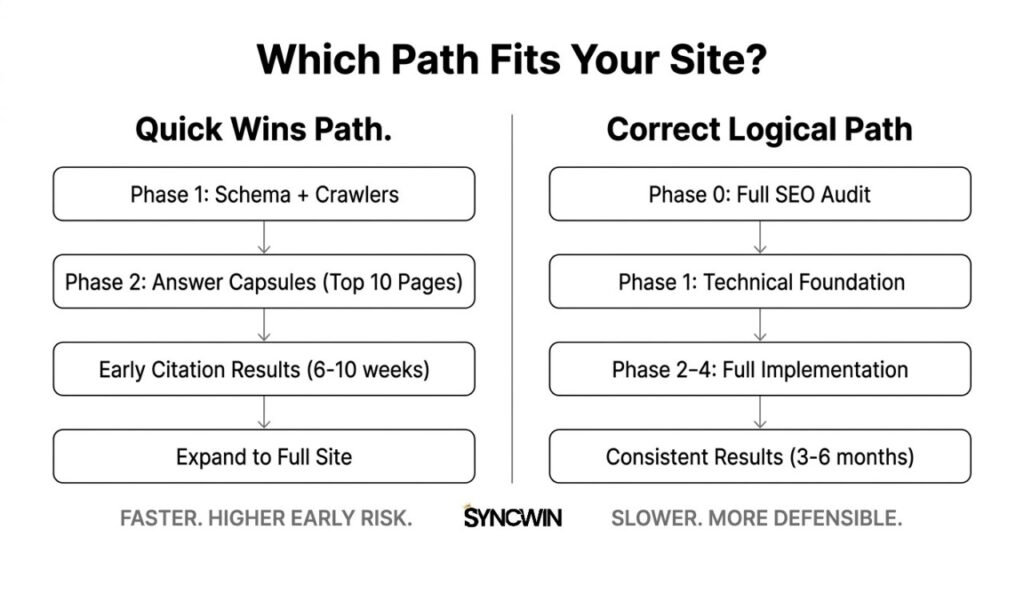
The honest trade-off: The Quick Wins Path gets you citation visibility faster, but can expose gaps when you try to scale. The Correct Logical Path takes longer before early signals appear, but everything you build is on solid ground. If you are not sure which phase your site is ready for, complete Phase 0 first. The audit will tell you.
Phase 0: Pre-Implementation Audit
Required for: Correct Logical Path. Strongly recommended for: Quick Wins Path before scaling.
Technical SEO Checklist
- Site loads in under 3 seconds on mobile. Test with Google PageSpeed Insights
- Core Web Vitals pass: LCP under 2.5 seconds, INP under 200ms, CLS under 0.1
- Total HTML document size is under 1MB per page. Pages above this threshold may be partially indexed or skipped by AI crawlers entirely during their retrieval phase.
- Server response time is under 2 seconds. AI crawlers operate with strict time budgets. Slow servers cause crawler timeouts that result in pages being missed.
- Site is fully mobile-responsive. Test with Google’s Mobile-Friendly Test
- HTTPS is active across all pages, with no mixed content warnings
- XML sitemap submitted to Google Search Console and Bing Webmaster Tools
- robots.txt is configured correctly and not blocking important pages or AI crawlers (see Phase 1 for the AI crawler check)
- No significant crawl errors in Google Search Console
- Canonical tags implemented on all key pages
WordPress note: Rank Math and Yoast both surface most of these issues in their site audit dashboards. For non-WordPress sites, Screaming Frog’s free version (up to 500 URLs) covers the technical basics.
On-Page SEO Checklist
- Every key page has a unique title tag (50-60 characters) and a unique meta description (150-160 characters)
- H1 tags are present and unique on every page
- Primary keyword appears in the H1, the first paragraph, and at least one H2
- Images have descriptive alt text
- Service and product pages have substantive content (minimum 800 words for informational content)
Off-Page SEO Checklist
- Google Business Profile is claimed, verified, and fully complete. For any local business, this is non-negotiable before AEO.
- Business listed on major directories with consistent NAP (Name, Address, Phone) across every single one
- India and Kolkata businesses: Justdial, Sulekha, IndiaMart, and TradeIndia listings are live and NAP-consistent
- US businesses: Yelp, BBB, Apple Maps, and Bing Places are live and NAP-consistent
- At least a basic backlink profile exists from credible, relevant sources
AEO Readiness Check
Answer these three questions before proceeding:
- Does your site have at least 10 to 15 pages of substantive, experience-backed content on your core topics?
- Is your business accurately described and findable on the platforms AI tools trust: GBP, LinkedIn, Wikidata, and relevant directories?
- Do your existing pages answer specific questions your customers ask, or do they mostly describe your services in general terms?
If the answer to all three is yes, move to Phase 1. If one or more are no, fix those gaps first.
AEO built on thin content or fragmented entity data will not produce results worth measuring.
Phase 1: Technical AEO Foundation
Quick Wins Path: Apply this phase to your top 10 pages by traffic. Correct Logical Path: Apply sitewide.
1.1 AI Crawler Access Audit
Before you optimize a single piece of content, confirm that the AI crawlers feeding the platforms you want to appear in can actually access your site. Many websites block unfamiliar user agents by default, often through CDN security settings or legacy robots.txt configurations.
If AI bots are blocked, none of your AEO work will produce results. You will not receive a warning. You will simply be invisible.
| AI Crawler | Platform | What It Does for AEO |
|---|---|---|
| OAI-SearchBot | ChatGPT Search | Real-time retrieval for ChatGPT query responses |
| GPTBot | OpenAI | General crawling for ChatGPT knowledge updates |
| Google-Extended | Gemini / AI Overviews | Feeds Google’s generative answer layer |
| PerplexityBot | Perplexity AI | Real-time indexing for Perplexity responses |
| ClaudeBot | Anthropic Claude | Data collection for Claude’s analysis |
Source: Cloudflare Bot Management Documentation and individual platform crawler documentation. Verify current user-agent strings before updating robots.txt, as these change periodically.
What to check:
- Open your robots.txt file (yourdomain.com/robots.txt) and confirm none of the above user agents are blocked
- If you use Cloudflare or another CDN, check that bot management settings are not blocking unfamiliar agents by default
- Verify bot access by reviewing your server logs. Each of these crawlers should be returning a 200 HTTP success status. A 403 or a 404 means they are being turned away.
- Confirm your site is indexed in Bing Webmaster Tools. ChatGPT Search relies on the Bing index for real-time retrieval. If you are not in Bing’s index, you are not in ChatGPT’s retrieval pool.
1.2 JavaScript Rendering Check (The Island Test)
A critical and often overlooked AEO failure point is JavaScript-dependent content. Many AI crawlers cannot execute complex JavaScript the way a browser does.
If your core content is rendered client-side, it may be invisible to the crawlers that feed AI platforms.
Run the Island Test:
- Disable JavaScript in your browser (Chrome: Settings > Privacy and Security > Site Settings > JavaScript > Block)
- Load each of your top 10 pages
- Check whether the following are still visible: all body text, definition paragraphs, pricing information, comparison tables, FAQ sections, and numbered step-by-step lists
- If any of this content disappears with JavaScript disabled, the page fails the Island Test. It is not AEO-ready.
Fix: If your WordPress theme uses heavy client-side rendering, consider enabling server-side rendering for key content blocks. Most major WordPress themes render core content server-side by default. Custom JavaScript components or page builders that hide content in JS are the more common culprit.
Non-WordPress note: If you use a JavaScript-heavy framework (React, Vue, Next.js client-side), implement Static Site Generation (SSG) or Server-Side Rendering (SSR) for any pages you want to rank in AI answers.
1.3 Schema Markup Implementation
Schema markup is the machine-readable metadata layer that tells AI crawlers what your content is, not just what it says. For answer engines, it acts as a direct translator that reduces inference errors during the retrieval and synthesis phases.
The 2026 standard is “Schema Stacking”: nesting multiple interconnected schema types within a single JSON-LD @graph structure to give AI systems a complete, 360-degree view of your entity in one pass.
Priority schema types for small businesses:
- FAQPage schema on every service page, product page, and informational article with question-and-answer pairs. This is the highest-leverage schema type for AEO. It maps Q&A pairs directly for AI extraction.
- Organization schema on your homepage and About page. Include: business name, URL, logo, contact details, founding date, and social profile links.
- LocalBusiness schema if you serve a specific geographic area. Include address, service area, operating hours, and price range.
- Person schema on your author bio page. Link it to LinkedIn, any published work, and Wikidata if available.
- HowTo schema on any step-by-step guide or process page.
- Article and BlogPosting schema on content pages. Include the dateModified field on every article and update it whenever the content is refreshed. AI engines have a strong recency bias and prioritize content updated within the last 90 days.
- BreadcrumbList schema sitewide for structural clarity.
Example @graph structure (JSON-LD):
{
  "@context": "https://schema.org",
  "@graph": [
    {
      "@type": "Organization",
      "name": "Your Business Name",
      "url": "https://yourdomain.com",
      "sameAs": [
        "https://linkedin.com/company/yourpage",
        "https://www.wikidata.org/wiki/QXXXXX"
      ]
    },
    {
      "@type": "FAQPage",
      "mainEntity": [
        {
          "@type": "Question",
          "name": "What does your business do?",
          "acceptedAnswer": {
            "@type": "Answer",
            "text": "Direct 50-80 word answer here."
          }
        }
      ]
    }
  ]
}
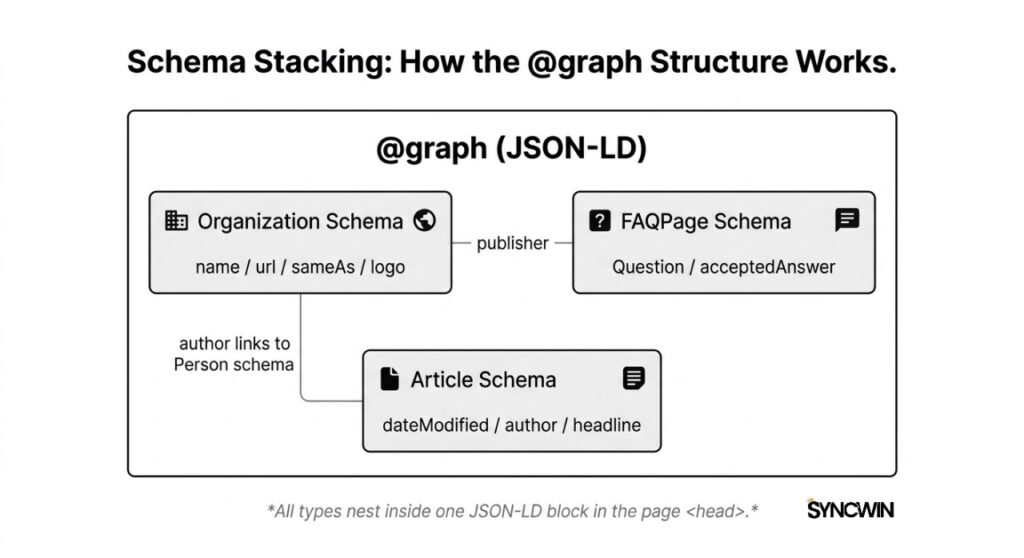
WordPress note: Rank Math’s free version generates FAQPage, HowTo, Organization, and Person schema from its interface. Yoast covers Organization and BreadcrumbList natively. Validate every schema implementation with Google’s Rich Results Test before publishing.
Non-WordPress note: Add the JSON-LD block in the <head> section of each page. Google’s Structured Data Markup Helper generates the code if you are doing this manually.
1.4 sameAs Entity Linking
- In your Organization schema, add sameAs properties linking to: LinkedIn company page, Google Business Profile URL, Facebook business page, Wikidata entry (if available)
- This tells AI systems that all of these profiles represent the same entity. Without it, fragmented or conflicting business information across platforms can result in incorrect AI responses about your business.
1.5 The llms.txt File
The llms.txt file is a curated Markdown document placed at your domain root.
Where robots.txt controls what crawlers can access, llms.txt tells AI models what to focus on and how to interpret your brand. It is the closest thing to a direct briefing document for the AI systems you want to appear in.
| Format | What It Does | Best Practice |
|---|---|---|
| H1 title | Names the brand or site entity | Use your exact business name consistently |
| Blockquote | Mission statement or site summary | One or two clear sentences, no marketing language |
| H2 sections | Content categories by intent | Label by purpose: “Services,” “About,” “Resources.” |
| Link format | (URL): one-sentence description | Describe what the AI will find, not what you want it to think |
- Create yourdomain.com/llms.txt as a plain-text Markdown file
- Include: business name, mission statement, core services, key page URLs with one-sentence descriptions, founding date, location, and what your business does not do
- Update this file whenever your key pages, services, or business details change
- Verify AI crawlers can access it by checking that it is not blocked in robots.txt
Phase 2: On-Page Content Implementation
This is where most of the visible AEO work happens. It is also where the biggest errors are made.
2.1 The Island Test for Prose
Before restructuring anything, apply the Island Test to your writing.
Every paragraph in your content should make complete sense in isolation.
AI systems chunk your content into segments during retrieval. If a paragraph relies on context from the one above it to be understood, the AI may extract it incorrectly or skip it.
Common failures:
- Paragraphs starting with “This,” “They,” or “It” without defining the subject within the same paragraph
- Conclusions that reference “the above” without restating the point
- Data claims where the statistic appears in one sentence, and the source appears two paragraphs later
- Audit every key page for ambiguous pronouns and forward references
- Rewrite any paragraph that would be confusing without reading what came before it
2.2 Write Answer Capsules
An answer capsule is a 40-60-word paragraph placed immediately after each H2 or H3 that directly answers the question implied by that header. This is what AI systems extract. Everything below it is supporting depth for human readers and long-term authority.
Content format and AEO impact:
| Format | AEO Impact | Best Use |
|---|---|---|
| 40-60-word direct answer capsule | Critical | Definitions, answering core queries |
| FAQ sections with schema | Critical | People Also Ask targeting |
| Comparison tables | High | Product and service evaluations, pricing |
| Numbered lists | High | Step-by-step processes, tutorials |
| Short supporting paragraphs | Medium | Context, examples, detail |
Source: Frase.io FAQ Schema Study, November 2025. Pages with FAQPage schema are 3.2x more likely to appear in Google AI Overviews.
Checklist for answer capsules:
- Every key section has a 40-60-word answer capsule immediately below the H2 or H3
- The capsule answers the question the header implies without requiring any surrounding context
- The capsule includes at least one specific, verifiable detail: a number, a named tool, a timeframe, or a measurable outcome
- No capsule opens with “In this section,” “Today we’ll explore,” or any meta-commentary
2.3 Rewrite Headers as Direct Questions
- Audit every H2 and H3 on your top 20 pages
- Rewrite abstract topic labels as direct questions
| Before | After |
|---|---|
| “Our Services” | “What services does [Business Name] offer?” |
| “Pricing” | “How much does [service] cost for a small business?” |
| “Process” | “How does the [service] process work from start to finish?” |
| “About the Team” | “Who runs [Business Name] and what is their background?” |
| “Benefits” | “What are the benefits of [service] for small businesses?” |
2.4 Build FAQ Sections
- Add a dedicated FAQ section to every service page and high-traffic informational article
- Use Google’s “People Also Ask” boxes for your target keywords to source questions
- Answer each FAQ in 50-80 words: direct, specific, no padding
- Apply the FAQPage schema to every FAQ section
- Kolkata and India businesses: include 2-3 FAQ questions written in Bengali on local service pages. Regional language AI queries are growing in India, and almost no local competitor has addressed this yet.
2.5 Content Quality Standards (Non-Negotiable)
This is the section most implementation guides skip. Structure and schema are meaningless without content that earns the citation.
- Every piece of published content has a named author with a linked bio page
- High-priority pages include at least one personal observation, specific experience, or direct opinion that could not have come from someone who has not done this work
- Every factual claim or statistic has a linked source. No exceptions.
- Key explanatory sentences follow the Semantic Triplet structure: Subject > Mechanism > Outcome. Instead of “our service is effective,” write: “SyncWin’s local AEO setup [Subject] adds FAQPage schema and Bengali FAQ content to service pages [Mechanism], which increases citation frequency in regional language AI queries within 60 days [Outcome].”
- Content on high-traffic pages is reviewed and updated every 90 days. The dateModified field in the Article schema is updated each time. AI engines have a measurable recency bias. A page that has not been touched in 12 months is at a structural disadvantage.
- Each update cycle: add one new statistic with source, refresh one example, and review whether any claim has become outdated
2.6 Internal Linking for Topical Authority
- Every cluster article links to at least one pillar article in the topic cluster using descriptive anchor text
- Pillar articles link back to cluster articles using varied, contextual anchor text
- No key page is more than 3 clicks from the homepage
- Check the internal links report in Google Search Console for orphan pages and fix them
Current internal linking map for this topic cluster:
This checklist article links to:
- What is AEO? for readers who need the full framework before implementing
- AEO vs SEO for readers working through the “why both matter” question
- AEO vs GEO vs LLMO for readers encountering other AI optimization acronyms
- What is zero-click search? for readers who want the business case behind doing any of this
Phase 3: Local AEO Implementation
Applies to all businesses with a physical location or a defined service area.
3.1 Google Business Profile
Your GBP is not a static listing. AI platforms pull from it in real time to synthesize local recommendations. A partially completed or outdated GBP is a direct liability for local AI citation.
- Business name, address, phone, and website are exact character-for-character matches across your website, GBP, and every directory listing
- All service categories are selected accurately and completely
- Business description written in plain language with your primary service keywords included naturally
- Minimum 10 photos uploaded, updated every 30 days
- Every customer question in the Q&A section has a response from the business
- GBP posts are updated at a minimum twice per month
- Every review has a response from the business, positive and negative
Third-party reviews are cited in 34.5% of AI Overviews. Your review management is directly connected to your AI citation rate.
3.2 NAP Consistency Audit
- Run a NAP audit across every platform where your business appears
- India and Kolkata businesses: Justdial, Sulekha, IndiaMart, and TradeIndia listings all match exactly
- US businesses: Yelp, BBB, Yellow Pages, Apple Maps, and Bing Places all match exactly
- Global: Facebook Business, LinkedIn Company Page, and GBP all match exactly, including abbreviations. “Street” and “St.” are treated as different entries by some AI systems.
One inconsistency is enough for an AI model to treat your listings as two different entities and reduce confidence in both.
3.3 Hyperlocal Content
- Create individual landing pages for each primary service area or neighborhood you serve
- Each page mentions specific geographic anchors: neighborhood names, landmarks, pin codes, and major cross-streets
- US example: “web design services in Midtown Atlanta near Piedmont Park” performs better in local AI queries than “web design services in Atlanta”
- Kolkata example: “event catering in Salt Lake Sector V near City Centre 1” performs better than “event catering in Kolkata.”
- Add LocalBusiness schema with serviceArea defined on each hyperlocal page
Phase 4: Off-Site Entity Building
This phase makes your business a recognized, grounded entity across the platforms AI models trust. It takes the longest and cannot be rushed. The results here compound over time.
4.1 Wikidata Entry
- Search wikidata.org for your business to check whether an entry already exists
- If not, and if verifiable external sources about your business exist, create an entry
- A Wikidata entry is one of the strongest LLMO signals available. ChatGPT specifically uses Wikidata as a grounding dataset for entity verification.
- Minimum fields: business name, founding date, headquarters location, official website, industry, and founder with sameAs links to LinkedIn
4.2 Author and Founder Presence
- The primary author or founder has a complete, regularly active LinkedIn profile
- Author bio pages on your website link to LinkedIn, Wikidata (if applicable), and any published third-party work
- The author or founder is quoted by name in your own content, expressing specific opinions, not just writing about topics from a distance
4.3 Earned Third-Party Mentions
Brand mentions on authoritative platforms correlate three times more strongly with AI visibility than traditional backlinks. Earning links is still important. But being mentioned by name in trusted sources matters just as much.
According to SE Ranking research, domains with millions of brand mentions on Reddit and Quora have roughly 4x higher chances of being cited by ChatGPT than those with minimal activity.
- Your business name appears on at least 3 to 5 credible third-party sources: industry publications, news outlets, community platforms, or partner sites
- Participate in relevant Reddit threads and Quora answers in your niche. ChatGPT’s citation behavior is heavily influenced by Reddit community data. A genuine, helpful answer in a relevant subreddit with your business name visible builds entity presence in the training dataset.
- Guest posts or contributor articles on industry publications carry significant LLMO weight. More than most on-site content.
- Encourage customers to leave detailed reviews on platform-specific review sites relevant to your industry. These are cited in over a third of AI Overviews.
Phase 5: Measurement & Monitoring
Implementation without measurement is guesswork. This phase tells you whether your AEO work is producing results and where to adjust.
AEO Key Performance Indicators (2026)
| Over 30% higher than the organic baseline | What It Measures | 2026 Target |
|---|---|---|
| Citation Share of Voice | Percentage of industry-relevant AI responses that cite your brand | Over 15% in your primary niche |
| Brand Mention Frequency | Total times your brand is recommended across major AI platforms | Positive year-over-year growth |
| AI Referral Conversion Rate | Percentage of AI-referred visitors who complete a transaction | Over 30% higher than the organic baseline |
| Prompt Coverage | Number of unique queries where your content is extracted | Growing, multi-cluster coverage |
| Sentiment Score | How AI describes your brand (tone and reliability) | Consistently positive |
Source: Adobe Digital Insights, January 2026. Based on 2025 holiday season retail data.
5.1 Set Up AI Traffic Tracking in GA4
- In Google Analytics 4, create a custom channel group for AI-referred traffic
- Add these as a custom channel: chatgpt.com, perplexity.ai, gemini.google.com, bing.com/chat, claude.ai
- Track sessions, conversion rate, and goal completions from this channel separately from organic search
- Set a Month 1 baseline. Review monthly. AI-referred sessions converting at a higher rate than organic is your primary early signal that AEO is working.
- A 12-month GA4 analysis of 94 e-commerce brands by Visibility Labs found ChatGPT referral traffic converting 31% higher than non-branded organic search, consistently outperforming organic in 10 of 12 months.
5.2 Manual Citation Testing (Every 2 Weeks)
- Run these queries across ChatGPT, Perplexity, and Google AI Overviews:
- “What is the best [your service] in [your city]?”
- “[Your business name]: what do they offer?”
- “[Your primary service keyword] for small businesses”
- Document whether you appear, what the AI says, and whether the information is accurate
- If the AI states incorrect information about you, submit a correction through the platform’s feedback tool and update your llms.txt and Organization schema immediately
5.3 Google Search Console (Weekly)
Google Search Console is free and gives more direct insight into how Google processes your content than most paid tools. Start here before investing in anything else.
- Monitor impressions vs clicks on your key pages. Growing impressions with flat or declining clicks is the normal pattern in a zero-click environment. The response is to optimize for citation, not to treat this as a failure.
- Check rich result types being triggered (FAQ, HowTo, Organization)
- Review Core Web Vitals status
- Check the “Search appearance” filter to see which structured data is generating rich results
5.4 The Quarterly Freshness Cycle
AI engines have a measurable recency bias. Content updated within the past 90 days is significantly more likely to be cited than identical content that has not been touched.
- Every 90 days: review your top 20 pages
- Add one new statistic with source, refresh one example, update the dateModified field in the Article schema
- Remove any outdated claims or statistics that have been superseded by newer data
5.5 Paid Tools (When the Foundation Is in Place)
These are worth exploring once your Phase 0 through Phase 4 work is done and you have baseline data to compare against.
- Semrush: includes AI Overview tracking, showing which keywords trigger AI Overviews and whether your domain is cited
- Profound: tracks citation velocity across multiple AI platforms simultaneously
- LLMrefs: functions as a rank tracker for AI citations, mapping keywords to generative responses
- Sight AI: monitors brand mentions and sentiment across ChatGPT, Claude, and Perplexity with an “AI Visibility Score.”
None of these is necessary in the early phases. Google Search Console, GA4, and manual testing cover everything you need for the first six months.
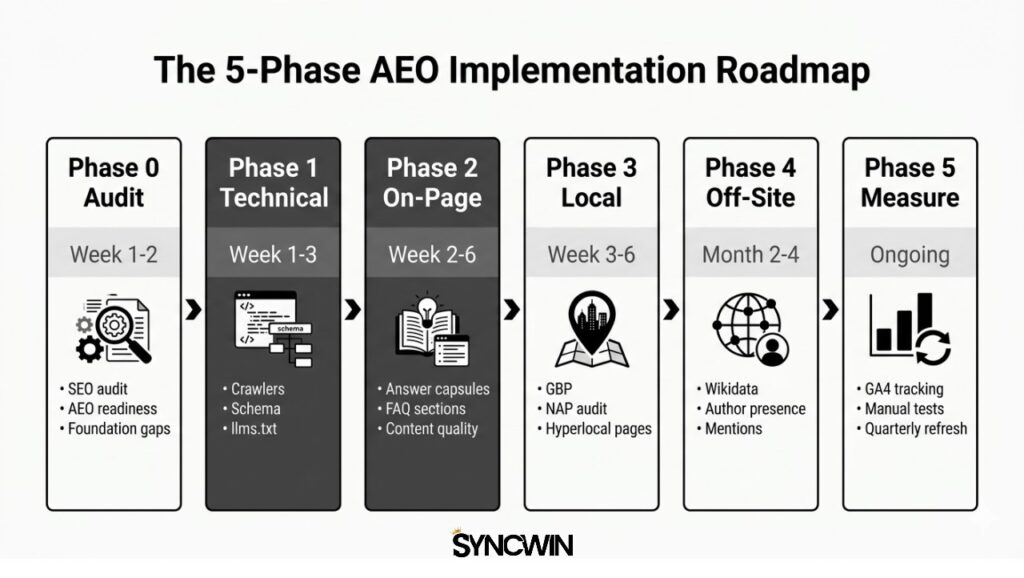
Full Checklist Reference Table
| Phase | Key Actions | Priority | Timeline |
|---|---|---|---|
| Phase 0: Audit | Technical SEO, on-page SEO, and off-page SEO assessment | Critical (Logical Path) | Week 1-2 |
| Phase 1: Technical | AI crawler check, Island Test, schema stacking, sameAs links, llms.txt | Critical | Week 1-3 |
| Phase 2: On-Page | Answer capsules, question headers, FAQ sections, content quality, internal links | Critical | Week 2-6 |
| Phase 3: Local | GBP optimization, NAP audit, hyperlocal pages | High for local businesses | Week 3-6 |
| Phase 4: Off-Site | Wikidata, author presence, earned mentions, review strategy | Medium | Month 2-4 |
| Phase 5: Measurement | GA4 AI channel, manual testing, GSC monitoring, quarterly refresh | Critical (ongoing) | From Month 1 |
Frequently Asked Questions
Do I need to complete all five phases before I see any results?
No.
Phases 1 and 2 produce the most visible early results: schema implementation and answer capsule restructuring can generate citation appearances in Perplexity and Google AI Overviews within 6 to 10 weeks on pages with decent existing SEO.
Phases 3 through 5 build the long-term authority and measurement infrastructure. If you are short on time, start with schema on your top 10 pages and answer capsules on your highest-traffic content.
I’m on WordPress. What do I actually need installed?
For most of this checklist, one well-configured SEO plugin covers the schema requirements.
Rank Math’s free version handles FAQPage, HowTo, Organization, BreadcrumbList, and Article schema from its interface. Yoast covers similar ground. Pick one and use it fully. You do not need both.
Google Search Console is the only external tool that is genuinely essential from day one.
I’m not on WordPress. Can I still follow this checklist?
Yes. Every strategic step in this checklist is platform-agnostic. The technical differences are: schema is added as JSON-LD in your page <head>, llms.txt is a plain text file at your domain root, and NAP consistency is managed through your platform’s settings or manually.
If your platform has no built-in schema support, a developer can add JSON-LD to page templates in under an hour.
What is the Island Test, and how do I run it?
The Island Test checks whether your content is visible without JavaScript. Disable JavaScript in your browser settings and load your key pages. If your body text, tables, FAQs, or step-by-step content disappear, those elements are rendered client-side and invisible to most AI crawlers. That content needs to be moved to server-side rendering.
Why does schema markup matter so much for AEO?
Pages with schema markup are three times more likely to earn citations in AI Overviews than equivalent pages without it.
Schema removes the inference step for AI systems. Instead of guessing what your FAQ content is, the AI reads the label. Instead of estimating whether your business is a trustworthy entity, it reads the verified sameAs links.
Schema reduces the friction between your content and the AI’s citation decision.
How long before AEO produces results?
Quick Wins Path: citation appearances in 6 to 10 weeks on pages with existing SEO and high-quality content.
Correct Logical Path: consistent citation results across platforms in 3 to 6 months. LLMO results (unprompted ChatGPT mentions) take the longest because they depend on training data cycles that run on multi-month schedules.
Is AEO equally relevant for businesses in India and the USA?
The tactics are identical. The opportunity differs.
In the US, AI search integration is more mature, and competition for citation slots is growing. In India, 73% AI adoption combined with almost no local AEO implementation means the first-mover advantage is genuine and available now.
A local business in Kolkata that completes this checklist today is ahead of the vast majority of its local competitors before any of them have started.
What does zero-click search have to do with why I’m doing this?
Zero-click search is the core business case for AEO. When 64% of Google searches end without a click, the goal shifts from getting clicked to getting cited. That article covers the business impact in full, including which query types are most affected and what the data shows about AI-referred traffic quality.
What about agentic AI? Does this checklist still apply?
Agentic AI, where systems like Google’s AI Mode or Microsoft Copilot perform actions on behalf of users rather than just answering questions, is the next phase of this shift.
For small businesses, agentic readiness means having your structured data complete enough that an AI agent can identify your pricing, availability, and services without ambiguity. Everything in this checklist builds toward that.
The businesses with clean, structured data and verified entity signals in 2026 are the ones that agentic AI will recommend in 2027.
Conclusion
This checklist is not short because the work is not shallow. AEO requires building the right foundation, structuring your content for machine extraction, establishing your business as a trusted entity across multiple platforms, and monitoring the results over time.
Most businesses will not do all of this at once. That is fine. The sequence matters more than the speed. SEO foundation first. AEO structure second. Entity presence third. Measurement throughout.
The businesses being cited in AI answers today are not necessarily the biggest or the most well-funded. They are the ones who built clean, structured, experience-backed content before their local competitors did. That window is still open in most markets, especially in India, where basic digital infrastructure is still being built.
If you want the full picture of why any of this matters before you implement:
- What is AEO? for the complete framework and a 6-month roadmap
- AEO vs SEO for why the SEO foundation is not optional
- AEO vs GEO vs LLMO for understanding the different AI platforms. This checklist targets
- What is zero-click search? for the business case that makes this work worth doing
Drop any implementation questions in the comments. I read everyone.
Running a business outside India and want someone to handle this implementation? SyncWin works with small businesses globally on AEO audits, schema implementation, content restructuring, and full AI visibility setup. Get in touch with SyncWin, and we will start with an honest assessment of which phase your site is ready for.
Based in Kolkata or West Bengal? We work directly with local businesses on GBP optimization, NAP consistency across Indian directories, Bengali and English content, and complete AEO implementation at local rates. Contact SyncWin for local SEO and AEO services.