
Traditional SEO tracks rankings and clicks. AI visibility metrics track something different: how often your brand gets cited when users ask an AI platform a relevant question. In 2026, both data streams matter. Understanding what AI Share of Voice and AI Visibility Score measure, and knowing when to prioritize them, is the foundation of any serious AEO measurement strategy.
Key Highlights
- Traditional metrics (rankings, organic traffic, and domain authority) do not capture AI citations. A separate measurement approach is required.
- AI Share of Voice (AI SOV) measures how often your brand appears in AI platform responses across a set of systematically tested target queries.
- The AI Visibility Score (AVS) is a normalized 0-100 index, calculated by auditing 80 responses across 4 AI platforms weekly using a structured prompt library.
- Approximately 59% of Google searches end without a click, per SparkToro’s 2024 data. AI citation visibility operates independently of that click traffic. (Source: SparkToro / Datos, 2024 Zero-Click Search Study)
- A Nasscom-Meta whitepaper (2024) found 94% of Indian tech-enabled MSMEs recognize AI’s business potential, yet 65% still lack awareness of the tools needed to act. (Source: Nasscom-Meta, “Empowering India’s Growth: Unlocking AI’s Potential for Tech-Enabled MSMEs,” June 2024)
- A B2B SaaS company grew AI-referred product trials from 550 to 2,300+ in 4 weeks with a dedicated AEO strategy, per Discovered Labs. (Source: Discovered Labs B2B SaaS AEO Case Study, 2025)
- The free starting point: open ChatGPT, Perplexity, Gemini, and Google AI Mode. Test your FAQ schema questions or primary keywords. Check for citations.
- SEO is the foundation. AI visibility metrics are the layer built on top, not a replacement for organic rankings.
Why Do Traditional SEO Metrics No Longer Tell the Full Story?
Traditional SEO metrics measure performance in a click-based search model: rankings, organic sessions, click-through rate, and domain authority.
Traditional SEO metrics still matter for click-based performance, but they overlook an entire category of behavior. When a user asks ChatGPT to recommend a digital consultancy in Kolkata or asks Perplexity which accounting software suits US startups, none of those interactions appear in Google Analytics or Search Console.
A separate measurement framework is needed to capture what happens before the click.
Approximately 59% of Google searches now end without a click to any website, per SparkToro’s 2024 data.
A business can rank well organically and remain completely invisible in AI-generated responses.
The reverse is also true: modest domain authority combined with well-structured content can earn consistent AI citations above stronger competitors.
How AI Overviews affect website traffic details the gap between visibility and traffic that these new metrics are designed to address.
What Is AI Share of Voice (AI SOV)?
AI Share of Voice (AI SOV) measures the percentage of AI-generated category conversations where your brand is mentioned, out of all brand mentions tracked across your competitive set.
Unlike traditional SEO share of voice, which tracks click distribution based on ranking positions, AI SOV counts explicit citations and mentions across a set of systematically tested prompts. A brand with 30% AI SOV is cited in roughly 30 of every 100 relevant AI responses monitored across a defined prompt library.
The calculation is straightforward: divide your brand’s total AI mentions by all competitor mentions in the same prompt set, then multiply by 100.
A roofing company in Dallas and a digital consultancy in Kolkata both compete for AI SOV within their respective category and geographic scopes.
The quality of the prompt library matters as much as how often you test. Prompts must mirror how your ideal customer actually asks questions, not how you describe your own services.
How AI platforms decide citations explains why some brands appear consistently, and others do not, even within the same category.
What Is the AI Visibility Score (AVS)?
The AI Visibility Score (AVS) is a normalized index from 0 to 100 that gives businesses a single, portable number for tracking AI platform presence over time. The standard calculation runs 20 non-branded, purchase-intent prompts across 4 major AI platforms (ChatGPT, Gemini, Perplexity, and Google AI Mode), creating 80 scored responses per weekly tracking cycle. Each response is assigned a prominence score, and the total is normalized to produce the final index.
The scoring rubric for each response:
| Score | Condition | Example |
|---|---|---|
| 5 points | Brand named as the primary recommended solution | “For AC repair in South Kolkata, Brand X is the leading option” |
| 3 points | Brand mentioned as a valid secondary alternative | “Other reputable options include Brand Y and Brand Z” |
| 1 point | Brand not named but included as a citation link | A response about tax optimization, citing the brand’s blog post |
| 0 points | Brand completely absent from the response | No mention, no link, no presence |
(Source: AEO industry measurement practices, 2025–2026)
The maximum possible raw score across 80 responses is 400. The AVS equals total raw score divided by 400, multiplied by 100.
What AVS scores indicate:
- 0 to 8: Pre-visibility. No meaningful presence in AI conversations.
- 8 to 25: Early traction. Beginning to appear for some category queries.
- 25 to 50: Category presence. Consistently cited across multiple platforms.
- 50 to 75: Category authority. Strong, reliable citation on most relevant queries.
- 75 and above: Category dominance. Cited as a primary recommendation at scale.
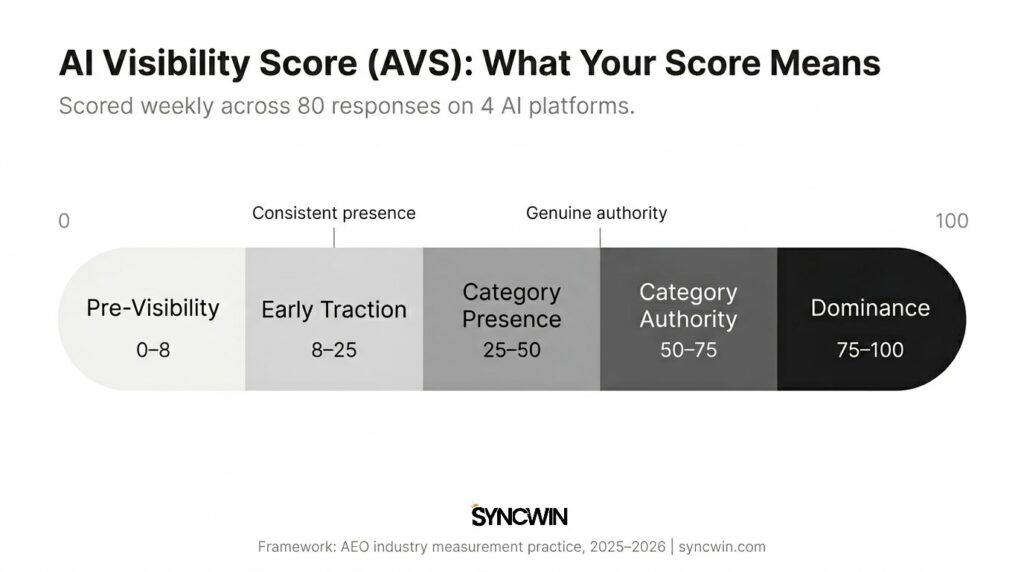
The AVS framework is a practitioner-developed AEO measurement model used across the GEO/AEO industry. Scoring parameters may vary by implementation.
How Do You Measure AI Visibility Without Paid Tools?
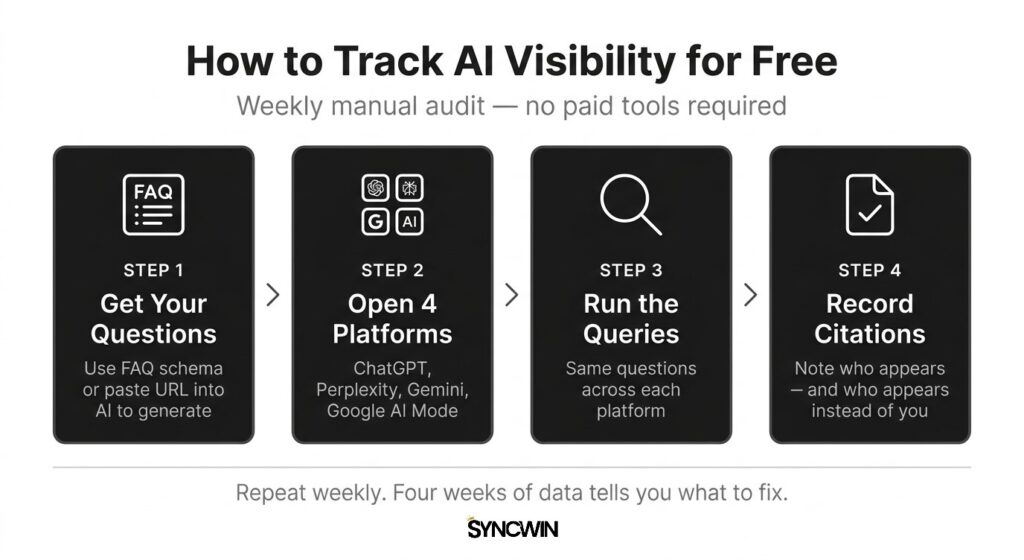
The free manual approach is more effective than it sounds, and it is where every small business should start, regardless of budget. Open ChatGPT, Perplexity, Gemini, and Google AI Mode. Run the same questions across each platform. Record which ones cite your website, where in the response you appear, and who appears in your place when you are absent.
The most effective prompt set comes directly from your own content.
If your articles already have FAQs with schema markup, those questions are your first test queries. Use the exact questions you have already structured for AEO and check for citations.
If your content does not have FAQs yet, paste the URL of any key page into an AI platform and ask it to generate the most likely questions a user would ask about that page.
Then run those generated questions across all four platforms and record what gets cited.
From my own experience with SyncWin: I use my FAQ schema questions from recent articles as the first batch of test prompts on ChatGPT, Perplexity, and Gemini each time I check citation presence.
Primary and semantic keywords work as test queries, too. Build a question around your core topic and check which sources each platform cites in response.
This process takes under an hour a week, requires no subscription, and gives you immediate qualitative data on exactly where you stand.
For businesses in India, where voice search continues growing rapidly, test queries in both English and your regional language on Google AI Mode and Perplexity.
Tracking AI referral traffic in Google Analytics 4 is also worth setting up alongside your manual audits.
Manual AI platform audits show you where your brand appears in AI responses. GA4 shows you what that traffic actually does once it arrives on your site.
You can separate AI-referred sessions from standard organic traffic by creating a custom channel group in GA4 that maps referrals from ChatGPT, Perplexity, Claude, and other AI platforms to their own channel.
Analytics Mania has a clear step-by-step walkthrough for setting this up in GA4, including the exact channel groupings and referral sources to configure.
What Tools Are Available for AI Visibility Tracking?
Several dedicated platforms now exist for tracking AI citation presence automatically across platforms. They range from free open-source deployments to full enterprise dashboards.
The table below covers what is currently available. Pricing is approximate as of early 2026 and changes frequently, so verify current plans directly with each vendor before committing to anything.
| Tool | Primary Use Case | Verified Starting Price |
|---|---|---|
| Semrush AI Toolkit | Multi-platform citation tracking is integrated into the Semrush subscription | From ~$99.95/month (Pro plan) |
| Peec AI | Purpose-built AI citation tracking for SMBs and boutique agencies | From ~€85/month (~$95 USD) Starter |
| Profound | Enterprise AI brand analytics and citation intelligence | From $99/month (ChatGPT only); full access from $399–$499/month+ |
| HubSpot AEO Grader | Free AI readiness audit; paid Marketing Hub tiers for CRM integration | Free (grader); paid hubs from ~$45/month |
| Ahrefs Brand Radar | Brand mention monitoring across search-backed prompt data | Free (entry level); advanced features require a paid plan |
| TraceAIO | Open-source self-hosted deployment for full data control | Free (requires own compute infrastructure) |
| Scrunch | Cross-LLM prompt analytics with citation gap detection | From ~$250/month |
| Botify | Enterprise technical SEO combined with generative engine analysis | Custom enterprise pricing |
(Source: Vendor pricing pages, April 2026 / Discovered Labs tool comparison, December 2025 / AIVO Blog, March 2026)
Pricing is approximate and changes frequently. Verify current plans at each vendor’s website before purchasing. All prices are as of early 2026.
No specific tool is recommended here. Each serves a different use case, budget level, and technical capacity. Research each one against your actual requirements before spending anything.
The free manual approach is sufficient for most small businesses in the early stages of AEO optimization. Paid tools become genuinely useful once you are tracking 15 or more queries across multiple platforms consistently every week, and the manual process becomes too slow.
Should You Track AI Visibility Before Your SEO Foundation is Solid?
The short answer is no. SEO is the foundation. AEO, AI visibility metrics, and Share of Voice tracking are layers built on top, not replacements for it.
seoClarity’s analysis of 432,000 keywords confirms that 97% of URLs cited in AI Overview responses also appear in the top 20 organic search results.
Your content has to be findable before it can be citable.
A business that cannot rank for its own category terms in standard search is not ready to optimize for AI citations. Fix the foundation first.
Once technical SEO is in place: clean schema markup, consistent entity data, well-structured answer-first content, and real topical depth, then AI visibility becomes meaningful to measure and worth optimizing.
The AEO vs SEO comparison covers this in detail. The short version: one is a prerequisite for the other. Running them in the right order is what makes both work.
What Does Good AI Visibility Look Like in Practice?
The Discovered Labs case study is one of the clearest documented examples of AEO-driven AI visibility growth.
A B2B SaaS company had 550 self-reported AI-referred product trials as a baseline. After fixing broken schema markup, resolving duplicate content, improving internal linking, and publishing 66 optimized decision-intent articles in one month, the company grew AI-referred trials from 550 to 2,300+ in four weeks with a 600% citation uplift across ChatGPT, Claude, and Perplexity.
The mechanics behind that result were not complex. Schema repair, structured answer-first content, and semantic depth drove the change.
For a small business owner in Chicago or a solo operator in Kolkata, “good AI visibility” at an early stage does not mean dominating every category prompt on all four platforms.
A realistic and trackable target: your brand is cited at least once across a weekly manual audit of your 10 core customer queries, appearing consistently over time.
That baseline requires no paid tool, no enterprise budget, and no technical team to achieve and measure.
The AEO implementation checklist covers the exact content and technical steps that make this kind of citation growth reproducible.
FAQs About AI Visibility Metrics
What is AI Share of Voice, and how is it calculated?
AI Share of Voice (AI SOV) measures how often your brand is cited across AI platform responses compared to all competitors in the same category and geography.
Divide your brand’s total AI mentions across a defined prompt library by all competitor mentions in the same set, then multiply by 100.
Tracking this manually requires a consistent set of 15 to 20 prompts and a weekly testing routine across ChatGPT, Gemini, Perplexity, and Google AI Mode.
It is the most practical starting metric for any small business beginning to measure AI presence.
What is the AI Visibility Score, and how is it different from AI SOV?
AI SOV measures competitive share. The AI Visibility Score is an absolute performance index. The AVS runs 20 prompts across 4 platforms (80 scored responses), assigns each response a 0-5 prominence score, totals the raw score, and divides by 400 to produce a 0-100 index.
An AVS above 25 indicates consistent category presence. Above 50 indicates genuine authority. AI SOV shows how you compare to competitors. AVS shows how you are performing in absolute terms over time.
Do I need a paid tool to track AI visibility?
No. The free manual approach is sufficient to start. Use your FAQ schema questions as test prompts across ChatGPT, Perplexity, Gemini, and Google AI Mode.
If your content does not have FAQs, paste your page URL into any AI platform and ask it to generate the questions most likely to surface that content.
Test those questions across each platform and record what gets cited. Paid tools add automation and scale once you are tracking 15 or more queries weekly, and the manual process becomes too slow for the volume.
Can I track AI referral traffic in Google Analytics?
Yes. GA4 allows you to create custom channel groups that separate AI-referred sessions from standard organic traffic. You define referral source rules for ChatGPT, Perplexity, Claude, Gemini, and other AI platforms so their traffic appears as a distinct channel in your reports.
Analytics Mania has a detailed guide for setting this up in GA4, including the exact sources and channel definitions to configure. This complements manual AI platform audits: one shows where you appear, the other shows what that audience does on your site.
How does AI visibility connect to zero-click search behavior?
Zero-click search is when a user’s question gets answered within the search interface or AI tool without any click-through to a website. Approximately 59% of Google searches now end this way, per SparkToro 2024.
AI citations are a primary driver. Tracking AI visibility gives you a way to measure brand presence in that 59%, even without direct traffic attribution. How AI answer engines are changing SEO explains the commercial implications of that visibility.
How does this apply to Indian and Kolkata businesses specifically?
A 2024 Nasscom-Meta whitepaper found 94% of Indian tech-enabled MSMEs recognize AI’s potential for growth, yet 65% lack awareness of the specific tools and workflows needed to act.
The awareness gap is real. For businesses in Kolkata and across India, the measurement approach is the same as anywhere: test your core queries manually on AI platforms weekly.
Additionally, test in Bengali or Hindi, since regional language voice queries are growing, and most local competitors have not begun optimizing for those patterns yet.
What is the connection between AEO and AI visibility metrics?
AEO is the practice of structuring content so AI platforms can extract and cite it. AI visibility metrics are how you measure whether that structuring is working. AEO informs what you build. AI SOV and AVS tell you whether it is generating citations.
The relationship between AEO, GEO, and LLMO shows how measurement approaches differ across platforms. The AEO implementation checklist covers the content and technical prerequisites before tracking metrics becomes meaningful to act on.
What should a small business do this week to start tracking AI visibility?
Open ChatGPT, Perplexity, Gemini, and Google AI Mode. Find the FAQ questions on your most important content page, or paste the page URL into an AI platform and ask it to generate likely questions.
Run those questions on each platform. Record which platforms cite you and where you appear in the response. Note who appears instead of you when you are absent.
That is your baseline. Repeat the same queries on the same platforms every week for four weeks. That data tells you what to fix before you need to spend anything on a tracking tool.
Conclusion
Rankings are still worth earning. But ranking on page one while being invisible to AI platforms that your potential customers use for research is no longer a complete strategy.
AI Share of Voice and the AI Visibility Score give you a measurement framework for the part of the picture that Google Analytics misses. Neither requires enterprise tools to start. A weekly manual audit using your FAQ schema questions across four AI platforms costs nothing and gives you actionable data immediately.
Build the AEO foundation first. Track citations manually. Set up AI traffic tracking in GA4, so referral visits from AI platforms show up as a distinct channel. Add paid tools when the volume of queries you are monitoring makes the manual process too slow.
Understanding how AI answer engines are changing SEO gives you the full context for where these metrics fit in the bigger picture.
If you want to build the content and entity structure that earns consistent AI citations in the USA and globally, SyncWin works with small businesses on exactly this foundation. Start the conversation here.
For businesses in Kolkata and across India, most competitors have not started tracking AI visibility yet. The window to build citation authority ahead of the local market is open right now. Reach out to SyncWin and let’s start with an honest audit of where you stand.