
AI platforms decide what to cite by retrieving relevant pages from the web or a curated knowledge base, scoring them for authority, accuracy, and structure, and then generating a response that references the sources that passed those filters. The exact pipeline differs by platform, but the content qualities that earn citations are consistent: clear answers near the top of the page, verifiable facts, and a trusted, well-structured source.
Key Highlights
- Every major AI platform that cites sources uses Retrieval-Augmented Generation (RAG): retrieve first, then generate
- ChatGPT operates in two modes: offline (no citations, hallucination risk) and search mode (real citations only)
- Perplexity is cited on every query through a six-stage retrieval pipeline. Even so, independent audits found error rates as high as 37%
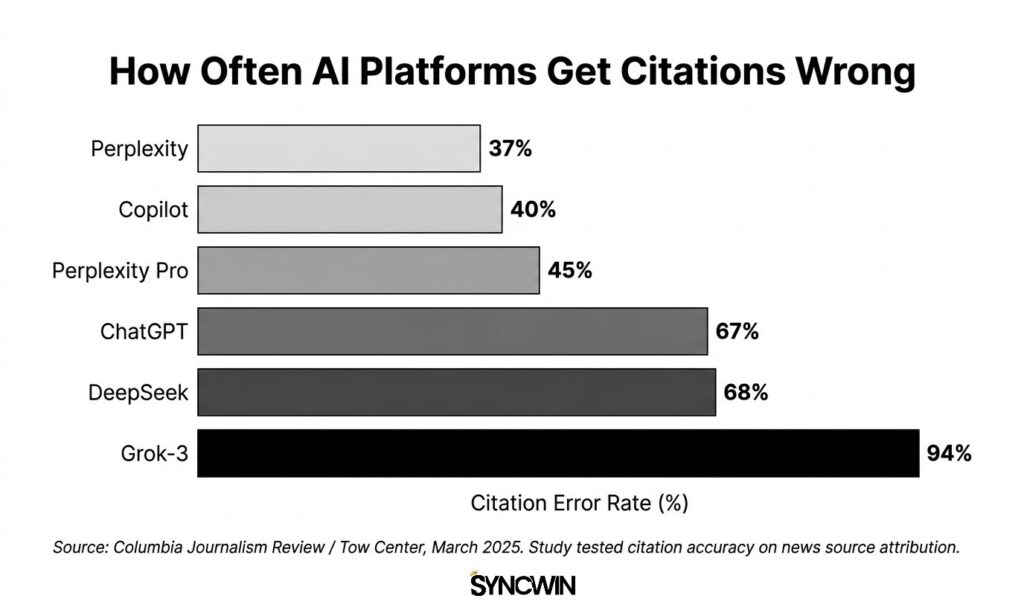
- ChatGPT’s citation error rate in the same CJR study: 67%. Perplexity at 37% was the best performer. Grok-3 was the worst at 94% (Columbia Journalism Review, March 2025)
- Google AI Overviews apply a hard E-E-A-T filter before a single source is cited. Passing that filter is the price of entry.
- 55% of AI Overview citations come from the first 30% of a page. If your answer is buried, it will not be cited (CXL study, March 2026).
- Claude, in its standard interface, now browses the web by default and is more reliable for factual information than offline ChatGPT
- AI hallucinations are real, documented, and have caused serious harm in legal, medical, and business contexts
- The content signals of all six platforms’ rewards are nearly identical: authority, structure, factual density, and topical depth
What RAG Actually Is (& Why It Matters for Your Business)
Before getting into how each platform works, there is one concept worth understanding clearly: Retrieval-Augmented Generation, or RAG.
Here is the plain-language version:
When you ask an AI a question, it has two options. It can answer from its training data alone (what it already “knows”), or it can go fetch current information from the web before answering. RAG is the second approach: retrieve relevant documents, then generate a response grounded in that retrieved content.
Think of it like the difference between asking a friend a question from memory versus asking them to look it up first and then answer you. The second approach produces more accurate and current answers because the model is grounding its response in real documents rather than recalling patterns from training.
You have probably used RAG without realizing it. When you create a Custom GPT in ChatGPT, upload documents to a Claude Project, build a Gem in Gemini, or set up a knowledge base in Perplexity Spaces, you are implementing a form of RAG. You are giving the model a curated set of documents to reference before it responds.
This is exactly what enterprise companies use to build internal AI assistants that answer questions about their own products without hallucinating. If you want to build a custom RAG system for your business, tools like n8n make this accessible without requiring a developer.
For content creators and small businesses, RAG is the reason why structuring your content for extraction matters. If the AI retrieves your page during its fetch phase and the answer is clearly stated near the top, you get cited. If the answer is buried in paragraph seven of a long narrative, the retrieval system moves on to the next result.
The Two Modes Every Business Needs to Understand
Before looking at individual platforms, there is a foundational distinction that affects everything.
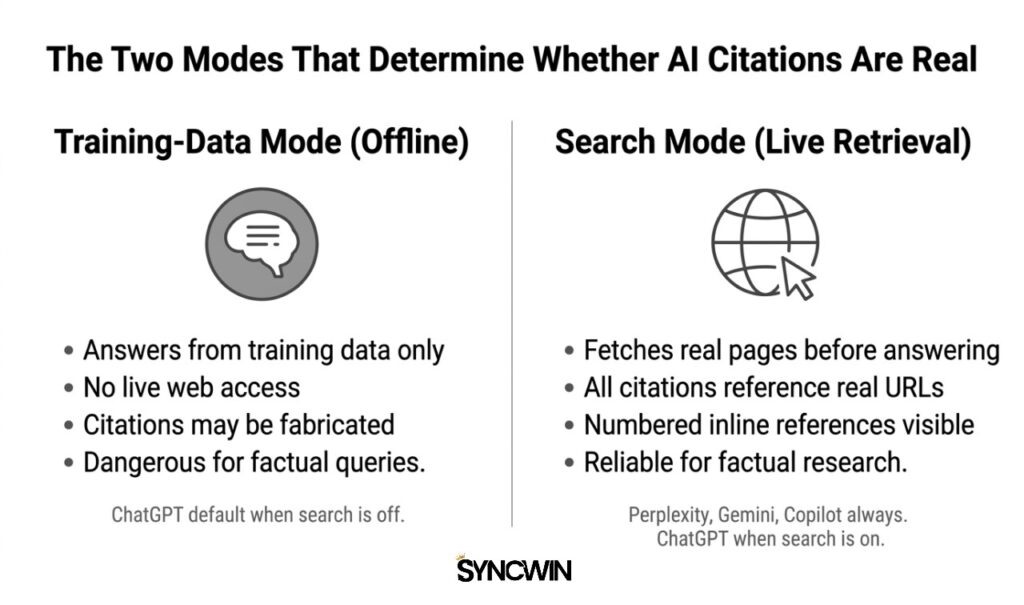
AI platforms fall into two operating modes:
Training-data mode (offline): The model answers entirely from what it learned during training. No live web access. No real citations. If you ask for sources, the model often produces ones that sound plausible but do not exist, because it was trained to mimic citation patterns, not to verify them. This is where the well-documented hallucination problem lives.
Search mode (live retrieval): The model fetches current pages from the web before generating its response. Citations reference real, retrievable URLs. The answer is grounded in content that exists.
Most of the dangerous AI misinformation that has circulated in recent years, including in legal, medical, and business contexts, came from training data mode being used for factual queries. More on that below.
For a small business trying to appear in AI citations, search mode is the only mode that matters. Content that earns citations is content that gets retrieved during the live search phase.
How Each Platform Decides What to Cite
Google AI Overviews
Google AI Overviews use what researchers have described as a multi-stage pipeline. It starts with query fan-out: Google decomposes a user’s question into multiple sub-queries and runs all of them simultaneously, pulling hundreds of candidate pages. From that pool, a series of filters narrows the results down to the 5-15 sources that appear in the final overview.
The critical filter in Google’s pipeline is E-E-A-T: Experience, Expertise, Authoritativeness, and Trustworthiness. This is a hard gate. Pages that do not pass this filter are excluded before any further ranking occurs. Once through, the Gemini model re-ranks the remaining pages at the passage level, selecting the specific sentences or paragraphs most relevant to the query. Those passages are then fused into the synthesized response with inline citations.
One finding from citation analysis stands out: 55% of Google AI Overview citations come from the first 30% of a page. The answer that appears near the top of your content is the answer most likely to be cited. Content buried deep in a long article is rarely surfaced, regardless of how good it is. This is exactly why the AEO implementation checklist recommends placing a 40-60 word answer capsule at the top of every key section: that is where the retrieval system looks first.
What Google prioritizes:
- Pages already ranking in the top 10 organic results carry a significant citation advantage
- E-E-A-T signals: named authors, verifiable credentials, original research, primary sources
- Answer-first content structure: the direct response to the question within the first 150 words
- Schema markup that labels content types explicitly (FAQPage, HowTo, Article)
- Freshness: recently updated pages outperform outdated ones for time-sensitive queries
Perplexity AI
Perplexity is built around one core promise: every answer comes with cited sources, every time. No offline mode. No training-data-only responses. Every query triggers a live search, and the citations are embedded into the answer before generation begins.
The pipeline behind this has been reverse-engineered by independent researchers and consists of six stages: query parsing, initial retrieval using both keyword matching and semantic embeddings, multi-layer re-ranking, authority and freshness filtering, prompt assembly with pre-embedded citation markers, and final generation. Each stage filters the candidate set further. A page that never survives the early retrieval phase will never be cited, regardless of how authoritative it is.
The most important finding from Perplexity’s pipeline analysis: retrieval quality is the primary bottleneck, not the language model’s capability. The quality of sources determines the quality of the answer. If your content does not make it through the retrieval filters, it simply does not exist in that response.
In my own research workflow, I find Perplexity to be among the most reliable platforms for factual information, alongside Gemini. The reason is the same: both are doing live retrieval on every query, and both surface their sources visibly, which makes it easier to verify claims.
What Perplexity prioritizes:
- High domain authority and freshness (Perplexity explicitly scores recency in its filters)
- Clear, scannable structure: headings, summaries, bullet points that make claims extractable
- Pages that make direct, verifiable factual claims rather than vague opinion content
- Standard SEO fundamentals: crawlability, fast load times, proper indexation
Note: Independent audits found Perplexity’s error rate (cases where citations do not fully support the generated claim) as high as 37%. This is not a reason to dismiss the platform, but it is a reason to verify important claims rather than accepting AI output at face value.
ChatGPT (OpenAI)
ChatGPT requires more explanation than the others because its behavior depends entirely on which mode is active.
Offline mode (no web search): ChatGPT answers from its training data. If you ask for citations, it will produce sources that sound real but may not exist. It was trained on text that includes citations, so it has learned to produce citation-style outputs even when it is fabricating them.
OpenAI’s own documentation confirms: “ChatGPT responses that use search will contain inline citations.” The inverse is also true: responses without search will not contain reliable citations.
Search mode (web retrieval active): When the web search feature is enabled, ChatGPT issues real queries, retrieves real pages, and embeds real citations into its response. The presence of clickable numbered references like [1], [2] in the answer indicates that retrieval occurred. If those reference markers are absent, the answer came from training data only.
By default, recent versions of ChatGPT automatically trigger a web search for queries about current events, factual data, or when the user asks for sources, as per OpenAI’s official documentation.
For a small business owner, the safe habit is to check whether the answer includes visible, clickable citations before treating any ChatGPT response as factual.
In my experience, this is where the most dangerous trust problem lives. Non-technical users, particularly older demographics who are less familiar with how these platforms work, often have no way of knowing whether a response came from live retrieval or offline generation.
When ChatGPT confidently states something that is simply wrong, many people believe it.
What ChatGPT prioritizes (in search mode):
- Pages with strong brand presence across Wikipedia, Reddit, LinkedIn, and established publishers
- Named entities and structured content that the Bing index can crawl and rank
- Content that directly answers the specific sub-queries ChatGPT issues during retrieval
- Bing indexation is essential: ChatGPT’s search mode relies on the Bing index for real-time retrieval. If your site is not indexed in Bing, it will not appear in ChatGPT search citations.
Google Gemini
Gemini is Google’s AI assistant and the model powering both AI Overviews and Google’s standalone AI experience. It is deeply integrated with Google’s existing search infrastructure, which gives it access to a vast, continuously updated web index.
In my experience, Gemini consistently produces among the most factually accurate AI responses, with fewer unsupported claims than most other platforms. The reason is structural: Google’s index is the largest and most frequently crawled in the world, and Gemini inherits that retrieval quality.
Gemini also integrates with Google’s Knowledge Graph, which means it has an entity-level understanding of businesses, people, places, and products.
For a small business, this means that a well-structured Google Business Profile, consistent NAP data across directories, and Organization schema on your website all feed directly into how Gemini understands and represents your business.
What Gemini prioritizes:
- Google’s existing organic ranking signals: domain authority, backlinks, Core Web Vitals
- Google Business Profile completeness and review sentiment for local queries
- Multi-modal content: Google consistently surfaces YouTube alongside text sources. A well-structured video with a clear transcript improves Gemini citation odds.
- E-E-A-T at the entity level: the credibility of the author and the business matters as much as the credibility of the page
Microsoft Copilot
Microsoft Copilot always performs live web search. There is no offline mode for general queries. Every response comes with clickable citations drawn from the Bing index, and Copilot makes its sources visible in a dedicated panel beside the response.
For factual research, I rank Copilot as my second preference behind Gemini and Perplexity. The live retrieval is consistent, the source transparency is better than most platforms, and the Bing integration means it surfaces a broad and frequently updated set of sources.
For a small business, Bing indexation is more important than most people realize.
ChatGPT’s search mode, Microsoft Copilot, and a growing number of enterprise AI tools all rely on Bing’s index as their primary retrieval source. A site that appears in Google but is absent from Bing is invisible to this entire category of AI citations.
What Copilot prioritizes:
- Bing index presence and authority (this is the primary retrieval source)
- News and editorial content: Copilot has a measurable bias toward recent news and journalism, reflecting Bing News integration
- Clear, structured answers near the top of pages
- The same technical SEO fundamentals that help with Google: crawlability, schema, and fast load times
Claude (Anthropic)
Claude’s citation behavior has evolved. In standard use, Claude now browses the web by default and provides more reliable factual responses than offline ChatGPT.
This is consistent with my own experience: Claude is generally more careful about distinguishing what it knows from what it is uncertain about, and the interface makes its limitations clearer when web access is not available.
Where Claude differs from the other platforms is in its “Citations” feature. When you provide Claude with documents directly (through a Project, uploaded files, or the API), Claude can cite specific passages from those documents with exact source locations.
This is a form of RAG you control directly: you supply the knowledge base, and Claude cites within it. This is excellent for internal business applications, but less relevant for a small business trying to appear in public AI answers.
For the purposes of getting your content cited in Claude’s web-retrieved responses, the same principles apply as with the other platforms: be crawlable, be structured, provide direct answers early, and maintain topical authority.
What Claude prioritizes:
- Carefully sourced, factual content: Claude is explicitly tuned to avoid unsupported claims, which means it favors content that cites its own sources
- Structured, modular paragraphs that can be extracted and cited at the passage level
- Named authors with verifiable expertise
- Content that does not rely on promotional language, which Claude’s quality filters tend to discount
The Master Comparison: How All Six Platforms Differ
| Platform | Retrieval Method | Always Cites? | Primary Index | Citation Style | Best Suited For |
|---|---|---|---|---|---|
| Google AI Overviews | RAG + E-E-A-T filter + Gemini re-ranking | Yes | Google Search Index | Inline, expandable panel | Broad informational and local queries |
| Perplexity AI | Six-stage RAG pipeline, always live | Yes | Open web + semantic index | Numbered footnotes, always visible | Research and comparative queries |
| ChatGPT (search mode) | Bing-based retrieval when activated | Only in search mode | Bing index | Numbered inline references [1], [2] | Conversational queries, recent events |
| ChatGPT (offline) | Training data only | No (hallucination risk) | Internal weights | Fabricated or absent | Should not be used for factual claims |
| Google Gemini | Google index + Knowledge Graph | Yes | Google Search Index | In line with source cards | Factual, multimodal, local queries |
| Microsoft Copilot | Bing Live Search, always on | Yes | Bing index | Sidebar citation panel | Current events, business research |
| Claude (standard) | Web browse by default, doc-level RAG | Yes (with caveats) | Web + uploaded docs | Passage-level citations from documents | Writing assistance, document analysis |
The Content Signals All Platforms Reward
Despite their different pipelines, every platform above rewards the same core content qualities. This is the list that matters for your AEO strategy.
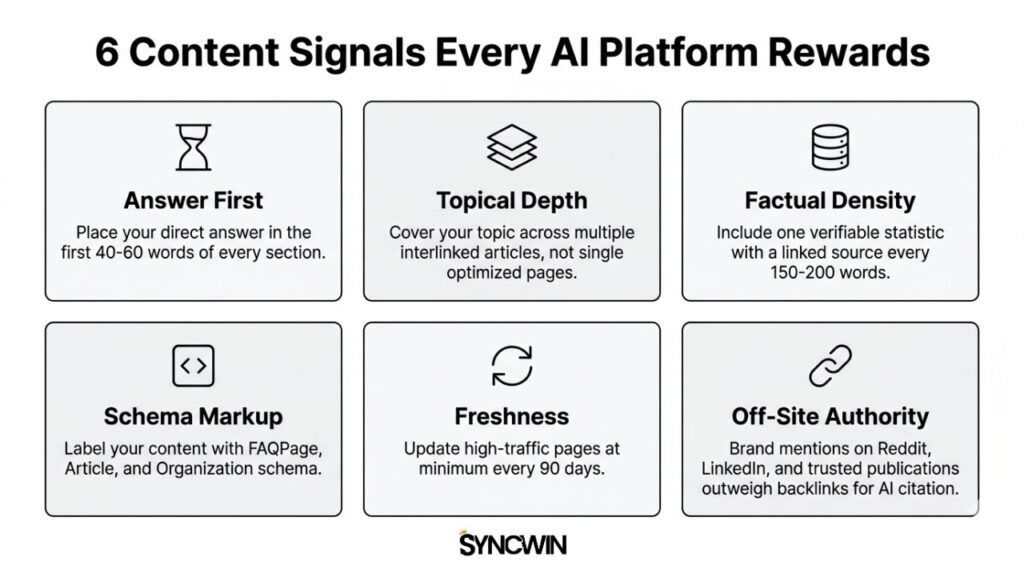
1. Answer-First Structure
Every platform’s retrieval system has been shown to favor content positioned early on a page. The 55% finding from Google AI Overviews (citations coming from the first 30% of page content) is not unique to Google. ChatGPT citation analysis found the same “ski jump” pattern: answers near the top get cited; answers buried deep do not.
The practical response is simple: write a direct, 40-60-word answer at the top of every major section. This is what AI retrieves. Everything below it is the depth that builds human credibility and long-term authority.
2. Topical Authority & Depth
AI engines are increasingly building implicit knowledge graphs. A site that consistently covers a topic across multiple, interlinked articles earns a level of entity trust that a single well-optimized page cannot replicate. This is why topic clusters matter as much for AEO as they do for traditional SEO.
The AEO fundamentals cluster on SyncWin is structured with this in mind: each article covers one specific question deeply, links naturally to related articles, and collectively builds the topical authority that signals expertise to every AI retrieval system.
3. Factual Density & Cited Sources
Content that includes specific, verifiable statistics and cites the original sources is significantly more likely to be retrieved and cited by AI. The reason is mechanical: AI retrieval systems score content on “information certainty.”
A deterministic, sourced claim (“Google AI Overviews now appear in 25% of US searches, per Semrush March 2026”) scores higher than a vague assertion (“AI Overviews are becoming more common”).
4. Schema Markup
FAQPage, HowTo, Organization, Article, and LocalBusiness schema all provide machine-readable labels that tell AI crawlers what your content is.
Pages with comprehensive schema are significantly more likely to earn citations than identical pages without it. Schema does not improve your content quality. It makes your content quality legible to machines.
5. Freshness
For time-sensitive queries, all six platforms favor recently updated content. Perplexity and Bing explicitly score freshness in their retrieval filters. Google’s recency bias is well-documented in its documentation.
A page that has not been updated in 12 months is at a structural disadvantage for any query where current information matters.
The quarterly content refresh recommended in the AEO implementation checklist is not administrative maintenance. It is a direct citation signal.
6. Authority & Off-Site Presence
Brand mentions on authoritative third-party platforms (Reddit, Wikipedia, LinkedIn, and industry publications) correlate significantly with AI citation frequency across all major platforms.
For Google AI Overviews and Gemini, domain authority derived from backlinks remains a strong signal. For ChatGPT and Copilot, Bing authority matters. For Perplexity, freshness, and direct crawlability weigh more than accumulated link authority.
This is why the AEO vs SEO comparison consistently makes the point that off-site presence is not an optional layer. It is one of the primary signals that tells AI systems whether a source is trustworthy enough to cite.
When AI Gets It Wrong: Hallucinations Are Real & Documented
Knowing how AI platforms decide what to cite also requires understanding what happens when the system fails. Hallucinations are not rare edge cases. They are a documented, ongoing problem with measurable consequences.
A Nature study analyzing AI-generated medical answers found that 50 to 90% of responses contained statements not fully supported by the cited sources, even when web search was active. The citation appeared real. The claim was not supported by what the citation actually said.
Beyond medical research, several high-profile cases have illustrated what happens when AI hallucinations meet real-world decisions:
The lawyer who submitted fake cases: In 2023, New York attorney Steven Schwartz submitted a legal brief containing citations to six court cases that did not exist, all of which were generated by ChatGPT. Schwartz told the court he had been unaware that ChatGPT could fabricate legal citations. The case resulted in sanctions and became one of the most widely cited examples of AI hallucination causing professional harm. (CNBC, June 22, 2023)
Google’s AI Overview told users to put glue on pizza: In May 2024, Google’s AI Overviews told users that adding “non-toxic glue” to pizza sauce would help the cheese stick. The answer was traced to a satirical Reddit post from 2013 that the system had treated as factual. Google removed the response and acknowledged the failure. (BBC, May 2024)
ChatGPT invented a sexual misconduct claim: In 2023, ChatGPT falsely accused American law professor Jonathan Turley of sexual misconduct on a trip to Alaska, complete with a fabricated Washington Post article as the citation. The Washington Post article did not exist. The trip did not happen. (Washington Post, April 2023)
These are not isolated incidents. They reflect a structural characteristic of how AI language models work: they are optimized to produce fluent, confident-sounding outputs, not to guarantee factual accuracy.
For a small business owner, the practical lesson is straightforward. Use platforms that perform live web retrieval for any query where factual accuracy matters.
Gemini, Perplexity, and Copilot are my first choices for research because of their live retrieval and visible citations, although I always cross-verify data because sometimes they produce inaccurate citations.
Claude’s default web browsing makes it more reliable for factual queries than offline ChatGPT. Whatever platform you use, check the sources before repeating the claim.
This is also why I believe non-technical and older demographics face a real risk from AI misinformation.
Many people do not know the difference between a response from offline ChatGPT and one from Perplexity. Both produce confident, well-formatted answers. Only one reliably cites real sources. That gap in understanding has consequences.
What This Means for Your Content Strategy
Understanding how AI citation pipelines work makes the practical actions obvious.
Structure every page for the retrieval phase, not the reading phase.
The AI that decides whether to cite your content is not reading it the way a human does. It is scanning for extractable answers near the top, verifying the page’s authority signals, and checking whether the claims are specific and sourced.
Understanding what AEO is helps clarify exactly what “structured for retrieval” means in practice.
Make sure Bing can find you. A significant share of AI citations across ChatGPT and Copilot comes from the Bing index.
Submit your sitemap to Bing Webmaster Tools if you have not already, and check that OAI-SearchBot, PerplexityBot, Google-Extended, and ClaudeBot are not blocked in your robots.txt.
Build topical authority, not single-page optimization. Every platform rewards sites that cover a topic consistently across multiple interlinked pieces.
One perfectly optimized page is less likely to be cited than a site that has covered the same topic from multiple angles over time. This is one of the reasons AEO, GEO, and LLMO all point toward the same content strategy, even though they target different platforms.
Treat freshness as an ongoing responsibility.
Perplexity and Bing explicitly score recency. Google’s freshness signals are well-documented. A page that has not been touched in a year is at a measurable disadvantage for queries where current information matters.
Verify before you repeat. The hallucination problem is not solved. It is managed. Even the most reliable platforms produce unsupported citations at meaningful rates.
Any AI-generated claim that matters to a real decision should be verified at the primary source before it is acted on or repeated. This applies equally to claims about your competitors, your industry, and your own business.
Understanding why zero-click behavior is rising and why AI citations matter for visibility is the business case behind all of this. That context is covered in full in the zero-click search guide if you want the economic picture before diving deeper into citation strategy.
Frequently Asked Questions
What is RAG, and why does it matter for AI citations?
RAG stands for Retrieval-Augmented Generation. It is the method AI platforms use to fetch real documents from the web before generating a response.
Without RAG, an AI answers from training data alone, which means citations may be fabricated.
With RAG, the AI retrieves current pages, grounds its response in that content, and cites the real URLs it used.
Platforms like Perplexity, Google AI Overviews, Gemini, and Copilot all use RAG on every query. ChatGPT uses it only when search mode is active.
Why does ChatGPT sometimes cite sources that don’t exist?
When ChatGPT’s web search is not active, it answers from training data alone. It was trained on billions of text samples that include academic papers, articles, and citations, so it has learned to produce citation-style outputs even when it is not retrieving any real sources.
The citations it generates in this mode often sound plausible but do not exist. This is a well-documented limitation. The fix is simple: make sure web search is active before asking ChatGPT for factual information or sources.
Which AI platform is most reliable for factual information?
Based on my own research experience, Gemini and Perplexity consistently produce the most accurate factual responses with the fewest unsupported claims. Both perform live web retrieval on every query and make their sources visible.
Microsoft Copilot is my second preference for the same reason: always-on live search and visible citations. Claude, with default web browsing enabled, is more reliable than offline ChatGPT.
For any high-stakes factual query, verify the primary source regardless of which platform you use.
Does my content need to rank on Google to be cited by AI platforms?
For Google AI Overviews and Gemini, there is a strong correlation between organic ranking and citation frequency.
For Perplexity, freshness, and structural clarity matter more than ranking position.
For ChatGPT and Copilot, Bing indexation and authority matter independently of Google ranking.
Practically speaking, strong SEO is still the most reliable path to AI citation across all platforms, but ranking first on Google is not a guarantee of citation, and not ranking first does not exclude you.
How do I know if my content is being cited by AI platforms?
Test manually: search your core queries in ChatGPT, Perplexity, Google with AI Overviews enabled, and Gemini. Document whether your business or content appears.
Google Search Console now reports AI Overview traffic separately, which gives you a measurable signal.
For more structured tracking, tools like Semrush and Profound monitor citation frequency across platforms.
What is the most important thing I can change on my website today to improve AI citation rates?
Add a 40-60-word direct answer at the top of every major page section.
That single structural change directly addresses the most consistently documented pattern across all AI citation research: answers positioned early on a page are cited far more frequently than identical answers positioned later.
Pair this with the FAQPage schema, and you have covered the two highest-leverage AEO actions available without a full content rewrite.
The AEO implementation checklist covers the full sequence from this starting point.
Is it possible for AI to cite my content inaccurately?
Yes.
Research has documented cases where AI platforms cite a real URL but generate a claim that the cited source does not actually support. This happens across all RAG-based platforms at varying rates.
The Columbia Journalism Review’s 2025 study tested eight AI platforms on citation accuracy and found collective failure rates across all of them: Perplexity performed best at 37%, ChatGPT at 67%, and Grok-3 at 94%. Even the best performer got it wrong more than one in three times.
The implication for businesses: even being cited by AI does not guarantee that the AI’s characterization of your business or content is accurate. Run quarterly brand audits by prompting AI platforms with questions about your business and verifying the responses against your actual content.
Conclusion
AI citation is not random. It follows a logic, and that logic is learnable.
Every major AI platform retrieves content before it generates a response. The platforms that do this consistently (Perplexity, Gemini, Copilot, Claude) produce more reliable answers than those that do it conditionally (ChatGPT). All of them apply similar filters: authority, structure, factual density, freshness, and answer-first positioning.
The businesses that understand this are already adapting. They are structuring their pages for retrieval, not just for reading. They are building topical authority across clusters of interlinked content, not optimizing single pages in isolation. They are maintaining consistent, verified entity data across every platform where AI systems look for business information.
The hallucination problem is real and is not fully solved. That makes source verification a permanent responsibility, not a temporary workaround. Use platforms that show their sources. Check those sources. Do not repeat AI-generated claims that affect real decisions without verifying the primary reference.
The full framework for making your content consistently citable is covered across this topic cluster. Start with what AEO is and how it works, understand how AEO relates to SEO before changing anything, and follow the AEO implementation checklist when you are ready to apply it to your own site.
Drop any questions in the comments. I read everyone.
Running a business outside India and want help making your content consistently citable across AI platforms? SyncWin works with small businesses globally on AEO strategy, schema implementation, content restructuring, and AI visibility setup. Get in touch with SyncWin, and we will start with an honest assessment of where your content stands.
Based in Kolkata or West Bengal? We work directly with local businesses on complete AEO implementation at local rates. Contact SyncWin for local SEO and AEO services.