
Vector embeddings are numerical representations of meaning. Search engines convert your content into numbers to match any query by intent, not by exact wording. This explains why content built around genuine answers outperforms keyword-heavy pages, and why zero-click search now affects most queries before anyone clicks.
Key Highlights
- Modern search engines match meaning via numbers, not exact characters. Keyword density alone no longer determines rankings.
- Google built semantic search through three updates: RankBrain (2015), BERT (2019), and MUM (2021).
- BERT improved relevance for roughly one in ten English-language searches at launch.
- MUM is approximately 1,000 times more capable than BERT and processes over 75 languages simultaneously.
- Pages with schema markup are 3x more likely to appear in AI Overview citations than pages without it.
- AI-referred visitors convert 31% higher than standard organic visitors, per Adobe’s January 2026 data.
- India has the highest global AI adoption rate at 73%. The first-mover AEO window is open right now.
- Content structured with direct answer capsules earns AI citations. Keyword density alone does not.
What Is a Vector Embedding?
A vector embedding is a list of numbers representing the meaning of a word, sentence, or page. Neural networks learn these number patterns from large volumes of text during training. Content with similar meaning ends up with similar numbers, which is how search engines find relevant results even when exact words never overlap.
Search engines do not read your content as text. They convert the meaning of your page into a numerical map.
Every word, phrase, and idea gets mapped to a position in a shared mathematical space. Similar topics cluster closely.
When someone runs a search, the query gets converted into the same type of numerical map. The engine finds the closest match.
Vector matching is why “comfortable sneakers” and “cushioned running shoes” now return overlapping results.
How Did Search Go From Keywords to Meaning?
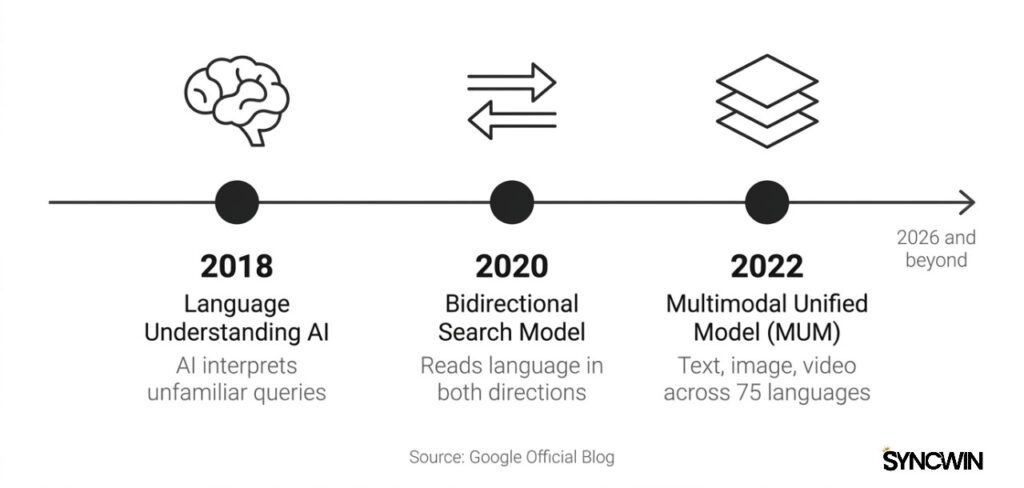
Google shifted from exact character matching to semantic understanding through three algorithm updates: RankBrain in 2015, BERT in 2019, and MUM in 2021. Each update moved the search further from matching typed words and closer to reading intent. Understanding this progression explains why content strategy changed fundamentally and why keyword-stuffed pages continue to lose ground.
What did RankBrain change in 2015?
RankBrain was Google’s first AI-powered step into semantic search, launched in 2015.
RankBrain mapped unfamiliar queries to known concepts by learning from existing search behavior patterns.
RankBrain also started reading behavioral signals: dwell time, return clicks, and post-click engagement.
What did BERT change in 2019?
BERT launched in October 2019 and read language bidirectionally across full sentences for the first time.
Earlier models processed queries left to right. BERT read every word in relation to every other word around it.
Google confirmed BERT improved relevance for roughly one in ten English searches immediately at launch.
The word “to” in “flights from India to the USA” is directional. Before BERT, search treated that word as noise.
What did MUM change in 2021?
MUM launched in 2021 and processes text, images, and video across more than 75 languages at once.
Google described MUM as approximately 1,000 times more capable than BERT at understanding context and intent.
A business in Kolkata publishing Bengali content can now surface for English-language queries through MUM’s cross-language synthesis.
A Hindi-language product comparison from a Mumbai retailer can directly inform an English-language buyer’s search in Chicago.
What Is the Strings vs Things Shift in Search?
In 2012, Google described a fundamental change in how it intended to understand the web. The goal, stated plainly in Google’s Knowledge Graph announcement, was to move from “strings to things.”
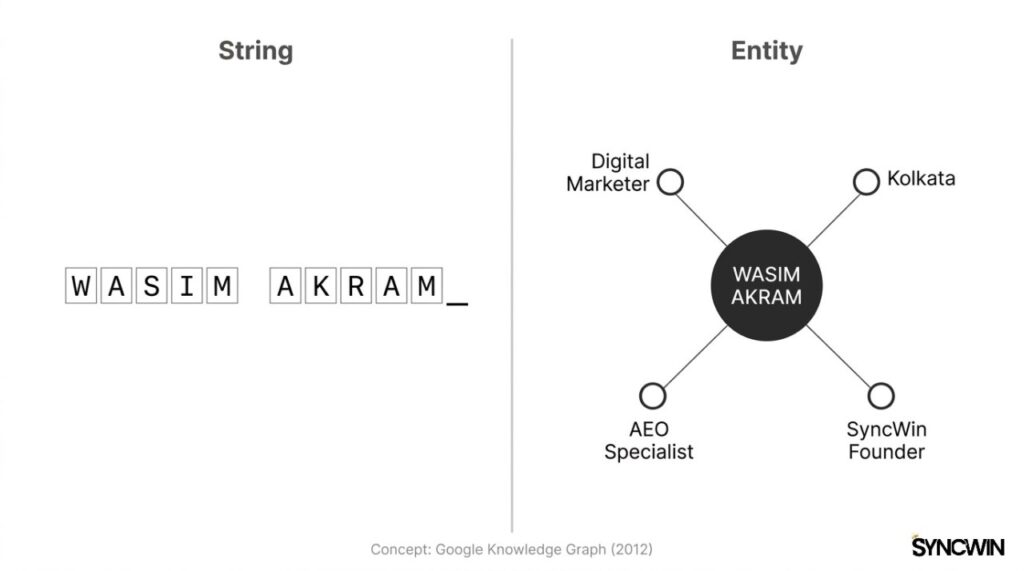
A string is a sequence of characters. A thing is a real-world entity with attributes, relationships, and verifiable context.
Vector embeddings are the technical mechanism that made this entity model possible at scale. Your business is now evaluated as an entity, not a collection of keywords on a page.
Typed into a search box, “Wasim Akram” is eleven characters and a space. Treated as a thing, “Wasim Akram” is a person, a digital marketer, the founder of SyncWin, someone based in Kolkata, someone whose work connects to WordPress and AEO. One interpretation sees letters. The other sees an entity with real attributes and relationships.
For a small business, this distinction is everything. A boutique accounting firm in Houston and a digital consultancy in Salt Lake City are not just websites with keyword-stuffed pages. They are entities with names, locations, services, reviews, and reputations.
The clearer that an entity is defined across the web, the more accurately search engines and AI tools can represent and recommend it.
Why Do Vector Embeddings Matter for AI Answer Engines?
AI platforms like ChatGPT, Perplexity, and Google Gemini use vector search to decide what to cite in their responses. Each platform finds the passage most closely matching the meaning of a query, then extracts it as a direct answer.
Pages structured around clear, self-contained answer passages earn citations consistently. Pages built only around keyword density get passed over at the extraction stage.
AI platforms decide citations by finding the closest semantic match to a query’s actual intent.
A page packed with keywords but no clear answer passage gets skipped during the extraction step entirely.
The AEO implementation checklist defines these as answer capsules: 40-60-word paragraphs placed directly below each heading.
Answer capsules are what AI systems extract. Supporting paragraphs below them are for human readers and depth.
Zero-click search means most queries get answered before anyone clicks. Getting cited is now the visibility that matters.
Pages with schema markup are 3x more likely to appear in AI Overview citations than equivalent pages without it.
How is Semantic Search Different From Keyword Search?
Semantic search and keyword search operate on fundamentally different logic. One matches characters. The other matches the meaning. The table below shows what changed and why it affects how you build content.
| Factor | Keyword Search | Semantic Search |
|---|---|---|
| How does it read content | Matches exact characters | Matches meaning via vector proximity |
| How does it read the content | Manual mapping only | Automatic via embedding similarity |
| Conversational queries | Struggles to interpret | Handles naturally |
| What it rewards | Keyword frequency and density | Topical depth and clear answers |
| Core business implication | Write for the algorithm | Write for the question being asked |
| AI citation impact | Low without semantic structure | Direct path to extraction and citation |
The Connection to AEO and AI Answer Engines
Semantic search is the foundation that AEO (Answer Engine Optimization) is built directly on top of.
When ChatGPT, Perplexity, or Google AI Overviews generate a response, they do not run a keyword search. They pull from a semantic index, identify content that carries the right meaning for the query, and extract the most clearly structured, self-contained answer available.
The way AI platforms decide which sources to cite follows the same logic: proximity of meaning, clarity of structure, and consistency of the entity behind the content.
The difference between AEO and traditional SEO is partly a difference in how you think about what you are building. Keyword SEO treats content as a targeting exercise. AEO treats content as an entity-building exercise where clarity, structure, and semantic depth are the competitive advantages.
This is also why zero-click search behavior has accelerated. AI tools answer questions directly because semantic search gives them the confidence to pull a passage and present it as a complete answer. Your job is to be the passage they pull.
What This Means for Your Content and Business
Define your entity clearly across every platform.
Your business name, location, services, and core attributes should be stated consistently across your website, Google Business Profile, and every directory listing you hold. Search engines build their understanding of what your business “is” from all of these signals together. Inconsistencies create ambiguity in the entity layer, and ambiguity hurts citation rates.
Build topical depth instead of keyword coverage.
A single well-covered topic cluster signals to semantic search that your business is an authority in that area. A page about “accountancy services for small businesses in Kolkata” supported by related pages on GST filing, bookkeeping basics, and audit preparation is a stronger semantic signal than ten separate pages each targeting a different keyword with no connecting thread.
Write answers first, context second.
Every section of your content should answer a specific question clearly within the first sentence or two. This is not just readable writing. It is how semantic search systems extract content and how AI engines decide what to cite. The AEO implementation checklist covers the full structural requirements in detail.
Use schema markup to confirm your entity.
JSON-LD structured data is the most direct way to tell a search engine exactly what your business is. Organization, LocalBusiness, FAQPage, and Person schema give the system explicit, machine-readable confirmation of your entity’s attributes. For businesses in India, adding location-specific schema with pin codes and neighborhood references helps AI systems answer hyperlocal queries accurately.
Take your regional language seriously.
With MUM processing more than 75 languages and improving constantly for morphologically complex scripts like Bengali and Hindi, Indian businesses have a genuine opportunity that most competitors have not touched. A business in Gariahat publishing structured Bengali content about their services is not just reaching local Bengali readers. They are building a semantic presence in a space that is genuinely undercrowded and growing in AI search relevance.
FAQs About Vector Embeddings in SEO
What is a vector embedding in plain terms for a small business owner?
A vector embedding is a list of numbers representing what a piece of content means rather than what characters it contains.
Neural networks assign similar number patterns to similar-meaning content during training.
This is the foundation of semantic search and why a query and a page no longer need identical wording to match and rank together.
Do I need to understand the math behind vector embeddings to benefit from them?
The mechanics matter less than the practical implications. Write content that directly answers a specific question. Structure each section with the answer first, context second.
Maintain consistent entity information across GBP, directories, and schema markup. That is the complete practical output of how vector embeddings work in search, no equations needed.
What is the difference between semantic search and keyword search for local businesses?
Keyword search matches exact characters. Semantic search matches meaning via vector proximity.
A page about “GST filing for small businesses in Kolkata” can now rank for “tax help for local businesses in Bengal” because the vector meaning is close, even though the words differ.
Depth and specificity now matter more than keyword placement.
How do vector embeddings connect to AEO and AI citations?
AEO is built directly on top of semantic search.
AI engines use vector matching to identify the best answer passage for any query. Structuring your content with answer capsules, question-format headers, and FAQPage schema puts your content in the extraction path.
The difference between AEO and traditional SEO comes down to this: one targets rankings, the other targets citations.
Why did Google build BERT and MUM specifically?
BERT addressed the vocabulary mismatch problem: the gap between the words users type and the words documents use.
MUM extended this across multimodal and multilingual queries.
Both were built because keyword-based systems could not serve the natural, conversational way people actually search.
India, with a 73% AI adoption rate and growing voice search in regional languages, is one of the clearest real-world examples of why this evolution mattered.
What is the strings vs things concept & why does it matter for my business?
Google’s 2012 Knowledge Graph announcement described the shift: treat web content as real-world entities with attributes and relationships, not just text strings.
In practice, your business needs a consistent, verified presence across GBP, directories, and schema markup so AI systems can represent it accurately.
How AI platforms decide citations builds directly on this entity model.
How does this connect to GEO and LLMO alongside AEO?
Vector embeddings are the shared foundation under AEO, GEO, and LLMO.
Each targets a different layer of AI-driven search, but all three reward the same content fundamentals: clear answers, consistent entity data, semantic depth, and structured extraction signals like schema and answer capsules.
Conclusion
Vector embeddings are why modern search connects meaning instead of matching characters. The practical shift for small businesses is real: search now rewards content that answers clearly, entities defined consistently across every platform, and pages structured for machine extraction.
The businesses appearing in AI answers today did not get there by chasing an algorithm. They built clean content, correct schema, and a verified entity presence before their competitors did.
The full AEO, GEO, and LLMO breakdown shows how vector embeddings connect across every major AI platform. Start with the foundation before the tactics, and the results compound.
If you want your business to show up where buyers are searching in the USA, getting your semantic structure and entity layer right is the work that compounds over time. SyncWin builds this foundation for small businesses and adds the AEO layer on top. Start the conversation here.
For businesses in Kolkata and across India, the regional language semantic search window is genuinely open, and most local competitors have not moved yet. Reach out to SyncWin and let’s look at exactly where your business stands.