
Google’s Knowledge Graph launched on May 16, 2012, to move search from matching characters to recognizing real-world entities. It started with 500 million entities and now holds over 54 billion. For small businesses, this database controls whether you appear in Knowledge Panels, AI Overviews, and local results. Being a verified entity in the graph is the foundation of search visibility in 2026.
Key Highlights
- The Knowledge Graph launched on May 16, 2012, starting with 500 million entities and 3.5 billion facts (Source: Google Blog, May 2012)
- Google acquired Metaweb and its Freebase database in July 2010, which became the Knowledge Graph’s initial data foundation (Source: Google Blog, July 2010)
- By early 2024, the graph holds an estimated 54 billion entities and 1.6 trillion facts (Source: Kalicube via Offshore Marketers, 2024)
- Bengali language support was added in March 2017, expanding entity recognition for Indian businesses (Source: Wikipedia, Knowledge Graph)
- A verified and active Google Business Profile is the most direct path from an operating business to Knowledge Panel visibility.
- Indian directories like Justdial, IndiaMART, and Sulekha function as entity trust anchors for Google’s verification process in India.
- Knowledge Panels build brand credibility even without a click. Brand recall, not traffic, is the immediate return.
- The Knowledge Graph now grounds every Google Gemini and AI Overview response before it reaches the user.
What Is Google’s Knowledge Graph?
Google’s Knowledge Graph is a database of real-world entities and the relationships between them. It connects businesses, people, places, and concepts into a structured network of facts that Google uses to answer queries directly, generate Knowledge Panels, and verify AI-generated responses. The goal, stated in Google’s 2012 launch announcement, was a move from “strings to things.”
A “string” is a sequence of characters. A “thing” is a real-world entity with attributes, verified relationships, and persistent identity across data sources.
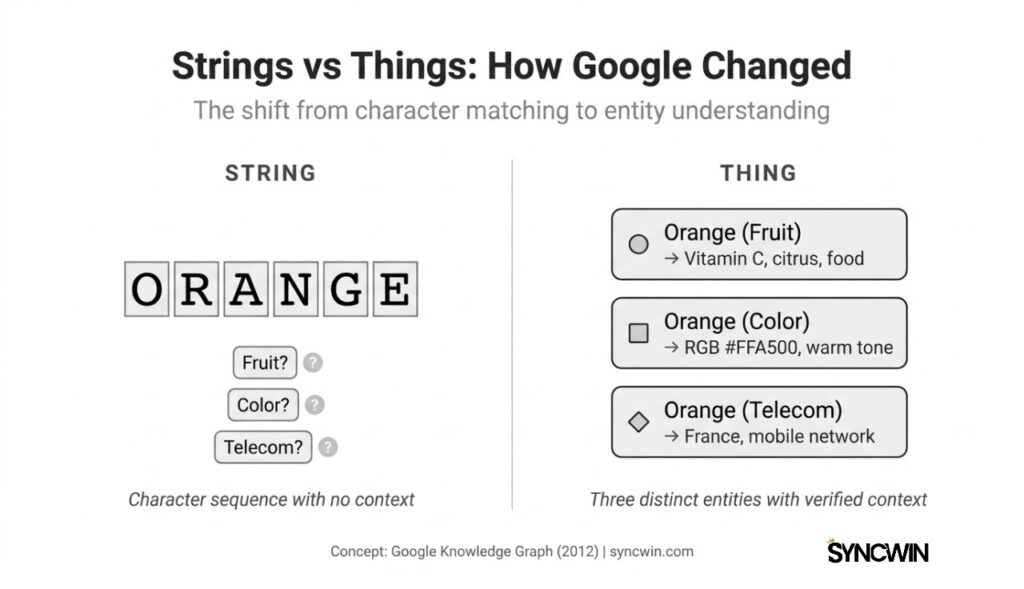
Before the Knowledge Graph, searching “Orange” returned pages containing that word regardless of whether the user meant the fruit, the color, or a telecom brand.
Knowledge Graph entries separate entities by context: each “Orange” is a distinct node with its own attributes and connections.
How vector embeddings work in AI SEO explains the mathematical layer that makes this entity mapping possible at scale.
Semantic search and keyword search operate on fundamentally different logic, and the Knowledge Graph is the data layer that powers the semantic side.
Where Did the Knowledge Graph Come From?
The Knowledge Graph’s foundations trace to Freebase, a collaborative graph-model database built by Metaweb Technologies, a San Francisco startup founded in 2007. Freebase organized real-world entities using stable identifiers called “mids” (Machine IDs), allowing consistent entity tracking across languages and sources.
Google acquired Metaweb on July 16, 2010, and spent the next two years integrating Freebase’s structured data into its search infrastructure alongside facts from Wikipedia and the CIA World Factbook.
| System | Founded | Data Model | Purpose |
|---|---|---|---|
| Freebase | Metaweb (2007) | Graph nodes and edges | Open collaborative entity database |
| Wikidata | Wikimedia (2012) | Structured wiki data | Community-driven open facts |
| Knowledge Vault | Google (internal) | Automated fact extraction | Proprietary web-scale mining |
| Knowledge Graph | Google (2012) | Entity-relationship graph | SERP features and AI grounding |
(Source: SyncWin editorial compilation / Wikipedia Knowledge Graph)
Freebase used graph architecture instead of traditional tables and keys, representing complex, multi-dimensional relationships between entities.
The “mids” system gave Google a way to track the same entity across different languages without confusion or duplication.
Google’s internal “Knowledge Vault” project then extended this by automating fact extraction from across the broader web, not just from curated sources.
What Changed When the Knowledge Graph Launched in 2012?
Google officially launched the Knowledge Graph on May 16, 2012, initially in English in the United States only. The launch introduced the Knowledge Panel, the structured information box that appeared on the right side of desktop search results for recognized entities.
At launch, the Knowledge Graph contained 500 million entities and 3.5 billion facts, described by Amit Singhal as the foundation for understanding “things, not strings.”
A recognized entity gained a permanent information presence in Google that could not be replicated through keyword optimization alone.
A business without entity recognition could rank for keywords, but could not generate the branded presence a Knowledge Panel creates.
By December 2012, within seven months of launch, the graph had grown to 570 million entities and 18 billion facts.
The Knowledge Panel was the public face of the graph. The entity database powering it was the infrastructure that would eventually run AI Overviews.
How Has the Knowledge Graph Grown Over 12 Years?
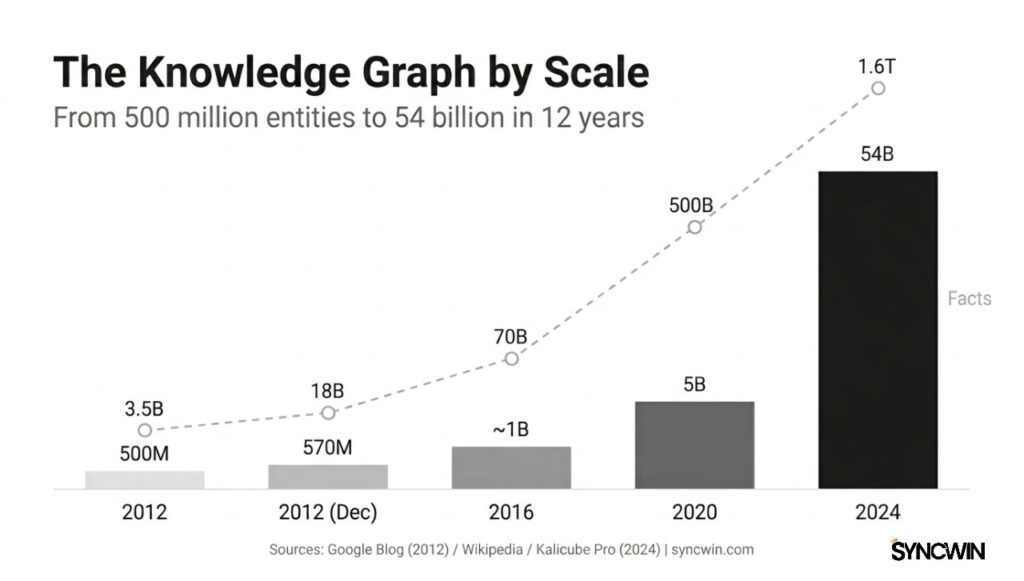
The growth of the Knowledge Graph from 2012 to 2024 reflects a fundamental shift in how Google classifies knowledge. Each milestone below marks a strategic expansion, not just a size increase. From voice search integration in 2016 to generative AI grounding in 2024, every phase changed what entity status meant for businesses.
| Milestone | Entity Count | Fact Count | Strategic Focus |
|---|---|---|---|
| May 2012 | 500 million | 3.5 billion | US English launch; Knowledge Panels introduced |
| December 2012 | 570 million | 18 billion | Multi-language rollout begins |
| Mid-2016 | ~1 billion | 70 billion | Google Assistant integration; voice search |
| May 2020 | 5 billion | 500 billion | AI assistant grounding; Knowledge Vault automation |
| Early 2024 | 54 billion | 1.6 trillion | Generative AI grounding for Gemini and AI Overviews |
(Sources: Google Blog, May 2012 / Wikipedia Knowledge Graph / Kalicube Pro, 2024)
In 2014, Google began transitioning Freebase data to Wikidata and announced Freebase’s eventual shutdown.
The Knowledge Graph Search API launched in December 2015, giving developers a structured way to query entities directly.
Bengali language support arrived in March 2017, a significant milestone for Indian businesses seeking entity recognition.
By early 2024, an estimated 10 billion new entities were added in a single Kalicube-tracked expansion in July 2023 alone, driven by AI-automated ingestion at a scale not previously possible.
How Did Google’s Local Business Tools Evolve Into Entity Management?
While the global Knowledge Graph mapped world knowledge, a parallel evolution shaped how local businesses entered the graph. Google’s local business tools changed five times between 2005 and 2021. Each version pushed small businesses closer to full entity status rather than treating them as simple directory entries.
For most small business owners, this evolution is how they have interacted with the Knowledge Graph, whether they realized it or not.
| Year | Product Name | Key Change |
|---|---|---|
| 2005 | Local Business Center | Basic map listing and address verification |
| 2009 | Google Places | “Place Pages” introduced: first business Knowledge Panels |
| 2011 | Google+ Local | Social signals, photos, and Zagat reviews integrated |
| 2014 | Google My Business | Unified dashboard: search, maps, and social data in one place |
| 2021 | Google Business Profile | Management moved directly into Google Search and Maps |
(Source: Near Media, November 2021)
The 2014 Google My Business launch was the most significant structural change for small businesses, unifying search, maps, and social data into a single interface.
For the first time, a small business could provide structured data directly to the Knowledge Graph without technical SEO knowledge.
The 2021 rebrand to Google Business Profile retired the standalone app and made GBP management part of the core Google Search and Maps experience.
From my own experience with SyncWin: the connection between GBP and Knowledge Panel visibility is direct. SyncWin has a verified, active GBP. When someone searches “SyncWin,” a Knowledge Panel appears consistently with images, social links, and business details. Other brands I have observed without a GBP do not generate a Knowledge Panel, regardless of how established they are.
I recently started serving local clients in Kolkata after years of working with global clients. The entity layer is the first thing I am tracking for every local engagement going forward, because what I have seen with SyncWin has made the connection between GBP completeness and Knowledge Panel generation clear enough to build a process around.
For businesses in Kolkata and across India, local directories function as additional trust anchors for entity verification. Justdial, IndiaMART, and Sulekha carry real weight in how Google builds confidence in an Indian business entity.
Most Indian businesses use these platforms as their primary digital marketing channels because basic listings are free, these directories rank independently on Google SERPs, and local customers actively use them to find and contact businesses.
| Indian Directory | Monthly Reach | Entity Verification Role |
|---|---|---|
| Justdial | 50 million+ | B2C trust signal; primary NAP verification |
| IndiaMART | High | B2B and wholesale entity authority |
| Sulekha | Significant | Professional services and educational queries |
| TradeIndia | Secondary | Manufacturing and trade citation signal |
(Source: Justdial / IndiaMART company data)
Inconsistent NAP data across these platforms, including different street spellings or phone number formats, fragments the entity signal and can suppress Knowledge Panel generation.
Does a Knowledge Panel Actually Help Small Businesses?
A Knowledge Panel gives a business structured visibility in Google Search for branded queries without requiring an additional click. The zero-click debate applies here: if the user does not click, does the panel help? My honest take is that it helps more than most small business owners realize, and the reason has nothing to do with traffic.
When someone searches for SyncWin and sees a well-structured panel with images, reviews, and social links, they form a brand impression before clicking anything.
Brand recall is the return on that impression, and in 2026, brand recall drives purchase decisions as much as search rankings do.
Approximately 59% of Google searches end without a click, as per SparkToro’s 2024 data. A Knowledge Panel makes your brand visible in that 59%.
The user who searches your business name and sees a clean, complete panel is more likely to trust you than one who finds an incomplete or absent result.
The bigger risk for small businesses is the opposite: a competitor with a verified entity presence and a complete panel appearing beside your unverified listing.
What Does the Knowledge Graph Mean for AI Search & AEO Today?
The Knowledge Graph of 2026 is not just a fact database. It is the grounding layer that Google Gemini uses to verify AI-generated responses before they reach users.
When an AI Overview cites a business, it draws from what the Knowledge Graph knows about that entity. Businesses with clear entity definitions, verified profiles, and structured schema get cited. Those with absent or inconsistent entity data get skipped, regardless of how well their pages rank.
How AI platforms decide citations starts with entity verification, not keyword presence.
How AI answer engines are changing SEO in 2026 covers the full shift and what the citation economy means for small businesses specifically.
AEO is built directly on top of the Knowledge Graph: your entity status is the prerequisite, your content structure is the extraction layer.
The difference between AEO and traditional SEO is partly this: traditional SEO competed for keywords, AEO competes for entity authority and citation inclusion.
| Strategic Component | Traditional SEO | AEO & Entity SEO |
|---|---|---|
| Primary goal | Rank a URL in the top 10 | Be cited in AI-generated responses |
| Content format | Narrative keyword-rich pages | Answer-first, machine-readable blocks |
| Technical focus | Keywords and backlinks | Entity schema and fact density |
| Success metric | Organic sessions and clicks | Citation frequency and brand mentions |
| Foundation | Domain authority | Knowledge Graph entity status |
(Source: SyncWin, May 2026)
Is a Multi-Platform Entity Future Coming?
Several regulatory developments between 2024 and 2025 have raised the possibility that businesses may eventually need to manage entity presence across multiple competing search and AI platforms. Whether this fragmentation fully materializes is genuinely uncertain. Here is what the evidence currently says, and the practical conclusion, regardless of how things develop.
An August 2024 US antitrust ruling found Google to be an illegal monopolist in general search.
A December 2025 remedy required Google to shorten default search contracts and share its web search index data with competing services.
In India, the CCI approved a settlement with Google on April 21, 2025, over Android TV licensing practices, requiring Google to offer a standalone Play Store license to smart TV manufacturers and ending restrictions on competing platforms.
ChatGPT Search, Perplexity, and Microsoft Bing are each building independent entity and citation layers that function outside Google’s Knowledge Graph.
AEO, GEO, and LLMO each target a different AI platform layer, but they share the same foundational requirement: a clean, verified, consistently maintained entity presence.
The practical conclusion: a business with a well-documented entity presence on Google today will have the easiest path to any competing platform that emerges. The foundational work transfers. Starting from scratch on a fragmented future platform will cost more than doing it right now.
What Should Every Small Business Do to Get Entity Status?
Getting entity recognition in Google’s Knowledge Graph is not automatic for most businesses. It requires a deliberate combination of structured signals: a verified GBP, schema markup on your website, consistent NAP data across third-party sources, and content structured for AI extraction. The steps below apply whether you are a consultancy in New York, a retailer in Houston, or a service provider in Kolkata.
Build and actively maintain your Google Business Profile.
GBP is the most direct path from operating business to Knowledge Panel visibility. Update your profile with real photos at a minimum once a month. A quiet, static profile reads as low-trust to Google’s verification systems.
Implement Organization and LocalBusiness schema markup.
JSON-LD schema on your website explicitly maps your site to your entity in the graph. Use the sameAs property to link to at least three to five verified third-party profiles: LinkedIn, Wikidata, Crunchbase, or relevant industry directories.
Maintain identical NAP data everywhere.
Your business name, address, and phone number must match exactly across your GBP, website, and every directory listing. For Indian businesses, this means Justdial, IndiaMART, and Sulekha need the same formatting as your GBP entry, down to street abbreviations.
Write answer-first content for AI extraction.
Every key page should open with a 40-60-word direct answer to the question it addresses. HTML tables for comparisons and specifications are far more extractable by AI systems than the same information buried in narrative paragraphs. The AEO implementation checklist covers the full content structure sequence.
Build reviews steadily and authentically.
A consistent, organic flow of genuine reviews is a stronger trust signal than a sudden spike from a promotional campaign. Sudden volume increases are flagged by Google’s AI-driven review monitoring systems.
FAQs About Google Knowledge Graph History
What is Google’s Knowledge Graph in simple terms?
Google’s Knowledge Graph is a database of real-world entities and how they relate to each other.
When Google identifies your business as a verified entity in this graph, it presents structured information about you directly in search results through a Knowledge Panel.
For small businesses, this means brand visibility even for users who never click through, and it is the foundation for being cited in AI-generated answers.
When did Google launch the Knowledge Graph & how big is it now?
Google launched the Knowledge Graph on May 16, 2012, initially in English in the United States, with 500 million entities and 3.5 billion facts.
By early 2024, it had grown to an estimated 54 billion entities and 1.6 trillion facts, now serving as the grounding layer for Google Gemini and AI Overviews globally.
How do I get a Knowledge Panel for my business?
The most reliable path to a Knowledge Panel is through a verified and consistently updated Google Business Profile.
Schema markup on your website using Organization and LocalBusiness JSON-LD, combined with consistent NAP data across high-authority directories, strengthens the entity signal.
For businesses in India, listings on Justdial, IndiaMART, and Sulekha add trust signals that contribute to entity verification in the Indian search index.
Why do Indian directories matter for Knowledge Graph visibility?
Google uses third-party sources to verify business entity data. In India, platforms like Justdial, IndiaMART, and Sulekha carry significant authority because they have high domain strength, rank independently on Google SERPs, and represent a large portion of India’s local business discovery landscape.
Most Indian businesses use these as primary digital marketing channels because listings are free and customers actively use them, which makes them strong NAP verification signals for Google.
How does the Knowledge Graph connect to AI Overviews?
The Knowledge Graph is the grounding layer for Google Gemini. Before an AI Overview appears in search results, its facts are verified against Knowledge Graph data.
Businesses with verified entity status, complete schema markup, and answer-first content are more likely to be cited in those responses.
This is the core of AEO, and it explains why how AI platforms decide citations start with entity verification rather than keyword matching.
What happened to Freebase?
Google acquired Freebase through its 2010 purchase of Metaweb and used it as the initial structured data foundation for the Knowledge Graph.
In December 2014, Google announced Freebase’s shutdown and began migrating its data to Wikidata.
The Knowledge Graph API launched in December 2015 as the developer-facing replacement, allowing structured entity queries without Freebase.
Does appearing in a Knowledge Panel hurt my website traffic?
A Knowledge Panel can reduce clicks for branded queries because it answers basic questions directly on the results page. However, the credibility and brand recall benefit typically outweigh the click loss for most small businesses.
A complete, well-maintained panel positions your business as a verified, established entity, which drives consideration and trust even when the user does not click.
Understanding how AI Overviews impact website traffic provides the full picture of zero-click visibility tradeoffs.
Conclusion
The Knowledge Graph started as a sidebar information box in 2012. By 2026, it is the infrastructure that determines whether AI systems trust and surface your business at all. That shift happened across twelve years of consistent expansion, and most small businesses have not updated their strategy to reflect it.
Your entity’s presence in the graph is not built through a single action. It is built through a verified GBP, consistent NAP data across directories, schema markup on your website, and content structured for AI extraction. Each of these reinforces the others.
How AI answer engines are changing SEO in 2026 shows where the Knowledge Graph fits into the broader shift. Start with your entity. Everything else builds from there.
Building entity authority and an AEO-ready content structure takes the right sequence of steps. SyncWin helps small businesses in the USA and globally establish that foundation and build the visibility layer on top. Start the conversation here.
For businesses in Kolkata and across India, the window for establishing entity presence across Google, Indian directories, and AI platforms is open now and ahead of most local competitors. Reach out to SyncWin and let’s look at exactly where your business stands in the graph today.