


I spent years publishing content across multiple sites without a consistent architecture. Some posts ranked well. Most did not. The difference was rarely the topic or the keyword. It was almost always the structure.
At WPnomy, I had articles ranking in the top 5 for competitive keywords. Over a few years, those rankings slipped to page 2 and 3. The content itself was not wrong. The structure had gotten stale. It no longer matched what Google and readers expected from a well-organized article.
After a structural refresh, with updated formatting, proper heading hierarchies, and the type-specific elements those articles were missing, they climbed back to page 1. The recommendations inside had barely changed. The architecture had.
That is what blog content architecture does. It is not decoration. It determines whether content gets found, read, and cited, or whether it sits invisible on page 4. If you have published posts that should have ranked but did not, check the structure before you blame the keyword.
Key Highlights
- 96.55% of all indexed pages receive zero organic traffic from Google. Poor or mismatched structure is one of the most preventable causes (Source: Ahrefs, 2023).
- Articles over 3,000 words earn 77.2% more backlinks than articles under 1,000 words, but only when depth is earned by substance, not padding (Source: Backlinko, 2019).
- The average word count of content cited in Google AI Overviews is 1,282 words, but 53.4% of those citations go to pages under 1,000 words, confirming clarity beats length every time (Source: Ahrefs, December 2025).
- Pages with the FAQPage schema are 3.2x more likely to appear in Google AI Overviews than pages without it (Source: Frase, November 2025).
- Approximately 60% of Google searches now end without a click, making AI citation a primary visibility goal alongside traditional rankings (Source: Forbes, March 2026).
- AI-referred sessions jumped 527% between January and May 2025, confirming that AI engines are no longer an emerging channel but an active traffic source worth structuring content for (Source: Frase, November 2025).
- Each major article type has its own structural requirements. Using the wrong format for the content type is one of the most avoidable reasons well-written content underperforms.
- The fastest way to plan a consistent article structure is a custom system prompt deployed inside an AI platform’s project workspace.
What is Blog Content Architecture?
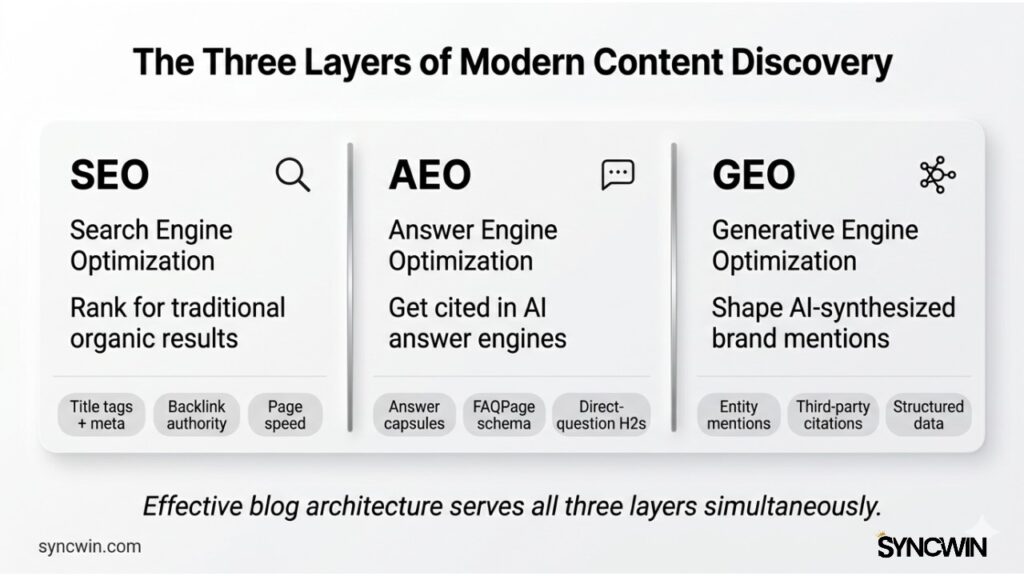
Blog content architecture is the systematic framework that defines how every section, heading level, structural element, and content block is arranged inside a published article. It governs what goes where, in what order, and why, ensuring every article serves human readers, search engine crawlers, and AI retrieval systems at the same time.
This goes beyond formatting. Every structural decision in a well-built article has a function. The heading level signals document hierarchy to a crawler. The 40-60-word answer capsule below each H2 gives AI retrieval systems a clean, extractable block. The FAQ section targets People Also Ask queries. The comparison table lets a reader decide without reading five paragraphs.
Note: Google removed FAQ rich results from traditional search results in May 2026, but the FAQPage schema remains a primary signal for AI Overview citations.
Structure is the system underneath the content. Formatting is just how it renders on screen.
Most beginners focus on word count, keyword placement, and tone. Those matter. But a well-keyworded, well-written article with a broken heading hierarchy and missing type-specific sections still underperforms. Structure is the foundation that everything else sits on. For the full optimization layer that sits above the structure, the AEO guide covers the strategic context.
Why Does Blog Structure Directly Affect Your Search Rankings & AI Citations?
Search engines read structure before they read content. The HTML heading hierarchy tells a crawler what the page is about and how sections relate. Schema markup translates content into machine-readable entities. Paragraph-level formatting determines whether an AI retrieval system can extract a clean, citable answer or has to skip the page entirely.
When I restructured those WPnomy articles, the content itself changed very little. The recommendations were almost the same. The products covered were the same. What changed was the heading hierarchy, the addition of comparison tables, and the type-specific elements that listicle formats require. Rankings moved from pages 2 and 3 back to page 1. The content had not changed. The architecture had.
AI retrieval systems, the ones powering Google AI Overviews and platforms like Perplexity and ChatGPT, run retrieval-augmented generation (RAG) pipelines. They split a query into sub-queries, pull the most relevant 40-120-word text chunks from across the web, and synthesize an answer. A page where every paragraph depends on the previous one for context cannot be extracted cleanly. It gets skipped.
Good structure solves this from the start. Self-contained paragraphs, answer capsules under every heading, and proper schema markup give retrieval systems everything they need to cite your content confidently. The full specification for how this works in practice is in the AEO implementation checklist.
What Structural Elements Does Every Blog Article Need, Regardless of Type?
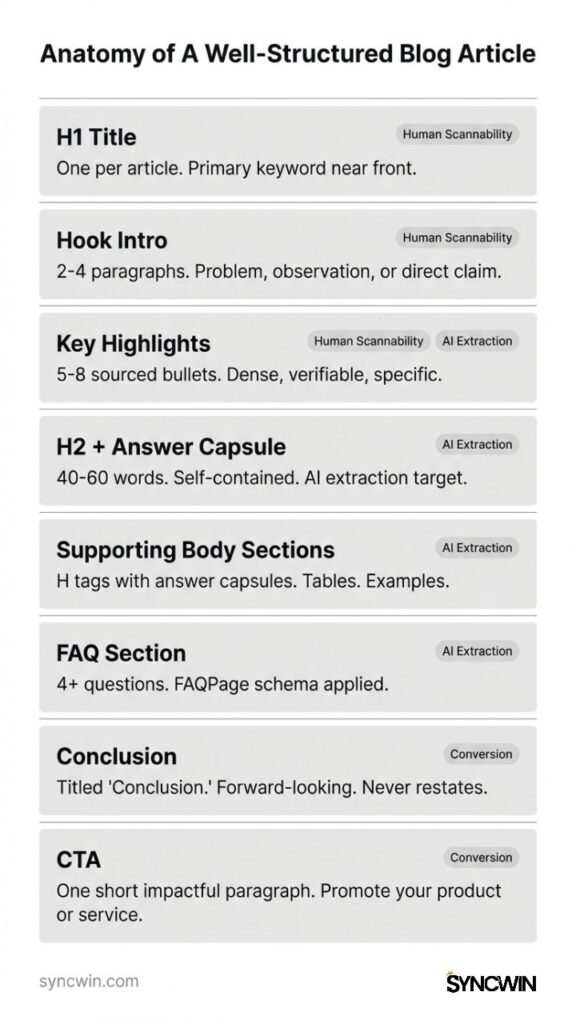
Every published article, regardless of format, requires the same core structural components. These are not style choices or optional extras. Missing any one of them is a structural error with a direct impact on how the page performs in search rankings and AI retrieval. The list applies to every site and every niche.
Here are the non-negotiables, in the order they appear in every article:
| Structural element | Where it goes | Purpose | Notes |
|---|---|---|---|
| H1 | Top of page | States the article topic clearly | Use once only |
| Hook intro | Before first H2 | Pulls readers in and frames the problem | Keep it short and direct |
| Key Highlights | After intro, before body sections | Gives fast proof and key takeaways | Best for sourced claims |
| Answer capsules | Immediately after each H2 or H3 | Helps humans skim and helps AI extract answers | Keep it self-contained |
| FAQ section | Near the end, before conclusion | Covers common reader questions | Good place for question-led queries |
| Conclusion | Near the end | Closes the article with forward motion | Do not simply repeat the article |
| CTA | Final block | Tells readers what to do next | Keep it short |
H1 (title): One per article. Primary keyword near the front. Sentence case. Matches the article’s specific angle, not just the broad topic.
Hook intro: 2-4 short paragraphs before the first H2. Opens with a problem, a direct observation, or a claim, the rest of the article backs up. No definitions. No “In this article, I will cover X.” No generic scene-setting.
Key Highlights section: A bullet list of 5-8 specific, sourced claims placed after the intro, before the first H2 body section. Every bullet is a factual claim, not a vague summary. Every statistic has an inline source link. AI systems extract this section heavily because of its density of specific, verifiable data.
Answer capsules: A 40-60-word, self-contained paragraph placed immediately after every H2 and H3, before any supporting content. This is the single most important AEO element in any article. The full specification is in the AEO implementation checklist.
FAQ section: A dedicated H2 section near the end, before the Conclusion. Questions sourced from Google’s People Also Ask for the target keyword. Each answer: 50-80 words, direct, specific, self-contained. The FAQPage schema is applied via your SEO plugin.
Conclusion: Always titled “Conclusion.” Never restates what was covered. Closes forward: what the reader does next, what changes, or what to read for more depth.
CTA: A short paragraph immediately after the Conclusion. Two lines, maximum.
What Are the Most Common Blog Structure Mistakes & How Do You Fix Them?
The two structural errors I see most consistently across client content audits are broken heading hierarchies and missing type-specific elements. Both suppress rankings directly. Both are completely avoidable. Neither is a writing problem. They are architectural decisions that can be fixed without changing a single word of the content itself.
Broken Heading Hierarchy
Many writers add H tags based on default paragraph styles or font size preferences, with no structural logic behind them. I have reviewed sites where H2 and H3 were used interchangeably, or where the hierarchy jumped from H1 directly to H4. Crawlers use heading structure to build a document outline. When that outline is broken, the page’s topical structure becomes unreadable to search engines.
The fix is simple: H1 appears once, as the title. H2 marks each major section. H3 marks subsections within those. Treat heading levels the way you would chapters and sections in a book. That is the full rule.
Missing Type-Specific Elements
Every article type has a set of structural components that readers expect and that search engines have learned to associate with that format. A product review without a pros and cons section is structurally incomplete. A comparison article without a side-by-side table forces the reader to hold two products’ specs in their head at the same time, which they will not do. A tutorial without a prerequisites section sends readers away before they even start. Missing these elements makes even excellent writing feel incomplete, and incomplete content does not rank.
How Long Should a Blog Post Actually Be?
There is no perfect word count. If you can fully cover a topic in 600 words and every sentence earns its place, that is the right length. Adding 800 words of padding to hit a number is not an SEO strategy. It is filler that dilutes the page’s quality.
That said, data-informed ranges do exist. Articles over 3,000 words earn 77.2% more backlinks than articles under 1,000 words, but that correlation holds because of depth and usefulness, not length alone. For social sharing, 1,000-2,000 words is the sweet spot, with diminishing returns past 2,000. For AI citation specifically, 53.4% of pages cited in Google AI Overviews are under 1,000 words, because what matters is answering one specific sub-query directly, not covering every possible angle in one article.
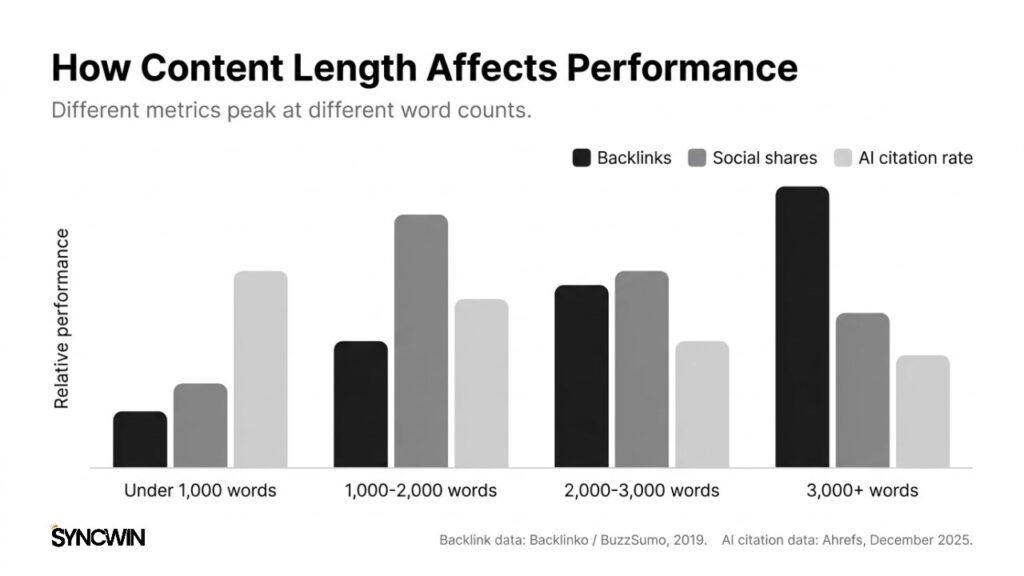
The most reliable method is to average the word count of the top 5-10 ranking pages for your target keyword and target within 20% of that average. Competitors averaging 2,000 words means you target 1,600-2,400. Only exceed the upper limit if you have something the ranking pages do not: original research, updated data, or a perspective none of them have covered.
The easiest mistake for beginners to avoid is treating word count as a quality signal. A 900-word article that fully answers one specific question outperforms a 2,500-word article that drifts across five loosely related ones. Write to the depth the topic deserves. Stop when it is covered.
What Is the Right Structure for Each Major Blog Article Type?
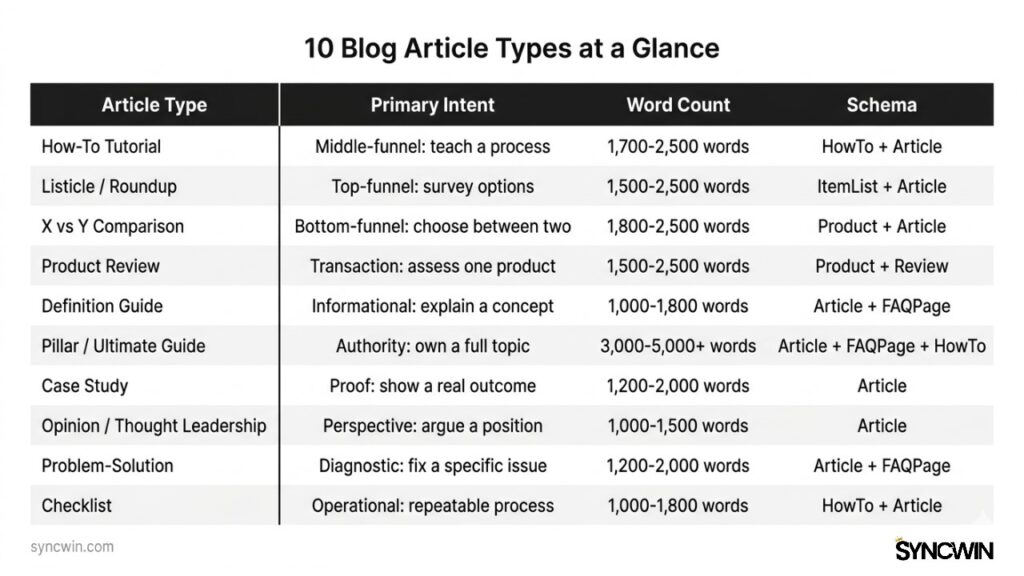
Different article types serve different search intents. Using the wrong structure for the content type is one of the most common and most avoidable reasons why well-written content underperforms.
Here are the 10 most published blog article types and the structural requirements for each.
| Article Type | Must-Have Table or Block | Best Supporting Element | ideal use case |
|---|---|---|---|
| How-to / Tutorial | Step table or step-by-step outline | Troubleshooting section | Sequential instruction |
| Listicle / Roundup | Summary comparison table | Consistent item formatting | Category evaluation |
| Product comparison | Side-by-side feature table | Conditional recommendation | Two-option decision |
| Product / tool review | Pros and cons table | Real screenshots | Purchase decision |
| Definition / beginner guide | Quick definition table | Real-world examples | Learning a new term |
| Pillar page / ultimate guide | Topic map table | TOC with jump links | Full topic ownership |
| Case study | Before-and-after data table | Snapshot box | Proof and credibility |
| Opinion / thought leadership | Argument summary table | Counterpoint section | Defensible stance |
| Problem-solution | Diagnosis to fix table | Prevention section | Solving a named issue |
| Checklist | Phase-based checklist table | Failure-handling notes | Repeatable process |
How-To & Tutorial Articles
How-to articles serve middle-of-funnel readers who need exact, sequential instructions.
Required structure: a prerequisites section listing tools and skill level before the steps start, active-verb H headings for each step (“Install the plugin,” not “Plugin installation”), a visual at each step where text alone is insufficient, and a troubleshooting section covering the most common errors at the end.
Schema: HowTo nested inside Article/BlogPosting, with each H3 step mapped to a HowTo step. Apply via the SEO plugin.
Ideal word count: 1,700-2,500 words.
Listicle & Roundup Articles
Listicle articles serve readers by surveying a category before making a decision.
Required structure: a summary comparison table before the full breakdown, consistent H formatting for every item in the same order, and a final decision section helping the reader choose based on their situation. Every item gets its own H with a “best for” qualifier in the heading.
Inconsistent item formatting is the most common listicle failure. If item 3 has pricing and item 7 does not, the article feels unfinished. Readers and crawlers both notice.
Schema: ItemList + Article. Apply via the SEO plugin.
Ideal word count: 1,500-2,500 words, depending on the number of items.
Product Comparison Articles (X vs Y)
Comparison articles serve bottom-of-funnel readers choosing between two specific options.
Required structure: a side-by-side feature table covering pricing, core features, support, and ideal user; honest separate sections where each product gets its best case made; and a conditional recommendation. “Choose X if [condition]. Choose Y if [condition].” A comparison without a recommendation is structurally incomplete.
The verdict does not come at the very end, buried after 2,000 words. State your overall take in the intro, then earn it with the details.
Schema: Product + Article, with Review schema added if a recommendation is included. Apply via the SEO plugin.
Ideal word count: 1,800-2,500 words.
Product & Tool Review Articles
Review articles serve transaction-ready readers one decision away from committing.
Required structure: overall verdict in the intro (not buried at the conclusion), specific pricing tiers with real numbers, honest limitations presented without softening, a pros and cons table, and screenshots from inside the product. Reviews without firsthand visuals read as secondhand accounts.
The schema rating must exactly match the visible on-page rating. A mismatch between JSON-LD and the displayed rating suppresses rich snippets.
Schema: Product + Review + AggregateRating. Apply via the SEO plugin.
Ideal word count: 1,500-2,500 words.
Definition & Beginner’s Guide Articles
Definition articles serve readers encountering a term for the first time.
Required structure: the definition immediately after the first H2 (not buried three paragraphs deep), a mechanism section explaining how it works using a real named example (not a hypothetical), a distinction section addressing the most common confusion about the term, and a real-world examples section with specific, named cases.
This article type is the foundation layer in any topic cluster. Strong definition articles feed topical authority at the domain level when they interlink with deeper cluster articles.
Schema: Article + FAQPage. Apply via the SEO plugin.
Ideal word count: 1,000-1,800 words.
Pillar Page & Ultimate Guide Articles
Pillar pages own a full topic and serve as the hub article in a topic cluster.
Required structure: a table of contents with jump links, comprehensive coverage moving from definition through implementation and measurement, and contextual internal links to every relevant cluster article placed where they genuinely add understanding. These are not introduction articles. They are the definitive reference on the topic.
Every word in a pillar page must earn its place. Length without depth makes these articles slower to load and easier to beat.
Schema: Article + FAQPage + HowTo for any sequential sections. Apply via the SEO plugin.
Ideal word count: 3,000-5,000+ words.
Case Study Articles
Case study articles serve late-funnel readers who need documented proof before committing.
Required structure: the result in the headline (not the process), a snapshot box above the first H2 summarizing the client, the challenge, and the outcome at a glance, and a before-and-after data table as the evidence anchor. The result must be specific and measurable. Vague outcomes like “significantly improved performance” do not convert.
Schema: Article. Apply via the SEO plugin.
Ideal word count: 1,200-2,000 words. Lean toward specificity over length.
Opinion & Thought Leadership Articles
Opinion articles make a specific, defensible argument.
Required structure: the position stated in the first paragraph (not after a long build-up), a section that presents the opposing view fairly before countering it, and a concrete action or decision the reader takes based on the argument. An opinion piece that leaves the reader with an interesting thought but no direction is an essay. To function as a thought leadership article, it must push the reader toward something.
Schema: Article. Apply via the SEO plugin.
Ideal word count: 1,000-1,500 words. Focus and brevity are part of the argument.
Problem-Solution Articles
Problem-solution articles serve readers arriving with a specific, named issue.
Required structure: root cause diagnosis before the fix (not just symptom description), a numbered step-by-step solution section, and a prevention section so the problem does not return. The intro must confirm the exact problem the reader is experiencing before offering anything. Readers who feel even slightly misunderstood in the first three sentences leave before reaching the solution.
Schema: Article + FAQPage. Apply via the SEO plugin.
Ideal word count: 1,200-2,000 words.
Checklist Articles
Checklist articles serve readers who need a repeatable process they can follow consistently.
Required structure: items grouped into phases rather than one long undifferentiated list, a brief justification for each item explaining why it matters (not just what to check), and a section covering what to do when an item fails. A checklist without context is just a list. Context is what makes it worth bookmarking and returning to.
Schema: HowTo + Article, with each phase mapped to a HowTo step. Apply via the SEO plugin.
Ideal word count: 1,000-1,800 words.
How Do You Write Content that Works for Both Human Readers & AI Engines?
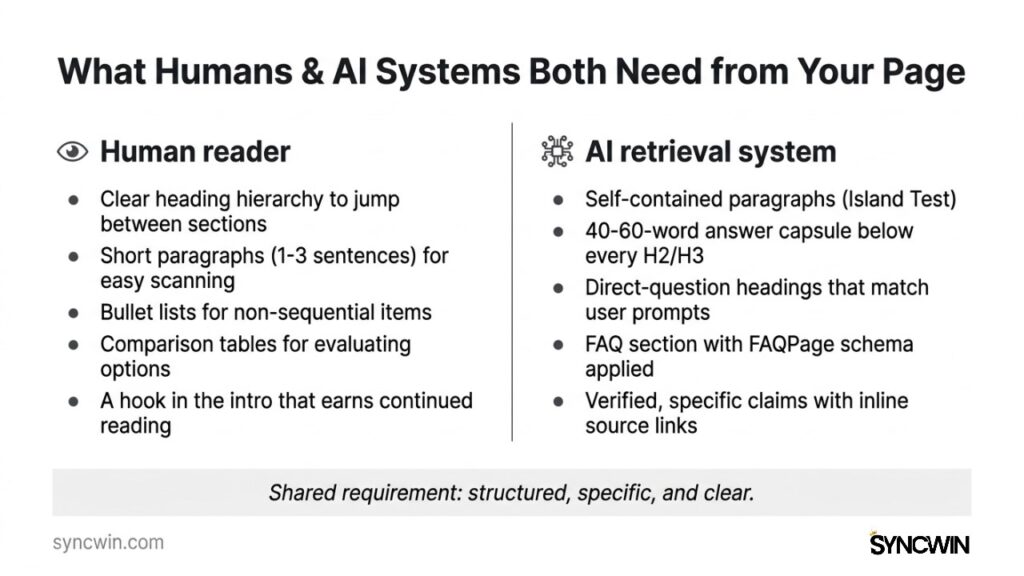
The goal is identical for both audiences: make it easy to find and extract the specific information they need. Humans skim. AI systems chunk content into segments during retrieval. A page built for human skimmability, with clear headings, short paragraphs, and self-contained sections, is almost always well-structured for AI extraction as well.
| Audience | What they need | Best format | Why it works |
|---|---|---|---|
| Human readers | Fast scanning and easy decisions | Clear headings, short paragraphs, comparison tables | Reduces effort and improves readability |
| AI retrieval pipelines | Self-contained chunks it can extract cleanly | Answer capsules, direct headings, isolated paragraphs | Makes the content easier to cite and summarize |
| Practical rule | One heading should deliver one complete thought | Table or compact block under each section | Improves both skimmability and extractability |
For Human Readers
A heading hierarchy that lets them jump to the section they need, short paragraphs (1-3 sentences), bullet lists for non-sequential items, numbered lists for steps, and comparison tables wherever two or more options need to be evaluated side by side. Humans decide whether to keep reading within the first few seconds. The intro and the subheadings do that work.
For AI Retrieval Pipelines
Every paragraph must pass the Island Test. Remove it from the article, and it must still make complete sense in isolation. AI systems extract content in 40-120-word chunks during the RAG process. A paragraph that opens with “This approach” or “As mentioned above” without restating the subject cannot be extracted cleanly. The full Island Test specification lives in the AEO implementation checklist.
The Practical Rule
If a human can skim any heading in your article and read two sentences below it to get a complete thought, you have already done most of the AI-extraction work, too. Understanding how semantic search differs from keyword matching also helps, because AI systems map meaning and context, not just phrases.
What is the Fastest Way to Plan a Blog Article Structure Before Writing?
Build a custom system prompt that encodes your structural requirements for each article type, then deploy it inside your AI platform’s project workspace. Claude Projects and ChatGPT’s custom instructions both work well for this. Give the AI the topic and article type, ask it to generate an outline following the system prompt, then fill in the sections manually or with AI assistance.
This approach eliminates the repetitive structural decisions that add time to every article. Which heading level goes where, whether this article needs a comparison table, how many FAQ questions are required, which schema applies, those decisions are made once, documented in the system prompt, and applied consistently without re-deciding them for every new piece.
The output is a clean, repeatable outline that matches your structural standards across every article type. The time invested in building the system prompt once is returned on the very first article it produces.
If you need the optimization layer on top of the structure, the AEO implementation checklist covers answer capsule formatting, the Island Test, FAQ schema requirements, and the full pre-publish checklist.
FAQs About Blog Content Architecture
What is blog content architecture, and why does it matter?
Blog content architecture is the systematic framework defining how sections, headings, and structural elements are arranged inside a published article.
It matters because search engines read structure before they read content, and AI retrieval systems extract specific text blocks during generation.
A well-structured page is easier to index, rank, and cite. A poorly structured page can be well-written and still invisible to both.
Do all blog article types need different structures?
Yes. Each article type serves a different search intent and a different point in the reader’s decision journey.
A product review requires a verdict in the intro, a pros and cons table, and specific pricing.
A tutorial requires a prerequisites section and sequential step headings with active verbs.
A comparison requires a side-by-side table and a conditional recommendation.
Using a generic structure across all types is one of the most common reasons well-written content underperforms.
How does blog structure affect AI citation in tools like ChatGPT and Perplexity?
AI systems extract content in short, self-contained chunks during retrieval-augmented generation. They favor pages where each paragraph makes sense in isolation, where headings are written as direct questions, and where FAQ sections with FAQPage schema are present.
According to Ahrefs, 53.4% of pages cited in Google AI Overviews are under 1,000 words, which confirms that clarity and structure matter more than length for AI citation.
Note: Google removed FAQ rich results from traditional search results in May 2026, but the FAQPage schema remains a primary signal for AI Overview citations.
How AI answer engines are changing SEO covers this in further depth.
What is the most common structural mistake in blog articles?
Two errors appear most frequently: broken heading hierarchy, where H tags are added based on visual style rather than document logic, and missing type-specific elements, such as a review without pros and cons, a comparison without a side-by-side table, or a tutorial without a prerequisites section.
Both are structural errors, not writing errors. The content can be strong, and the page can still underperform when the architecture is wrong.
How do I choose the right word count for a blog post?
Average the word count of the top 5-10 ranking pages for your target keyword, then target within 20% of that average. If competitors average 2,000 words, write between 1,600 and 2,400.
Each article type in this guide includes a data-informed word count range. Only exceed the upper limit if you have original data, an updated statistic, or a perspective none of the current ranking pages have covered. Padding to hit a number produces thin content.
Conclusion
Blog content architecture is the decision you make once, about how every article will be structured, so you stop remaking it for every post you publish.
The structural templates in this guide give you that foundation across every major article type, grounded in data and in what actually changes rankings when you apply them.
The next step is applying the right template to your next article: check the heading hierarchy, confirm the type-specific elements are present, and run the pre-publish checklist. Results from structural improvements can come quickly.
Those WPnomy articles went from page 2 and 3 back to page 1 after a structural update, without overhauling the content. The system is repeatable. Apply it consistently.
If you want a content architecture system built for your site from the ground up, our AEO content strategy service handles exactly that: structure, optimization, and the complete content system, built to last.
Running a business or blog in India and want content that ranks in both traditional search and AI answer engines? SyncWin works with businesses across Kolkata and India to build content systems that produce measurable results. Reach out and let’s get started.