
A zero-click search is a search query that ends without the user clicking any link.
The search engine, or an AI platform, answers the question directly on the results page.
The user reads the answer and closes the tab. No website gets the visit.
For businesses that depend on search traffic, this is the single most important shift to understand in 2026.
Key Highlights
- 64.82% of all Google searches now end without a single click (Digital Applied)
- Searches that trigger AI Overviews have an 83% zero-click rate (Similarweb)
- Informational queries (“what is X”, “how to Y”) have a 92-94% zero-click rate when AI Overviews appear (LLMrefs)
- TrustRadius lost 92.2% of its organic traffic between early 2024 and the end of 2025 (SE Ranking)
- Voice search queries are almost always zero-click by design
- Businesses cited inside AI answers earn 35% more organic clicks than those not cited, even in zero-click environments (PikaSEO)
- Zero-click is not new. Google featured snippets started this in 2014. AI Overviews accelerated it by an order of magnitude
- The businesses that adapt early, by optimizing for AI citation rather than clicks alone, are the ones that stay visible
I Noticed This in My Own Behavior First
There was no research paper that made this real for me.
It was a Tuesday afternoon, searching for something specific, and the AI Overview answered it before I got to the first organic result.
I closed the browser without clicking anything.
As someone who creates content professionally, I went back and clicked the cited source most of the time, just to verify the information was accurate.
In those early months of AI Overviews, the answers were not always right, and I learned that fast.
But that is not what most people do.
The average person reads the AI answer, decides it is good enough, and moves on. They do not cross-verify. They do not click through.
That moment made something very concrete: the page I might have built, optimized, and published to answer that exact question never got seen.
Not because it ranked poorly. Because the interface answered the question before anyone reached it.
This is the reality of zero-click search.
And if your business depends on people finding you through search, it directly affects you.
What Zero-Click Search Actually Is
Zero-click search describes any search query where the user gets their answer without leaving the search interface.
It happens through several mechanisms: Google’s featured snippets (the boxed answer at the top of results), Knowledge Panels (the business or entity info on the right side), People Also Ask boxes, AI Overviews, and now Google’s AI Mode, which replaced the traditional results page entirely for users who have it enabled.
The result is the same in every case. The user’s question gets answered. No website gets the traffic.
Zero-click is not a bug in how search works. It is working exactly as intended, from the search engine’s perspective.
Google, ChatGPT, Perplexity, and every other AI platform are trying to give users the fastest, most accurate answer possible.
Sending users to websites is secondary to that goal, and has been for years.
How We Got Here
This did not start with AI.
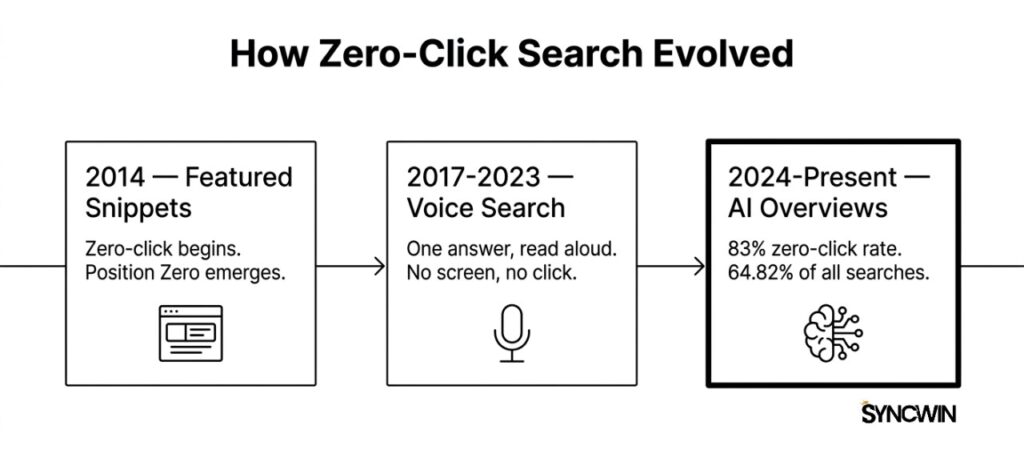
Zero-click behavior has been growing since 2014, when Google introduced featured snippets.
Back then, if your content was pulled into the featured snippet box, you lost the click but gained visibility.
Marketers called it “Position Zero” and debated whether it was worth having.
Voice search pushed this further.
When someone asks Alexa or Siri a question, there is no list of results. There is one answer, read aloud, and the interaction is over. No screen to look at, no link to tap. Zero-click by design.
Then AI Overviews arrived in 2024, and the scale changed entirely.
Google’s zero-click rate jumped from roughly 60% for traditional queries to 83% for queries where an AI Overview appeared.
In just over a year, the behavior spread from a niche pattern among featured-snippet queries to the default experience for hundreds of millions of searches.
By 2026, 64.82% of all Google searches end without a click.
That is not a projection. That is the current measured rate.
The Numbers Behind the Shift
Here is what the data actually shows, across different query types and platforms.
Zero-Click Rates by Search Type (2026)
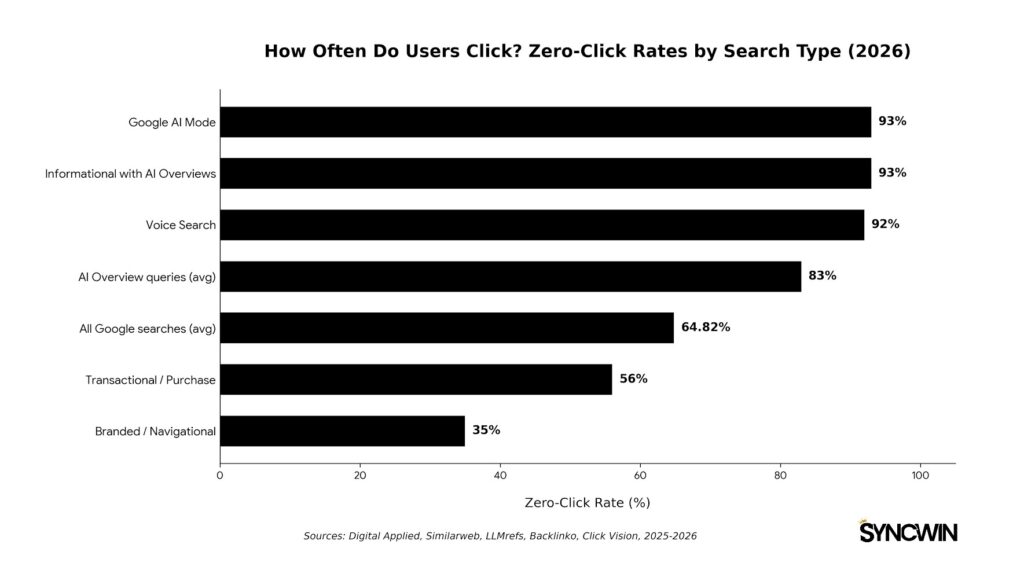
| Search Type | Zero-Click Rate | Source |
|---|---|---|
| All Google searches (average) | 64.82% | Digital Applied, 2026 |
| Queries triggering AI Overviews | 83% | Similarweb, 2025 |
| Informational queries with AI Overviews | 92-94% | LLMrefs, 2026 |
| Google AI Mode queries | 93% | Position Digital, 2026 |
| Voice search queries | ~92% | Backlinko, 2025 |
| Transactional / purchase queries | ~56% | Click Vision, 2026 |
| Branded / navigational queries | ~35% | Click Vision, 2026 |
(Sources: Digital Applied, Similarweb via Click Vision, LLMrefs, Backlinko, Click Vision, 2025-2026)
The informational category is the most important number for small businesses to sit with.
If someone searches “what is the best time to plant tomatoes” or “how much does a logo design cost”, there is a 92-94% chance they never click anything. They read the AI answer and leave.
For every 1,000 searches that trigger an AI Overview, roughly 170 clicks reach the open web. The other 830 stay inside the search interface.
What Happened to Websites Built on Informational Traffic
The businesses hit hardest by zero-click are the ones built entirely around informational content: review sites, comparison platforms, how-to blogs, affiliate websites, and ad-revenue publishers.
The review platform data is the clearest evidence of what this shift looks like at scale.
Review Platform Traffic Collapse (2024-2025)
| Platform | Traffic Decline |
|---|---|
| TrustRadius | -92.2% |
| Capterra | -89.0% |
| Software Advice | -86.5% |
| G2 | -84.5% |
| Gartner Peer Insights | -76.5% |
Source: SE Ranking, January 2026
These are not small or obscure websites. G2 and Capterra are category-defining platforms with years of SEO work, massive domain authority, and thousands of backlinks.
None of it protected them from the shift in user behavior.
I have seen this pattern up close.
My own software review and tool discovery website, Toolonomy, went through a version of this.
The traffic decline started in September 2023, when Google’s Helpful Content Update hit informational sites hard.
AI Overviews made it significantly worse. At the peak of the impact, traffic had dropped close to 90%.
It was a combination of two separate forces, the algorithm update and the AI revolution, landing at the same time. That combination was severe.
I am sharing this not to be dramatic about it, but because it illustrates exactly who zero-click affects most.
If your website’s primary value is answering questions that AI can now answer directly, the traffic model you built on is under pressure.
That is the honest reality.
What Still Gets Clicks
Not everything is being absorbed by AI.
The click still happens regularly in specific situations, and understanding where the clicks survive helps you prioritize.
Transactional queries still drive clicks because the user needs to complete an action.
Buying something, booking a service, filling out a contact form: the AI can recommend, but it cannot transact on the user’s behalf.
A search for “hire a web designer in Kolkata” still ends with someone visiting a website.
Navigational queries still drive clicks because the user wants a specific destination.
Someone searching “SyncWin website” is going to SyncWin.com. The AI does not intercept that intent.
Local queries are a mixed picture.
“Best dermatologist near me” may trigger an AI Overview, but the user still needs to call or book an appointment.
The AI cites a business; the user then visits that business’s profile or website to act on the recommendation.
Local businesses that are cited in AI answers still receive meaningful downstream traffic, just through a different path than a direct organic click.
Complex, high-stakes decisions still send people to websites.
Someone deciding whether to hire a lawyer, invest in equipment, or choose a healthcare provider is not going to make that decision based solely on an AI summary.
They click through to verify, read the full story, and check credentials.
The pattern is consistent: the more the user needs to act, verify, or commit, the more likely they are to click.
The more their need is purely informational, the more likely the AI is to answer it completely.
Voice Search: Zero-Click by Design
Voice search deserves its own mention here because it is the purest form of zero-click behavior.
When someone says, “Hey Google, what are the best restaurants near Park Street?” or asks Alexa, “What time does the post office close?”, there is no screen of results.
There is one answer, spoken aloud. The user either acts on it or does not. No click is possible.
Over 153 million Americans now use voice assistants, and 76% of voice queries have local intent.
That means the majority of voice searches are people looking for a business, address, or service nearby.
For a local business, being the answer a voice assistant reads is exactly as valuable as a top organic ranking, sometimes more so.
The difference is that ranking for voice requires the same structural signals as AEO: a direct, extractable answer, proper schema markup, and a Google Business Profile that AI can pull from in real time.
A future article in this series will cover voice search optimization in detail.
When it goes live, the link will be added here.
Is Zero-Click a Threat or an Opportunity?
Both. And the honest answer is that the threat part is largely out of your control.
You cannot stop Google from putting AI Overviews on informational queries.
You cannot make users click when they already have the answer.
The behavior shift is real, it is measured, and it is accelerating.
Treating this as a crisis you can reverse with better SEO tactics misreads what is actually happening.
What you can control is whether you are the business that gets cited in those AI answers, or the business that is invisible inside them.
The threat case:
- Informational traffic for content-heavy websites is declining regardless of ranking position
- Ad revenue and affiliate commission models that depend on page views are structurally compromised
- “Position 1” no longer guarantees the traffic it once delivered
- Businesses that have not adapted are losing ground every month to those that have
The case for opportunity:
- Businesses cited in AI Overviews earn 35% more organic clicks than those not cited, even in a zero-click environment
- AI-referred traffic converts at significantly higher rates because the user arrives pre-qualified
- Small businesses with clean, structured content can outperform large competitors in AI answers, something nearly impossible in traditional search
- The early-mover advantage is real and available right now, especially in markets like Kolkata, where most local businesses have not started
The businesses getting this right are not trying to fight zero-click.
They are making sure that when AI answers a question in their niche, it answers it using their content and mentions their name.
That is the shift worth making.
What Small Businesses Should Actually Do
This is not the article to go deep on implementation.
Two articles in this series cover that in detail, and if you have not read them yet, they are the right next step:
- What Is Answer Engine Optimization (AEO)? covers the full framework: answer capsules, schema types, the 6-month roadmap, and platform-specific strategies for ChatGPT, Perplexity, and Google AI Overviews.
- AEO vs SEO: What’s the Difference? explains exactly why SEO is still the foundation and how AEO layers on top of it, so you do not have to choose between the two.
Here is the short version of where to start:
- Audit your current traffic by query type. In Google Search Console, identify which of your top pages are ranking for informational queries. These are the pages most exposed to zero-click erosion. Know what you are working with.
- Add answer capsules to high-traffic pages. A 40-60-word direct answer at the top of each page section makes your content extractable by AI systems. This is the single highest-leverage structural change you can make.
- Implement the FAQPage schema on every service page. This maps your question-and-answer pairs directly for AI extraction. On WordPress, Rank Math or Yoast handles this without writing code.
- Optimize your Google Business Profile. For local businesses, GBP is the primary source AI platforms pull from for local queries. Complete every field, respond to every review, and keep your hours and services current.
- Track AI-referred traffic separately in GA4. Set up a custom channel group for sessions arriving from chatgpt.com, perplexity.ai, and gemini.google.com. This is the metric that tells you whether your AEO work is producing results.
- Shift how you measure success. If organic sessions are your only KPI, the data will look worse every quarter as zero-click rates rise. Brand mentions in AI answers, citation frequency, and conversion rate from AI-referred traffic are the metrics that tell the real story now.
Zero-Click Search FAQs
What is a zero-click search in simple terms?
A zero-click search is when someone searches for something online, gets the answer directly on the results page, and leaves without clicking any link.
It happens through featured snippets, AI Overviews, Knowledge Panels, and voice responses.
The user’s question is answered. No website receives the visit.
Why is zero-click search increasing?
Two reasons.
First, search engines have gotten better at answering questions directly, a process that started with featured snippets in 2014 and accelerated with AI Overviews in 2024.
Second, users have gotten comfortable with this behavior. Reading a summary is faster than clicking through to a website, and most people accept that trade-off without thinking about it.
Does zero-click search affect all businesses equally?
No.
Businesses built on informational content (how-to articles, comparison guides, review sites, affiliate blogs) are hit hardest because AI now answers those queries directly.
Local service businesses, e-commerce, and anyone with a transactional offer are affected less because the user still needs to visit the business to complete the action.
Can a business benefit from zero-click search?
Yes.
Being cited as the source inside an AI Overview or a ChatGPT response builds brand trust even when the user does not click.
Research shows that businesses cited in AI answers receive 35% more organic clicks than those not cited.
The click rate drops, but the quality of the traffic that does arrive is significantly higher because the AI has already recommended you.
What is the difference between zero-click search and voice search?
Voice search is a specific type of zero-click behavior.
When someone asks a voice assistant a question, the assistant reads one answer aloud.
There is no list of results and no link to click. All voice search results are zero-click by design.
AI Overviews on a screen are zero-click by choice: the user could click, but usually does not.
How do I know if zero-click is affecting my website?
Check Google Search Console.
If your impressions are holding steady or growing but your clicks and CTR are declining, zero-click is the likely cause.
Your content is being seen (or cited) but not clicked.
Setting up GA4 tracking for AI-referred traffic separately will show you whether you are receiving any visits from AI platform citations.
What can I do to stay visible in a zero-click world?
Structure your content so AI platforms can extract and cite it.
This means implementing schema markup, writing direct answer capsules at the top of each section, and maintaining consistent, accurate business data across all platforms.
The full approach is covered in the AEO fundamentals guide.
Is Google’s AI Mode the same as AI Overviews?
Not exactly.
AI Overviews appear above traditional search results; the user can still scroll down to organic links.
AI Mode, available to US users since March 2026, replaces the results page entirely with a Gemini-generated response.
AI Mode has a 93% zero-click rate compared to 83% for AI Overviews.
It represents the next stage of the same shift.
Conclusion
Zero-click search is not a trend to monitor. It is the current state of search, and the numbers show it is deepening, not stabilizing.
The businesses that treat this as a temporary problem to wait out will continue losing informational traffic with no clear floor.
The ones that adapt, by building content that AI platforms can extract and cite, are doing something more valuable than chasing clicks.
They are becoming the source of record in their niche, the business AI recommends when someone asks a relevant question.
The goal has shifted from getting clicked to getting cited.
That requires a different approach to content, but the underlying work is not entirely different from good SEO. It is an extension of it.
If you are not sure where to start, begin with the AEO fundamentals guide and the AEO vs SEO comparison.
Both are built for small business owners starting from wherever they are.
Drop your questions in the comments. I read everyone.
Running a business outside India and want to know how zero-click is affecting your specific market?
SyncWin works with small businesses globally on AEO strategy, content restructuring, and schema implementation.
Get in touch with SyncWin, and we will start with an honest look at where your traffic stands.
Based in Kolkata or West Bengal?
We work with local businesses directly on GBP optimization, local AEO, and full digital visibility setup. Contact SyncWin for local SEO and AEO services.