
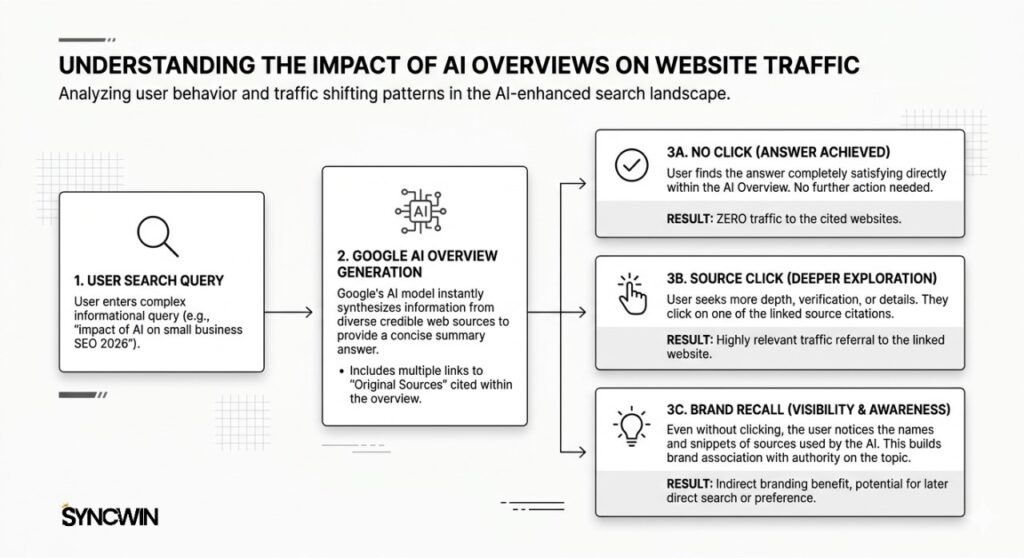
AI Overviews are reducing the volume of clicks that reach external websites by absorbing informational queries directly inside the search interface.
When an AI Overview appears at the top of a Google results page, the zero-click rate rises from a baseline of 60% to 72-83%. For small businesses whose traffic depends on informational content, this is the most significant structural shift in search since Google introduced PageRank.
Key Highlights
- AI Overviews now appear in 25% to 48% of all Google searches as of Q1 2026 (Source: Conductor)
- When an AI Overview is present, zero-click rates rise to 72-83%. In Google AI Mode, that rate reaches 93% (Source: DigitalApplied)
- CTR for the top organic position drops by 34.5% to 61% when an AI Overview appears above it (Source: SEO Mator)
- The first organic result is now pushed approximately 1,340 pixels below the fold when an expanded AI Overview is present (Source: ALMCorp)
- Informational queries trigger AI Overviews in nearly every case, which is 99.9%. Transactional queries are far more insulated at 1.2%. (Source: Ahrefs)
- AI-referred traffic converts 31% better than non-AI traffic. In B2B, that gap widens to up to 23x (Source: Adobe / The Digital Bloom)
- India leads global AI adoption. Over 58% of searches in Tier 2 and Tier 3 Indian cities are now voice-based (Source: Spinta)
- The businesses surviving this shift are not fighting zero-click. They are optimizing for citations and brand visibility rather than raw traffic.
The Traffic Model That No Longer Works the Way It Used To
For over two decades, the SEO game had a clear structure. You published content. You ranked. People clicked your link. Traffic arrived, ads got seen, affiliate products got bought, leads came in.
That structure has not disappeared. But it has changed significantly for a specific and very large category of content: anything informational.
When someone searches “what is the best time to post on Instagram” or “how much does a logo design cost in 2026,” Google now answers that question directly at the top of the page. The user reads the answer. Then, in most cases, they close the tab. They did not need to click. The AI Overview gave them everything they came for.
This is the core of what AI Overviews are doing to website traffic. Not eliminating it. Restructuring it along intent lines.
For a deep understanding of why this is happening at a behavioral level, the zero-click search guide covers the full picture, including the data showing which query types are affected most severely.
What the Numbers Actually Look Like
These are not projections. This is what the 2026 search data shows.
AI Overview Prevalence (Q1 2026)
| Query Type | AI Overview Appearance Rate |
|---|---|
| Informational (“what is,” “how to,” “why does”) | Near-universal (90%+) |
| Educational and research queries | High (60%+) |
| Healthcare and medical | 48.75% |
| Financial services | 25.79% |
| Information technology | ~25% |
| Real estate | 4.48% |
| Consumer retail/e-commerce | 6.82% |
Sources: Conductor analysis of 21.9M queries, Q1 2026, BrightEdge 9-industry tracker, March 2026, SE Ranking Q1 2026
Informational content is the primary target. If a significant share of your website’s traffic comes from people searching “how to,” “what is,” or “best way to” queries, you are operating in the most directly affected category.
What an AI Overview Does to Your Click-Through Rate
| Position | CTR Without AI Overview | CTR With AI Overview | Decline |
|---|---|---|---|
| Position 1 (organic) | ~1.76% | 0.61% to 1.3% | 34.5% to 61% |
| Average top-ranking page | Baseline | ~8% average | 46.7% |
| Paid ads average | Baseline | 6.34% | 68% |
Source: Seer Interactive longitudinal study, April 2026 (2.43 billion impressions, 53 brands). Ahrefs 300K-keyword study, December 2025, confirms 34.5% position-1 CTR drop.
Position 1 used to mean something specific: the top click. Now it means the first result below a block of AI-generated content that answers the exact question your page was optimized for. The user never reaches your link in the majority of informational queries.
The Physical Problem: Where Your Content Now Lives on the Page
When a full AI Overview expands on a desktop screen, the first organic result is pushed past the visible screen entirely on most devices.
At peak expansion in late 2025, an AI Overview reached an average height of 1,340 pixels on desktop, occupying 42% of the desktop screen and 48% of mobile screen space.
The user would need to scroll significantly just to reach the first organic result. Most do not. The AI summary above answered their question before they had any reason to.
Zero-Click Rates Across Different Search Modes
| Search Environment | Zero-Click Rate | What This Means |
|---|---|---|
| Traditional Google (no AI Overview) | 58.5% to 60% | Baseline behavior; always been high |
| Google with AI Overview present | 72% to 83% | 8 in 10 queries with AIOs end without a click |
| Google AI Mode (conversational) | 93% | Near-total information absorption by the platform |
| Voice search | ~92% | One answer, read aloud, no click possible |
Sources: Similarweb via The Digital Bloom, 2025, Position Digital 2026, Backlinko 2025
The AI Mode figure is the most significant signal about where this is heading. Google AI Mode is currently available to US users and is expanding. When most searches move to AI Mode, a 93% zero-click environment becomes the default, not the exception.
Which Businesses Are Hit Hardest & Which Survive
The impact of AI Overviews is not distributed evenly. It follows a clear logic based on what the user’s query actually requires.
High-Vulnerability Content
Informational blogs and how-to content: If your content strategy is built around answering questions that Google can now answer in the Overview, your traffic from those pages will decline. This is not a maybe. It is already measurable.
My own experience with this is direct.
My software review and tool discovery site, Toolonomy, went through a version of this. The decline started in September 2023 when Google’s Helpful Content Update hit informational sites hard. AI Overviews made it significantly worse.
At the peak of the impact, Toolonomy traffic had dropped close to 90%. Two separate forces, the algorithm update and the AI shift, landed at the same time. The combination was severe. I share this not as a complaint, but as something that can only be understood by living through it.
Review and comparison platforms: Review sites were among the first to feel the full force of this shift. G2, Capterra, TrustRadius, and similar platforms saw traffic declines of 76% to 92% in a single year as AI Overviews began summarizing software reviews directly.
Pure affiliate and ad-revenue content: Pages whose primary purpose is to capture informational traffic and monetize through ads or affiliate clicks are structurally exposed. The traffic model depends on clicks. AI Overviews reduce those clicks. The math does not work without adaptation.
More Resilient Query Types
Transactional queries: When someone wants to buy something, book a service, or contact a business, the AI can recommend but cannot complete the action. The user still needs to visit a website. This category is far more insulated.
Local and “near me” queries: Finding a specific restaurant in Salt Lake, Kolkata, or a plumber in South Delhi still requires the user to get a phone number, see a menu, or book an appointment. AI can surface the business. The interaction still happens on the business’s property.
Complex, high-stakes decisions: Someone choosing a doctor, a lawyer, a contractor, or a business partner is not going to make that decision from an AI summary alone. They click through, read the full story, check credentials, and verify.
Navigational queries: When someone searches specifically for your business name, they are going to your website. AI Overviews do not intercept brand-specific searches with meaningful frequency.
The Quality Paradox: Honest Take
The research community has developed an argument about this shift that I want to address directly, because I see it repeated uncritically everywhere.
The argument goes like this: yes, traffic volume is declining, but AI-referred visitors convert at much higher rates. The quality more than compensates for the quantity loss. This is the “quality paradox.“
Here is my honest read on it.
The data is real. Adobe Digital Insights confirmed that during the 2025 US holiday season, AI-referred traffic converted 31% better than non-AI traffic.
Ahrefs found that AI search visitors converted at up to 23 times the rate of traditional organic visitors in B2B contexts. Those numbers are verified and meaningful.
But the argument has a blind spot.
When an AI platform recommends your business, that visitor arrives pre-qualified. That is true. The conversion happens on your page, and you benefit from it. Also true.
What you cannot control is everything that happens in the AI interface before that click.
The AI is making editorial decisions about your business: how it describes you, what it says you are best at, what it says your limitations are, and whether it recommends you or a competitor. That entire layer of influence is outside your control, and it is where the purchase decision is increasingly being made.
For a local business in Kolkata with modest existing traffic, “higher quality AI-referred traffic” is not a meaningful compensation if the volume is so low that even high conversion rates produce very few actual customers.
The quality paradox holds for businesses that were already generating significant traffic. For businesses starting from near zero, it is less relevant.
The honest response is not to argue against the data or to pretend the quality improvement does not matter.
The response is to understand the full picture: volume is declining, quality is improving, and the platform where your brand reputation is now partly built (AI responses) is one you do not fully control. That is the reality, and the strategy has to account for all three parts of it.
The path forward is not to maximize clicks. It is to build a brand that AI platforms cite accurately and favorably, and to make sure that when someone does land on your site from an AI citation, the page converts them.
The India & Kolkata Context
India is not a secondary market for this shift. It is one of the most important ones.
India currently leads global AI adoption, with approximately 59% of the population using generative AI tools regularly. Over 58% of searches in Tier 2 and Tier 3 Indian cities are now voice-based, driven by the integration of AI assistants into affordable smartphones.
Google’s India-specific AI models are trained on Indic datasets and can rank and summarize content in Hindi, Tamil, Telugu, and Bengali with increasing accuracy.
For Kolkata specifically, the shift is arriving on top of a market where most local businesses have not yet completed basic digital setup: a proper website, a fully built Google Business Profile, and consistent NAP data across directories.
The AI revolution is layering complexity onto a foundation that many local businesses have not yet built.
This creates an unusual situation. The businesses most exposed to AI Overviews are those that have already built SEO-heavy informational content strategies.
Most Kolkata businesses have not done this, so they are not losing the traffic they had. But they are also not gaining the AI citation visibility that the businesses that adapt early will build. They are starting behind in a race that is already underway.
The content that performs for local AI queries in India is specific: Bengali and English answers about hyperlocal services, consistent GBP data that AI can pull from in real time, and structured FAQ content that mirrors the conversational phrasing of voice search.
A local clinic in Ballygunge with a clean website, complete GBP, and FAQ content covering “cost of physiotherapy near Ballygunge” is already ahead of the vast majority of local competitors, not because they have done something complicated, but because almost no one has started.
What the Research Gets Right About AI Referral Traffic
Let me separate the legitimate data from the overstatements.
Verified Performance Metrics for AI-Referred Visitors
| Metric | AI-Referred Visitor | Traditional Organic Visitor |
|---|---|---|
| Conversion rate (B2B, Ahrefs June 2025) | Up to 23x higher | Baseline |
| Conversion rate (holiday season retail, Adobe 2025) | 31% higher | Baseline |
| Average time on site | 86 seconds | 78 seconds |
| Pages per session | 4.0 pages | 5.5 pages |
| Session intent | Deep research or decision-making | Browsing or scanning |
Source: Conductor AEO/GEO Benchmarks Report, 2026. Note: AI-referred visitors convert at 2x the rate of traditional organic while requiring one-third the sessions.
The pages per session figure is interesting. AI-referred visitors view fewer pages but spend slightly more time on the landing page they arrive at. This makes sense: they were sent to a specific page to answer a specific question. They read it more carefully. They then either convert or leave. They are not browsing the site the way a traditional search visitor might.
The implication is clear: if your site relies on multi-page session depth to generate revenue, AI-referred traffic will behave differently. Optimize the landing page they arrive at as the conversion point. Do not rely on them to navigate elsewhere.
Three Businesses That Adapted & What They Actually Did
These are verified third-party case studies. None of them are SyncWin clients. They demonstrate what is possible when the adaptation is done correctly.
Northeast Medical Group (Healthcare, USA)
A healthcare network with over 130 locations achieved an 893% year-over-year increase in organic traffic despite the rollout of AI Overviews. Their strategy focused on a single approach: creating in-depth, expert-reviewed content that answered specific health questions at a level of depth AI Overviews cannot fully replicate.
Result: Their high-authority articles earned citations in Google AI Overviews that drive 8,300 visits per month from that citation alone. The visitors arriving were pre-qualified, resulting in a significant increase in booked appointments.
What this shows: In YMYL (Your Money or Your Life) categories like healthcare, AI systems favor cited authoritative sources. Being that source produces measurable downstream revenue even in a high-AIO environment.
Bloom & Wild (E-Commerce, UK)
A UK online florist achieved a 472% increase in organic traffic by building a blog strategy around top-of-funnel informational queries related to flowers, care guides, and seasonal gifting.
Their pages were built specifically for extractability: question-based subheadings, clear data tables, and structured information that AI systems could pull into responses. They then connected that informational traffic to product pages through strategic internal linking.
What this shows: Informational content is not dead. Content that earns AI citations can still funnel users into commercial pages, as long as the path is clearly structured.
Flyhomes (Real Estate, USA)
A real estate platform achieved 10,737% traffic growth in three months by using AI tools to expand its content library from 10,000 to 425,000 pages, focused on localized cost-of-living and housing guides.
This one requires an honest caveat. That scale of content production (415,000 pages in a quarter) was achieved through AI-generated content at scale. That is a strategy with real trade-offs: quality control is difficult at that volume, Google has explicitly targeted mass-produced AI content in its Helpful Content Updates, and the results are not guaranteed to be durable.
The Flyhomes’ growth was real. Whether it sustains is a legitimate question. This approach is not one I would recommend for a small business without significant resources and rigorous quality control in place.
What this shows: Localized, specific, fact-heavy content earns AI citations for local queries. The scale at which you produce that content is a separate decision.
The Copyright & Licensing Reality Small Businesses Should Know
The AI Overviews debate is not only about traffic. It is also about whose content is being used to generate the answers, and whether anyone is compensating the creators.
The legal position in 2026 is still unsettled, but two developments are worth knowing.
The New York Times filed a lawsuit against OpenAI and Microsoft in December 2023, arguing that training AI models on its journalism without licensing constitutes copyright infringement. In 2026, that litigation is ongoing and setting precedent for how courts view the relationship between AI training data and the original creators.
Separately, Anthropic reached a reported $1.5 billion settlement related to AI content licensing. This marked the beginning of a shift from “ask for forgiveness later” to actual licensing agreements between AI companies and content creators.
For a small business owner, this matters in one specific way: your content can be used to train AI models and generate answers without your explicit consent, and without compensation. The regulatory frameworks being built in Europe, India, and the US are all grappling with this. Whether this will produce meaningful protections for small content creators is unclear.
The practical response right now is to ensure that your content is being cited visibly (with attribution) rather than absorbed silently. A business that gets named as the source of an AI answer has some brand value from that citation, even without a click. A business whose content is used without attribution has neither the click nor the mention.
This is one of the reasons understanding how AI platforms decide what to cite matters for any business creating content in 2026.
What Small Businesses Should Actually Do: A 90-Day Roadmap
Days 1 to 30: Audit Your Exposure
- Identify your top 100 keywords in Google Search Console
- For each keyword, run a manual Google search and check whether an AI Overview appears
- Segment your content into: heavily exposed (informational, how-to, definition content) and relatively insulated (transactional, local, navigational)
- Check your GA4 referral sources for traffic from chatgpt.com, perplexity.ai, and gemini.google.com. If you have any, document it and measure its conversion rate separately.
- Run a “citation gap analysis”: search your core queries in ChatGPT, Perplexity, and Google AI Overview mode. See who is being cited. Note whether it is you or a competitor.
Days 31 to 60: Restructure for Citation
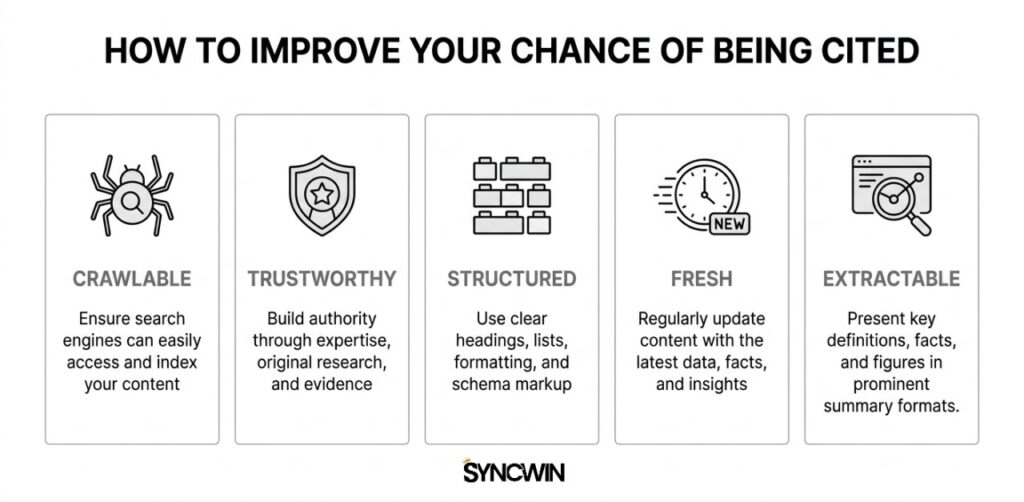
- Apply answer-first architecture to your 20 most important pages. Place a direct 40-60-word answer immediately below every H2 or H3 header.
- Ensure the first 30% of each key page contains your most critical, citation-ready facts. This is where AI extraction is most likely to occur.
- Implement the FAQPage, Organization, and LocalBusiness schema on all relevant pages
- Update your Google Business Profile completely. For local businesses in India and the US, GBP is the primary data source AI platforms use for local recommendations.
- Audit NAP consistency across all directories. Indian businesses: Justdial, Sulekha, IndiaMart. US businesses: Yelp, BBB, Google, Apple Maps.
The AEO implementation checklist covers every step of this restructuring in full, including the technical schema setup for WordPress and other platforms.
Days 61 to 90: Build the Authority Layer
- Establish an 8 to 12 week refresh cycle for high-traffic pages. Content updated within 60 days is 1.9 times more likely to be cited than older content.
- Earn brand mentions on authoritative third-party platforms: Reddit, LinkedIn, and industry publications. Off-site mentions now carry more weight than backlinks for AI citation.
- Move your best content toward first-hand experience: original research, client results, and named expert perspectives. These are the “unique tokens” AI systems cite because they cannot find them anywhere else.
The full framework for why AEO builds on SEO rather than replacing it makes this 90-day sequence clearer if you are working out where to start.
The New KPIs for 2026
Traditional SEO success metrics no longer tell the full story. Here is what to track alongside them.
| New KPI | How to Measure | Why It Matters |
|---|---|---|
| AI Citation Frequency | Manual testing in ChatGPT, Perplexity, and Gemini every 2 weeks | Direct measure of whether your AEO is working |
| AI Referral Conversion Rate | GA4 custom channel for AI traffic sources | Measures lead quality from AI platforms |
| Share of Model (SoM) | Specialized tools: Semrush, Profound, LLMrefs | Percentage of relevant AI responses that cite your brand |
| Brand Sentiment in AI Responses | Manual audit: run brand name queries across platforms | Confirms AI is describing your business accurately |
| Direct Traffic Ratio | GA4 and server logs | Measures audience loyalty independent of search |
| Content Freshness Rate | CMS audit: dateModified fields across key pages | Proxy for how often you are staying within citation windows |
KPI framework: Conductor AEO/GEO Benchmarks Report, Q1 2026. Measurement tools: Semrush, Profound, LLMrefs.
FAQs About How AI Overviews Are Changing Website Traffic
Are AI Overviews the same as Google’s featured snippets?
No, but they evolved from the same intent.
Featured snippets pulled one answer from one page and showed it in a box above the results.
AI Overviews synthesize information from multiple sources, generate a new response in the LLM’s own words, and show inline citations. They are more comprehensive, take up more visual space, and have a much higher zero-click rate than traditional featured snippets.
Understanding what AEO is and how it differs from traditional SEO covers the technical distinction between the two.
How much traffic should I expect to lose from AI Overviews?
It depends almost entirely on your content mix.
For pages targeting informational queries, CTR drops of 34% to 61% are documented when an AI Overview appears above the organic results.
For transactional pages, navigational pages, and local service pages, the impact is significantly lower.
Audit your top keywords first (see the 90-day roadmap above) to understand your specific exposure before calculating expected impact.
If I get cited in an AI Overview, do I still get the traffic?
Sometimes.
Being cited in an AI Overview does not guarantee a click, but it produces some.
Research from The Digital Bloom found that businesses cited in AI Overviews receive more organic clicks than those not cited, even in high-zero-click environments, because the citation creates brand trust that influences follow-up searches.
The click rate is lower than it used to be from a direct organic result, but the citation has brand value that extends beyond the single session.
Is Google AI Mode different from AI Overviews?
Yes.
AI Overviews appear above traditional organic results; the user can still scroll down to the regular link list.
Google AI Mode (available to US users as of 2026) replaces the results page entirely with a conversational Gemini response. AI Mode has a 93% zero-click rate compared to 72-83% for AI Overviews. It represents the next stage of the same shift: fewer links, more synthesis.
Is this shift happening in India at the same pace as in the USA?
The underlying mechanics are identical. The pace of visible impact differs because India’s AI adoption is high at the consumer level, but digital infrastructure at the small business level is still developing.
S businesses that built large informational content libraries are feeling the traffic impact immediately.
Indian businesses are mostly feeling the competitive cost of not having adapted yet, rather than losing the traffic they had.
Both situations require the same response: build structured, authoritative content, complete your GBP, and optimize for AI citation rather than ranking position alone.
What do AI Overviews mean for my Google Ads performance?
Paid ads have also seen CTR pressure from AI Overviews, with one study showing a 68% decline in CTR for ads when an AI Overview is present.
However, transactional and commercial intent queries are significantly less likely to trigger AI Overviews.
For informational queries, AI is now competing with both your organic and paid placements.
How does AEO relate to what is happening with AI Overviews?
AEO is the direct strategic response to AI Overviews.
Answer Engine Optimization is the practice of structuring your content so AI platforms extract and cite it rather than ignoring it. If AI Overviews are the problem (reducing your clicks), AEO is the adaptation (making your business the source AI cites).
The two concepts are directly connected: you cannot respond to AI Overviews without understanding AEO.
For a full breakdown of how AEO, GEO, and LLMO relate to each other, that comparison is covered separately.
Conclusion
The traffic model that most small businesses built their digital strategy on is under structural pressure. That is the honest starting point.
Informational content is the most exposed. Review sites, how-to blogs, and affiliate content built entirely on informational query traffic have already seen the impact in measurable terms.
My own experience with Toolonomy, where the combination of Google’s Helpful Content Update and AI Overviews produced a 90% traffic decline, is consistent with what the broader data shows.
The response is not to pretend the shift is not happening or to find a technical workaround that restores 2022-style click volumes. The response is to adapt the strategy to where search is going: citation over ranking, brand trust over link equity, and content that earns AI recommendations rather than content that simply ranks in a list.
For a local business in Kolkata or anywhere else starting from a modest digital footprint, this shift is actually an opening. The competition for AI citation in most local markets is nearly non-existent.
The businesses that build clean, structured, factually grounded content now, before local competitors do, are setting up a position that will be harder to displace in 18 months.
The full path from understanding this shift to implementing the response is covered across this topic cluster. Start with the AEO implementation checklist if you want to take action immediately.
Read how AI platforms decide what to cite if you want to understand the mechanics behind which content earns citations and which does not.
Drop any questions in the comments. I read everyone.
Running a business outside India and want an honest assessment of how AI Overviews are affecting your specific traffic?
SyncWin works with small businesses globally on AEO strategy, content restructuring, and AI visibility setup. Get in touch with SyncWin, and we will start with a citation gap analysis.
Based in Kolkata or West Bengal? We work directly with local businesses on complete AEO implementation, GBP optimization, and Bengali and English content strategy. Contact SyncWin for local SEO and AEO services.