
A business website builds credibility, drives organic traffic, and captures leads around the clock. In 2026, it also determines whether AI search tools like Google AI Overviews, ChatGPT, and Perplexity cite your business or your competitor’s. These 10 benefits apply to every type of small business: product sellers, service providers, consultants, and local shops.
I have been making a living online for over six years. Every income stream I have runs through websites I own and control. Not social media pages. Not third-party directories. Actual websites where I set the rules.
Affiliate income, freelance clients, consulting work, and ad revenue all of it traces back to web properties I have built and maintained. That’s not a coincidence. I have also built websites for dozens of businesses across Kolkata, India, and internationally. Every single one generates more enquiries, more consistent leads, and more trust than before it had a proper website. The pattern holds regardless of industry, city, or business size.
Here’s what I consistently see with small businesses that skip the website: they have Instagram, Facebook, maybe a WhatsApp number. But they have no anchor point. No place they own. When the algorithm shifts or the platform restricts their account, they have no fallback.
Social media is rented land. A website is yours.
The AI era has added one more reason this matters. Search engines are no longer the only gatekeepers. AI tools now answer customer questions directly, and they pull those answers from websites, not social media profiles. If your business doesn’t have a website structured for this, you’re invisible to an entirely new category of search behavior.
3 things you can apply right now, before reading the rest of this guide:
- Register a domain name and set up a branded business email ([email protected]). Verisign’s research shows 74% of consumers trust a branded email domain more than a free Gmail or Yahoo address.
- Create or claim your Google Business Profile and connect it to your website URL. This is the fastest path to appearing on Google Maps and in local search results.
- Publish one clear “Services” or “What we offer” page that states what you do, who you help, and how to contact you. This is your minimum viable business website.
Key Highlights
- 84% of consumers say a business with its own website looks more credible than one that operates only on social media.
- 31% of U.S. shoppers will not buy from a small business that lacks a dedicated website; for Gen Z, that figure rises to 40%.
- Organic search drives 53.3% of all web traffic across industries; social media drives roughly 5%.
- Businesses with an active blog generate 67% more monthly leads than businesses that publish no content.
- A 2024 study by researchers from Princeton University and IIT Delhi found that structuring content for AI retrieval can increase brand visibility in AI responses by 30% to 40%.
- 92% of consumers prefer to get business information directly from a website rather than from a social media page.
- Among Indian MSMEs that digitized, 41.4% reported a direct sales increase of 21% to 30% following digital integration.
What Does a Business Website Actually Do?
A business website is a 24/7 digital home base that builds credibility with new visitors, attracts search traffic without ongoing ad spend, and converts interest into leads or sales. In 2026, it also serves as the primary source that AI systems extract from when answering customer queries, a role no social media profile can fill.
The Foundation: Visibility, Trust, & Ownership
A website gives your small business three things at once: visibility through search engines, trust through a professional presence, and full ownership of a digital asset that no third party controls. Verisign’s research found that 92% of consumers prefer to get information about a business directly from its website rather than from any social media page.
Most small businesses have the logic backwards. They start with social media because it’s free and fast, then wonder why trust stays low, and leads stay inconsistent.
The sequence that works: build your website first. Use social media to bring people to it. The website is the destination. Social media is the road.
A business without a website is like a shop with no address. People might hear about you. When they search and find nothing, they move on to whoever shows up.
How the AI Era Changes What Your Website Needs to Do
AI tools, including Google AI Overviews, ChatGPT, and Perplexity, generate answers by pulling from websites they identify as credible, current, and well-structured. A 2024 study by researchers from Princeton University and IIT Delhi found that content structured for AI retrieval can increase brand visibility in AI-generated responses by 30% to 40%.
The same study found that roughly 50% of web sources cited in AI answers are less than 13 weeks old. Content freshness directly affects whether AI tools include your business or skip it entirely.
Social media profiles do not get cited in these results. Websites do.
Understanding what answer engine optimization is and how it works alongside traditional SEO is no longer optional for businesses that want full search visibility. It is the difference between ranking in Google’s blue links and being cited directly inside an AI-generated answer.
What Are the Main Benefits of A Website for A Small Business?
The 10 benefits below apply across every type of small business. The most impactful are credibility, content ownership, and AI search visibility. Each one builds on the others, and together they create a digital asset that compounds in value over time rather than requiring constant reinvestment to maintain its returns.
| Benefit | What it does | Why it matters in 2026 |
|---|---|---|
| Credibility | Builds consumer trust immediately | 84% of consumers link websites to legitimacy |
| Ownership | Protects you from platform shutdowns | Social accounts can be restricted or removed at any time |
| Organic traffic | Drives free, sustained visitors | 53.3% of web traffic comes from organic search |
| Lead capture | Converts visitors into enquiries | Works 24/7 without requiring staff |
| AI search visibility | Gets cited by AI tools | Social profiles are not cited by AI systems |
| AI-powered support | Handles queries automatically | Reduces costs and recovers cold leads |
| Local SEO | Drives foot traffic and local enquiries | Over 70% of Indian internet users browse on mobile |
| Brand identity | Professional image and branded email | 74% trust branded emails more than free domains |
| Email marketing | Direct, owned channel to your audience | Not subject to algorithm changes |
| Long-term ROI | Compounds over time | Content earns traffic for months or years after publishing |
1. Credibility that No Social Media Page Can Match
A business website immediately raises the credibility level that potential customers assign to your business. Verisign’s research found that 84% of consumers associate an owned web domain with higher legitimacy, and 77% say having a website makes a business look more professional.
86% of consumers actively prefer a business to operate a website rather than a social media page. When someone searches your business name and finds nothing, they don’t give you the benefit of the doubt.
They assume you’re not established enough, and they click on someone else.
The credibility gap is even wider in professional services. A potential client evaluating a contractor, consultant, or agency will almost always check the website before reaching out. No website, no contact in most cases.
2. A Platform You Fully Own and Control
Social media is rented land. The landlord sets the rules. The algorithm changes without notice. Your reach can drop overnight with no warning and no explanation. Your account can get flagged, restricted, or shut down completely.
I have watched this happen to businesses I know. They spent years building Facebook pages, Instagram profiles, and Facebook groups. One policy update, one account issue, and the direct line to their audience was gone.
A website is the opposite. The domain is yours. The content is yours. The email list you build through it is yours. No platform can take any of it.
Use social media to bring people to your website. Capture their email address. That email address is a direct line to your customer, and no algorithm touches it. Platforms come and go. Your email list stays.
This is the single most important piece of digital strategy I give to every small business owner, regardless of size or stage. Own your home base. Rent billboards, but own the land.
3. Organic Traffic that Builds without Paying for It
Organic search drives 53.3% of all web traffic across industries. Social media drives roughly 5%.
That ratio tells you exactly where the real volume comes from.
When your website ranks for terms your potential customers type into Google, it attracts visitors without any ongoing ad spend. A well-written service page or a well-structured article can drive targeted traffic for months or years after you publish it.
Businesses with active blogs generate 67% more monthly leads than those that publish nothing.
On-site SEO is what makes this happen. Proper keyword targeting, clean site structure, and relevant content give search engines the information they need to match your pages to the right queries. Without it, even a well-designed website sits invisible.
The compounding nature of organic traffic is the real advantage. Paid ads stop the moment the budget runs out. Organic rankings keep working.
4. Lead Capture & Sales that Work 24/7
A website with a contact form, booking system, or product catalogue collects enquiries and processes sales while you’re unavailable. A visitor can find your services at 11 PM on a Saturday, read your page, and send an enquiry. You wake up to a lead you didn’t have to chase.
That doesn’t happen with a Facebook page and a “Message us” button.
For a website that actually generates business, every page needs to serve a specific conversion purpose. The homepage should lead somewhere. The services page should have a clear next step. The contact page should make it effortless to reach you.
For businesses in India, UPI integration on a website removes the last remaining friction in the purchase journey. Over 90% of Indian MSMEs already accept digital payments. Making those payments available directly through the website rather than over WhatsApp is the natural next step.
5. Visibility in AI Search Results (GEO & AEO)
This is the benefit that didn’t exist two years ago and now matters more than most small business owners realize.
Google AI Overviews, ChatGPT, Perplexity, and Gemini answer questions by pulling content from websites they identify as credible, structured, and up to date. A business website structured with FAQPage schema and clear answer blocks gives AI retrieval systems the format they need to extract and cite your content, which increases visibility in AI-generated responses by 30% to 40% compared to unstructured pages on the same topic.
Your social media profile does not get cited in those answers. Your website does.
How AI Overviews affect your organic traffic has become one of the most pressing questions in search strategy for 2026. The businesses earning AI citations are those with structured content, accurate schema markup, and content that gets refreshed regularly.
The difference between AEO and what traditional SEO already does is the difference between ranking in Google’s blue links and being cited inside an AI-generated answer. Both matter. Neither is optional.
6. 24/7 Customer Support Through AI Tools
98% of small businesses now use at least one AI tool in daily operations. Embedding a conversational AI agent or chatbot into your website is one of the most accessible ways to act on that trend.
A financial advisory firm in Delhi deployed a website chatbot to automate lead qualification. The chatbot asked 6 to 8 targeted questions to score incoming prospects. In the first 90 days, the firm recovered 38% of leads that would have otherwise gone cold from slow manual follow-up.
Indraprastha Gas deployed a conversational agent across their web and mobile properties and achieved a 35% reduction in customer support call volume within six weeks.
These outcomes are not exclusive to large businesses. A basic chatbot on a small business website handles common questions, captures after-hours leads, and routes serious enquiries to the right person. For small businesses in India where customers expect fast responses, a chatbot connected to WhatsApp Business closes the gap between web presence and instant communication.
7. Local SEO & Discovery in Your Area
When someone searches “web design agency Kolkata,” “electrician near me,” or “best bakery in Chicago,” the results they see reflect local SEO signals. Businesses with a website, a Google Business Profile, and locally-relevant content consistently appear in those results. Businesses without all three are largely invisible to local searchers.
A Google Business Profile alone is not enough. Google pulls business hours, service details, and credibility signals from your website. The two work together. Neither alone covers what both do together.
Among Indian MSMEs that went digital, 69% reported at least 10% customer growth directly from digital channels. For businesses in Kolkata, which has grown significantly as a digital and IT services hub, local SEO on a properly built website brings in customers who are already searching for exactly what you offer.
8. A Professional Brand Identity and Branded Email
Your website creates the visual and written identity of your business online. A consistent, professional presence across your homepage, services pages, and contact page signals to any visitor that your business is real, established, and worth engaging with.
The branded email effect is often overlooked entirely. Verisign’s research found that 74% of consumers trust a company-branded email address ([email protected]) more than a free Gmail or Yahoo domain. 71% of small business owners agree that a branded email address elevates their professional standing.
If your business email is a free address, potential clients notice. The branded domain that comes with a proper website fixes that in an afternoon.
The essential features every business website needs to build this identity go beyond a logo and colour scheme. They include clear messaging, consistent contact information, and a page structure that guides visitors toward a specific action.
9. An Owned Email List & Direct Marketing Channel
Your website is where visitors become subscribers. An email list is the most reliable marketing asset a small business can own, more reliable than a social media following and more direct than any channel that runs through someone else’s algorithm.
Email marketing delivers a median conversion rate of 28.6% in e-commerce, compared to the 2% to 5% typical of paid ad traffic. The difference in return is significant enough to change how small businesses should think about where to invest their marketing effort.
The path is straightforward. A visitor finds your website through search or social. They read something useful and subscribe in exchange for a resource or an update. You now have a direct line to that person that no platform can interrupt.
Social media reach is rented. Email reach is owned. A list of 1,000 engaged email subscribers is worth more than 10,000 social followers on a platform you don’t control.
10. Better Long-Term ROI than Paid Advertising
Paid ads generate traffic while the budget runs. The moment you stop paying, the traffic stops.
A website with good content and solid SEO works the opposite way. It takes time to build, but the returns compound. A page that ranks for a relevant keyword keeps bringing in traffic for months or years after you publish it.
Consider what actually goes into building a website versus what you would spend on Google or Meta Ads to generate the same volume of leads over 12 months. The paid route requires continuous spending. The organic route requires upfront investment and consistent maintenance, then pays back indefinitely.
Most businesses that give up on their website do so before the organic results start arriving. Those who stay consistent for 12 to 18 months start seeing the compound returns that make the original investment impossible to argue against.
How Do You Get a Small Business Website that Actually Works?
Getting a website live is straightforward. Getting one that generates leads, builds search rankings, and earns AI citations requires following the five steps in order. Skipping any of them creates gaps that show up months later as stagnant traffic, low conversions, or missing search visibility.
Step 1: Secure Your Domain Name
Your domain name is your digital address and one of the most permanent decisions in your digital presence. Choose one that matches your business name as closely as possible, keep it short and easy to spell, and register it before anything else.
A .com extension remains the most universally trusted globally. For Indian businesses primarily serving local customers, .in is a credible and cost-effective alternative. Register the domain independently from your hosting provider so your digital assets stay cleanly separated.
Step 2: Choose the Right Website Platform
WordPress powers 43% of all websites globally and remains the strongest choice for small businesses that want full control over content, SEO settings, and long-term flexibility. It has the deepest ecosystem of plugins and professionals, which matters when your needs grow.
Wix and Squarespace offer faster launch times with hosting included, making them practical for businesses that need something live quickly and can accept some limitations on customization and SEO depth.
For e-commerce, WooCommerce or SureCart on WordPress handles full customization well. Shopify handles the speed of setup better. Both work for Indian and international markets. The right choice depends on your technical comfort level, your budget, and how much you expect your requirements to evolve over the next three years.
Step 3: Build the Essential Pages First
Launch with at least five pages:
- Homepage: clear headline, what you do, who you help, and a direct call to action visible above the fold
- Services or products page: specific details on what you offer, how it works, and pricing or pricing range
- About page: who you are, your background, and why customers should trust you specifically
- Contact page: multiple ways to reach you, including a form, email, phone, and WhatsApp if relevant
- Blog or resources section: at least two or three pieces of content targeting the search terms your customers actually type
The content structure and features your website needs beyond these five pages expand as the business grows. But these are the foundation. A website that launches without all five is missing something both customers and search engines look for.
Step 4: Structure Your Content for Search & AI from Day One
Every page needs a clear target keyword, a properly written title tag and meta description, and structured headings in the correct order. On-site SEO is not a layer you add later. It is how search engines read and rank your content, and retrofitting it after launch wastes months.
For AI search visibility, add schema markup to your pages from launch. Start with the LocalBusiness schema if you have a physical location, the Service schema for your offerings, and the FAQPage schema on any pages with question-and-answer content. Rotten Tomatoes saw a 25% increase in click-through rates after implementing structured data. The Food Network saw a 35% traffic increase after adding schema to 80% of its pages.
The full AEO implementation checklist covers schema placement, answer formatting, and content structure for AI extraction, all of which apply to your website from day one, not later.
Step 5: Track, Measure, & Maintain It Consistently
Install Google Search Console and Google Analytics on launch day. Search Console shows which queries bring visitors to your site and flags technical issues before they affect rankings. Analytics shows what visitors do once they arrive.
Website maintenance keeps rankings stable, pages loading fast, and security vulnerabilities closed. Schedule monthly checks at a minimum: broken links, platform and plugin updates, page speed, and content freshness.
Take the AI recency bias seriously here. Approximately 50% of web sources cited in AI-generated answers are less than 13 weeks old. Websites that go months without updates lose their place in AI citation pools, often faster than they lose traditional search rankings.
What are the Most Common Mistakes Small Businesses Make with Their Websites?
The three mistakes below account for the majority of business website failures I have seen across clients and businesses I have worked with. Each one is avoidable from the start, and each one significantly reduces the returns a well-built website would otherwise deliver.
No Clear Goal or Call to Action on The Homepage
A homepage that doesn’t tell visitors what to do next is a brochure, not a business tool. Every page on your website should direct the visitor toward a specific next step. The homepage should communicate what you do, who you serve, and what action to take, all within the first five seconds of landing.
Homepages with taglines like “Bringing excellence to everything we do” and a large hero image, but no clear direction, convert almost no one.
Homepages that say “We build WordPress websites for service businesses in Kolkata. Book a free consultation.” convert visitors into leads. The difference is specificity and a clear action. Every page on your site needs both.
Skipping Mobile Optimization
Over 70% of Indian internet users browse on mobile devices. In the U.S., mobile accounts for 82.9% of all landing page traffic. Building a website that works on desktop but performs poorly on mobile means the majority of your visitors have a worse experience than they should.
Mobile optimization covers load speed on mobile networks, tap-friendly button sizing, readable font sizes, and a contact or checkout flow that works without a full keyboard. It is also a direct search ranking factor.
Google uses the mobile version of your website to determine rankings for all searches, mobile and desktop alike. A slow, broken mobile experience damages your rankings and your conversions at the same time.
Launching & Leaving It
A website you build and never update is a static business card, not a growth asset. Content loses search relevance without updates. Service pages with outdated information erode trust. Blog articles with stale statistics suggest a business that’s no longer paying attention.
The compounding value of a website comes from consistent investment over time.
Businesses that launch and walk away lose most of what they built within six to twelve months. Those that maintain their websites consistently see organic rankings improve steadily, and AI citation frequency follows the same upward trend.
How Do You Measure Whether Your Business Website Is Working?
Track seven core metrics every month using Google Search Console and Google Analytics, both free tools. Organic traffic volume, keyword rankings, and lead conversion rate matter most for most small businesses. The remaining metrics provide context and surface problems before they become ranking or revenue issues.
Key Metrics & What They Tell You
Track these monthly. Trends over three months matter more than any single-month result.
| Metric | What it measures | Healthy benchmark |
|---|---|---|
| Organic search traffic | Visitors arriving from search engines | Month-over-month growth |
| Keyword rankings | Which queries do you appear for, and at what position | Top 10 for primary target keywords |
| Lead conversion rate | Visitors who complete a contact form or take action | 2-5% for most service businesses |
| Bounce rate | Percentage of single-page sessions | Below 60% for service sites |
| Page load speed (Core Web Vitals) | How fast do pages load and respond on mobile and desktop | LCP under 2.5 seconds |
| Email list growth | New subscribers acquired through website traffic | Positive net growth every month |
| AI citation frequency | How often AI tools cite your website in generated responses | Track using Market, Brand, and Comparison query sets |
Set a fixed monthly review date. Check the same metrics every time. A single month of low traffic is noise. Three consecutive months of declining traffic are a signal that something needs attention.
FAQs About Website Benefits for Small Businesses
Is a website still necessary when social media is free and easy to use?
Yes, without exception. Social media is effective for building awareness and driving traffic, but 31% of U.S. shoppers actively choose not to buy from a business that lacks a dedicated website, and for Gen Z, that figure reaches 40%.
Beyond purchase behavior, social accounts can be restricted or removed without warning. A website is the one digital asset you own outright and the only platform where AI search tools cite your business in generated responses.
Social media without a website is presence without permanence.
How much does a small business website cost in 2026?
A basic professionally built website in the U.S. typically costs between $3,000 and $7,000 for custom development, with hosting and annual maintenance adding $500 to $2,000 per year.
In India, equivalent professional development costs range from approximately ₹12,000 to ₹85,000, depending on scope and complexity.
No-code platforms like Wix and Squarespace offer subscription-based plans starting at under $200 per year globally, with faster setup but more limited SEO control, customization, and long-term scalability.
How long does it take for a website to generate results?
Paid traffic through Google or Meta Ads can generate visits within days of launch.
Organic search traffic, which drives 53.3% of all web visits across industries, typically takes three to six months to start building and six to twelve months to deliver consistent organic leads.
Publishing one to two blog articles per month and implementing solid on-site SEO from launch accelerates this timeline noticeably. Businesses that publish nothing and skip SEO from the start consistently wait the longest to see any return.
What pages does a small business website actually need?
At minimum: a homepage, a services or products page, an about page, a contact page, and two or three blog posts targeting relevant search queries.
A privacy policy page is legally required in most regions that handle visitor data, including India and the US.
As the business grows, case studies, testimonials, and dedicated FAQ pages all improve conversions and search visibility. The homepage and contact page are the two most important to get right from day one.
Can a business website help me appear in AI search results?
Yes. Google AI Overviews, ChatGPT, and Perplexity pull answers from websites with structured content, schema markup, and verifiable information.
Research from Princeton and IIT Delhi confirmed that websites structured for AI retrieval see 30% to 40% higher brand visibility in AI-generated responses. Social profiles are not cited by these systems.
Understanding what AEO is and how to implement it on your website is the practical starting point for building this visibility.
Should a small business in India invest in a website in 2026?
Yes, and the ROI case in India is stronger than in many other markets. The India SME Forum’s research found that 41.4% of digitized Indian MSMEs saw a direct sales increase of 21% to 30% from digital integration, and 69% reported at least 10% customer growth.
Development costs are significantly lower than in Western markets. With over 70% of Indian internet users on mobile, a mobile-optimized website in the relevant local language is a direct path to customers who are already searching for what you offer.
Conclusion
A business website is not a box to check. It is the foundation every other digital channel connects to.
I have seen both sides of this decision over six years of building for clients and running my own digital brands. Businesses that skip the website stay dependent on platforms they don’t control and audiences that can disappear overnight. Businesses that invest in one build an asset that generates leads, establishes credibility, and now earns them citations inside AI-generated search results.
In 2026, the bar for digital presence has moved. Organic search, AI search, and consumer trust all converge at one point: your website. That is where the investment pays off, and that is where every small business needs to start.
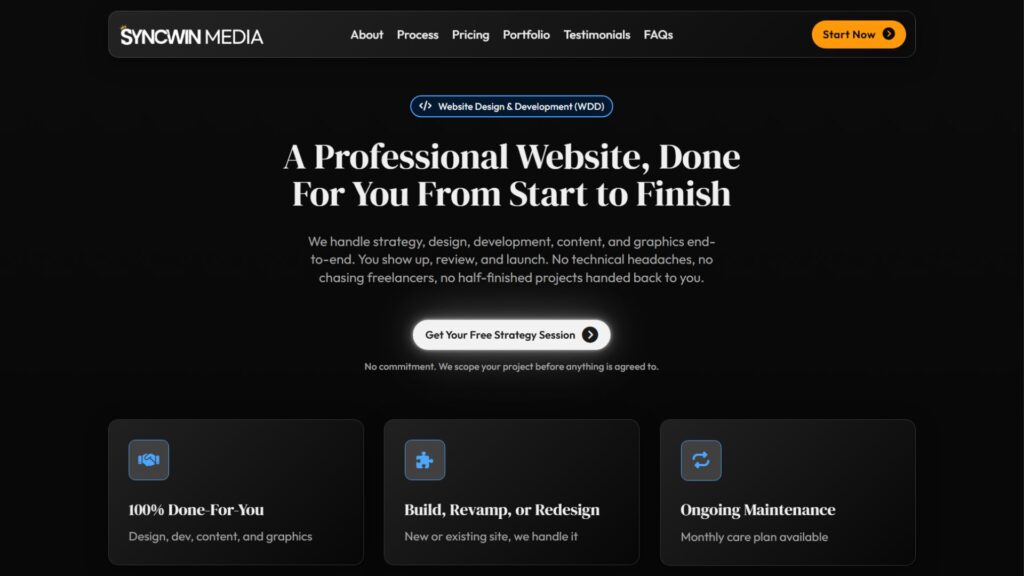
If you need a website built to generate business, structured for both search and AI visibility, SyncWin Media handles the full design and development. See our website design and development services and tell us what you need.
Based in Kolkata or anywhere across India, and want a website built for your specific market? Get in touch directly, and we’ll take it from there.